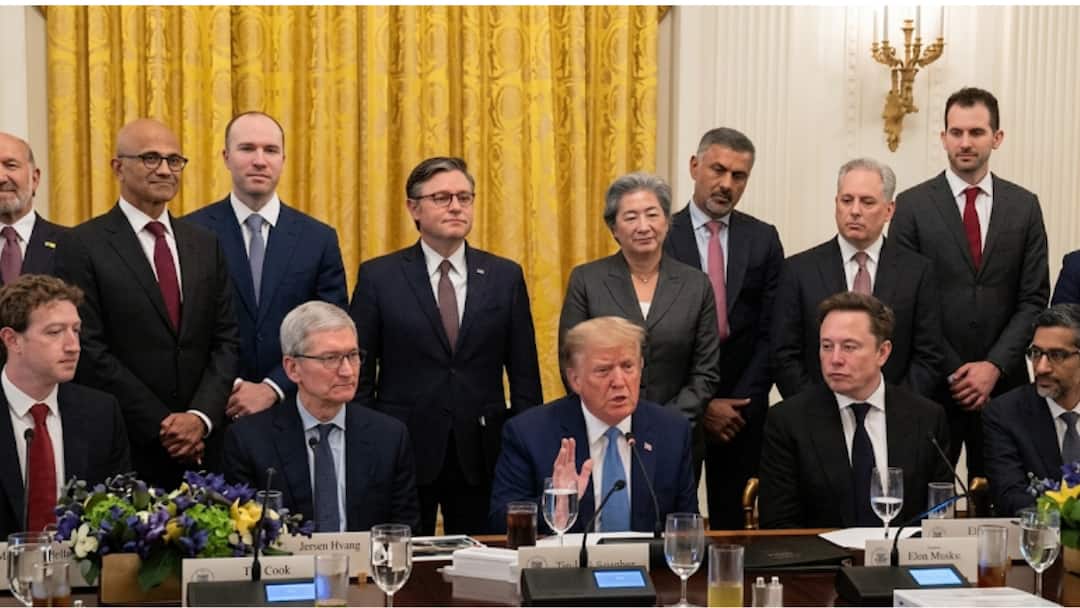
- Trump, tech leaders signed voluntary AI safety accord.
- Companies must establish, test, audit AI risk safeguards.
- Board-level oversight, independent committees ensure compliance.
- Accord suggests future laws, regulations for AI development.
US President Donald Trump and six technology industry leaders have backed a voluntary framework that puts the responsibility for managing risks from advanced artificial intelligence largely in the hands of the companies developing it. The White House Accord on Super Intelligence: A Joint Commitment on Frontier SI Responsibilities calls for AI firms to establish their own safety systems, test those safeguards internally, bring in independent reviewers and create board-level oversight.
Trump highlighted the companies’ willingness to monitor themselves following a meeting with technology executives at the White House on Tuesday.
“I think I’m seeing tremendous self-policing. And they understand that they have to self-police,” Trump told reporters outside the White House.
Companies To Police Themselves
The one-page agreement relies on voluntary commitments rather than immediately imposing a new regulatory regime on companies developing advanced AI systems.
Google CEO Sundar Pichai, Anthropic CEO Dario Amodei, Meta CEO Mark Zuckerberg, OpenAI President Greg Brockman, Nvidia CEO Jensen Huang and xAI founder Elon Musk signed the accord alongside Trump. Musk’s xAI is now part of SpaceX.
Trump later published the agreement on his social media platform, Truth Social.
At its core, the accord asks companies to take responsibility for identifying and addressing risks associated with increasingly capable AI systems.
ALSO READ: AI Gets New Name As Trump Gets Tech Giants To Sign ‘Morally Binding’ Pact
Internal Checks At First
The first part of the framework requires companies to establish internal controls covering AI models during both training and deployment.
These safeguards are intended to monitor risks involving areas such as cybersecurity, biosecurity and chemical threats.
Companies would then have their own teams examine whether those controls are functioning properly. Where weaknesses are identified, the internal teams would be expected to ensure they are addressed.
The approach therefore begins with companies evaluating their own systems before bringing outside scrutiny into the process.
External Audits, Board Oversight
The framework adds another layer of scrutiny by requiring companies to work with independent external auditors or evaluators.
These outside reviewers would assess whether the safety controls and monitoring mechanisms put in place by the companies are actually working as intended.
The process would culminate in oversight at the board level. Each company would establish an independent committee within its board of directors to review findings from both internal teams and external auditors.
The signatories have also agreed to meet regularly to discuss safety standards and best practices as advanced AI develops.
Third, the companies would engage independent third-party auditors or evaluators to test whether their safety controls and monitoring systems perform as intended. Fourth, each company would form a board committee, separate from management, to examine the reports produced by its internal teams and by the outside auditors.
ALSO READ: ‘No External Party Has Locus Standi’: India Rejects Erdogan’s Kashmir Remarks At UNGA
Door Open To Regulation
While the accord is voluntary, its language leaves open the possibility that some of its provisions could eventually become legally binding.
“Over time, it may make sense to codify these steps into laws and regulations,” the accord said.
This means the framework does not completely rule out government intervention in the future, even as the current arrangement relies on companies putting their own safeguards in place.
Trump Warns Against Restrictions
The agreement comes amid a broader push by the Trump administration to accelerate AI development and investment in the US.
Trump praised the technology executives for developing a sector he said would generate “unbelievable growth”. The rapid expansion of AI has driven substantial investment in data centres and computing infrastructure, with wider effects on economic activity and financial markets.
But concerns over the potential risks of advanced AI remain part of the discussion.
Anthropic CEO Dario Amodei, who attended the White House meeting, acknowledged that AI carries “very real risks”. Discussions on how those risks should be addressed are continuing.
Trump, meanwhile, has argued that the US should not slow AI development through excessive regulation. Earlier Tuesday, he said the country should not “stifle” the technology with restrictions, as per Reuters.
Disclaimer : This story is auto aggregated by a computer programme and has not been created or edited by DOWNTHENEWS. Publisher: abplive.com