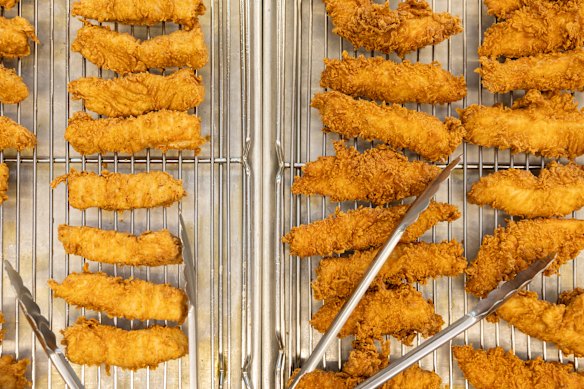

KFC is defending its territory as the top fried chicken player by overhauling menu classics and chasing sales “sugar highs” as it seeks to halve the time it takes to bring globally trending flavours to Australia.
This week, the Dirty Bird relaunched chicken tenders that claim to be crispier and 30 per cent bigger than its previous version after emerging fast food and fried chicken competitors led to a rise in customer complaints and a drop-off in sales of the boneless serving.
“We didn’t have the best tenders in the market,” said Vanessa Rowed, chief marketing officer at Yum! Brands, which operates KFC and Pizza Hut in Australia. “We have the best chicken, but we’re not necessarily clear with the customer because it was too small or it was a bit feeling a bit dry.”
KFC’s relaunch of chicken tenders is the first step in a broader overhaul of its core menu that could include revamping its bestselling Original Recipe, developed by Colonel Harland Sanders in 1940. El Jannah, Guzman y Gomez, Wingstop, and a growing number of independent rivals are threatening KFC’s customer base and market share with their own fried and boneless chicken offerings.
“It was always about size,” said Rowed. “We’re going to set the benchmark here [starting with tenders], and then we’re going to do that with every single product in our portfolio.
“We are not redoing the Original just yet, but I’m not saying no,” she added.
But the bigger, juicier tenders come at a slightly higher price: a three-pack bundle, which sold for $9.45, is now $10.95. A five-pack, previously $12.95, is now $14.95.
KFC Australia has been driving more customers into stores by jumping on globally trending flavours quickly and shortening the amount of time it takes to roll out new products. New menu items, which previously were introduced about every six weeks, are now being rolled out every four weeks.
Typically, it can take nine to 12 months of development before new items land on menus. KFC’s “Picklecore” range, which first launched in Canada and then the UK, was delivered to Australians in four months, despite customer research and testing indicating the flavour trend had yet to take hold with local consumers.
“We just took a punt,” said Rowed. “Sometimes you’ve got to go on gut instinct … What you don’t want to be is at the end of a trend.“
The first week of Picklecore’s launch delivered the best sales week ever for some stores, Rowed said, but by week two, that sales bump, or “sugar high”, began tapering.
“Food is very much like fast fashion,” said Rowed. “The news hits within week one, and by week four it’s old news, and the customer wants something completely different.”
Social media has drastically shortened customer expectations and demands to try new products, with beverages becoming another key frontier fast food giants are capitalising on. KFC and McDonald’s have separately released their own ranges of brightly coloured beverage offerings with toppings like popping pearls or cold foam that pick up traction on social media, to lure customers into stores. They command a higher margin at little additional cost.
Sauces and condiments is another. KFC’s chicken tenders launched alongside a range of 11 sauces, including Korean BBQ, Hot Honey, Smokey Maple and “Liquid Gold”, which generated a spike in Google searches when it launched in mid-March.
KFC’s strategy of innovating both old and new menu items has been driven by executives at the top. In the US, sales went backwards by 4.6 per cent in 2025, following a 5.2 per cent decline the year before. By sales, KFC has slipped to fourth place, with competitors Chick-fil-A and Raising Cane capturing customers.
KFC global chief executive Scott Mezvinsky conceded it had not kept up with customer tastes in the US. “The consumer obviously moved, gravitated towards boneless in a bigger way before we did. “We’re trying to play catch-up now,” he said in an interview with the Wall Street Journal earlier this year.
In Australia, which is one of KFC’s top most innovative markets, this has translated into more freedom to experiment and a greater willingness to be more adventurous.
“There is a different attitude coming through from the team to take a little bit more risk and to do some stuff that probably we wouldn’t have done before,” said Rowed.
“If we don’t reinvent ourselves, we will die. That’s the reality of brands like KFC.”
The Business Briefing newsletter delivers major stories, exclusive coverage and expert opinion. Sign up to get it every weekday morning.
 Jessica Yun is a business reporter covering retail and food for The Sydney Morning Herald and The Age.Connect via X or email.
From our partners
Disclaimer : This story is auto aggregated by a computer programme and has not been created or edited by DOWNTHENEWS. Publisher: www.smh.com.au