
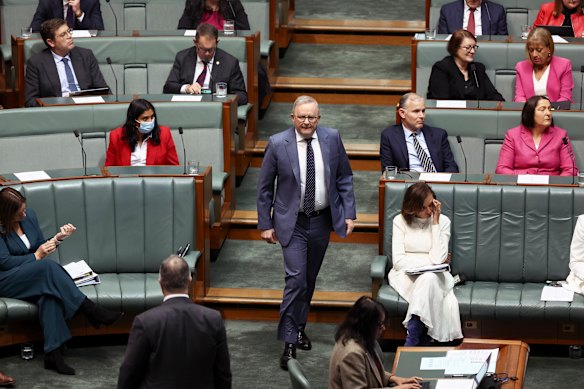
Politicians are often the butt of disrespectful jokes about the artificiality of their intelligence, but many seem to have taken it literally and are outsourcing their precious way with words to machines.
While universities and schools struggle with academic integrity breaches, faculty skill gaps and the future of jobs, and debate rages over the threat posed by AI and attendant data centres, many federal MPs have made up their minds about the technology and lead the English-speaking world for AI use in their parliamentary speeches.
According to British news and current affairs journal The Economist, a random sample of Australian parliamentary speeches made between September 2025-26 found more than 20 per cent delivered in the House of Representatives were flagged by AI content detector Pangram for AI-generated or AI-assisted text. Just under 15 per cent of Senate speeches were flagged.
Compared to other English-speaking legislatures, Australian MPs were the most prolific users, just ahead of Canada but triple the rate of the British. US and New Zealand politicians were least likely to use AI.
Once, politicians polished their own speeches or used staff and speechwriters to buff up their words. They harnessed the power of language to explain the world we want to live in.
At a time of White House noise, misinformation and disinformation, when truth is usurped by indifference and critical faculties relinquished with barely a whimper, the way we use language matters more than ever.
The power of language has shaped Australia, and some political speeches have achieved a kind of immortality. Among them: Robert Menzies’ 1942 “forgotten people” radio speech laid the basis of the Liberal Party; Ben Chifley’s 1949 Light on the Hill speech to the ALP conference; Gough Whitlam’s 1975 “The Dismissal” speech on the steps of Old Parliament House; Paul Keating’s 1992 Redfern Speech; Kevin Rudd’s 2008 “Sorry” speech.
Anthony Albanese’s 2024 speech on the Kokoda Track in the early days of his prime ministership was impressive, but Keating gazumped him in 1992 when he kissed the ground at Bomana War Cemetery and proclaimed that Kokoda should be ranked higher than Gallipoli in the national consciousness because the Diggers died in defence of Australia.
The memorable speeches occurred before ChatGPT and other AI assistants started evolving into political mouthpieces favoured by an increasing number of MPs.
The dearth of memorable parliamentary speeches lately, as well as the absence of language that inspires, captivates and ignites change, suggests many MPS have happily surrendered the most human form of communications to machines.
Speaker Milton Dick said there were no rules for how members used AI in speeches, but that MPs were responsible for what they said.
Parliamentary language is already littered with turgid corporate jargon and weasel words, but turning to AI to make speeches smacks of laziness and lack of imagination.
Our politicians owe it to the people of Australia to speak from their heart and in their own words.
Get a weekly wrap of views that will challenge, champion and inform your own. Sign up for our Opinion newsletter.
 The Herald’s View – Since the Herald was first published in 1831, the editorial team has believed it important to express a considered view on the issues of the day for readers, always putting the public interest first.
From our partners
Disclaimer : This story is auto aggregated by a computer programme and has not been created or edited by DOWNTHENEWS. Publisher: www.smh.com.au



