There are many ways in which we communicate who we are — and who we aspire to be. We furnish our homes, curate our online and offline presence, surround ourselves with people who inspire us, and dress according to the version of ourselves we want the world to encounter. Yet few of these expressions of identity are quite as intimate as jewellery.
It sits closer to the body than almost anything else we wear. It travels with us throughout the day and, while we may not constantly see it, we constantly feel it: the reassuring weight of a diamond-encrusted bangle around the wrist; the curve of a ring embracing a finger; sapphire earrings moving in the wind; the coolness of a stone resting against the décolletage, subconsciously reached for when overwhelmed with emotion or simply deep in thought.
But if jewellery is worn so close to the body, can its influence reach further? Can it touch not only the skin, but the mind? Can jewellery change the way a woman experiences herself — her desirability, her confidence, even her power? What happens when the object adorning her body has itself been designed to embody some of history’s most formidable women? These are the questions that sit at the heart of Boghossian’s latest high jewellery collection, Queens of Time.
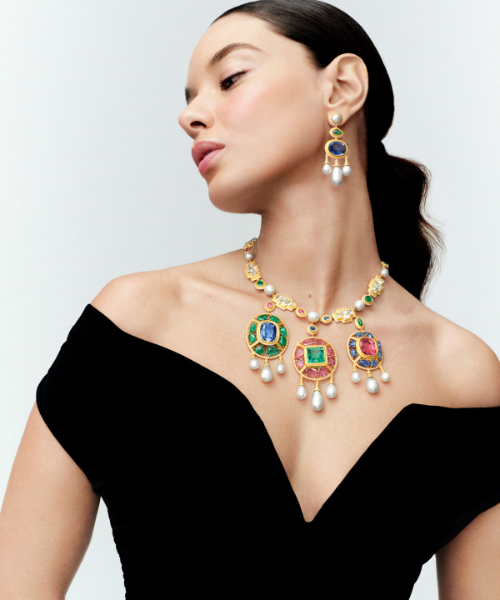
Following the architectural splendour of 2024’s Palace Voyages, the Maison has shifted its gaze from places to people. The collection consists of 39 jewels inspired by 11 queens, exploring not one definition of female power, but the many forms it can take. Rather than reproducing their historical jewellery literally, Boghossian translates their characters and legacies through gemstones, colour, symbolism, and form.
When asked how the creative process changed when moving from architecture to women, Roberto Boghossian, the Maison’s brand director, described the transition as “a natural evolution about taking it less literally with the inspiration and making it more about the feeling behind the people”.
It is that emphasis on feeling that makes Queens of Time particularly compelling. If the designer’s task is to translate the intangible qualities of a woman into something material, what exactly is the desired outcome when another woman puts that object on? Jewellery has, after all, historically allowed women to make power visible long before they were necessarily permitted to articulate it politically.
Cleopatra VII understood the potency of image particularly well. Beyond the romanticised figure that has survived in popular culture, she was a scholar, philosopher, and scientist who spoke nine languages and ruled over millions. For her, gold and precious gemstones were an expression of sovereignty and influence.

Cleopatra VII
Boghossian translates that flair for spectacle into golden-yellow mother-of-pearl. On the skin, the accompanying ring has an almost buttery quality, while the Cleopatra-inspired necklace takes the material to dramatic proportions: glossy, diamond-twisted strands of mother-of-pearl form a Hercules knot — a symbol of love, protection, and healing—alongside 18 yellow Asscher-cut diamonds. Nothing about it attempts to recreate Cleopatra’s jewellery literally, yet its warmth, extravagance, and physical presence make the woman behind it feel almost instinctively legible. And Cleopatra represents only one vocabulary of power.
For Atossa, the Persian shahbanu (queen) Boghossian looks towards sacred geometry, combining lapis, aquamarine, imperial morganite, pink tourmaline, carnelian, and diamonds. The Persian queen mother exercised considerable political and dynastic influence; the jewels she inspired, in turn, feel bold and commanding.

Atossa
Empress Theodora’s power was strategic and intellectual. The Byzantine empress advised Justinian on matters of state. Her suite combines buttery gold with sapphires, emeralds, spinels, pearls, and rough diamonds — allowing antiquity and modernity to coexist. Eleanor of Aquitaine, meanwhile, represents resilience: queen consort of both France and England, she endured 16 years of imprisonment before returning to political power. Her jewels draw on medieval ornamentation through pale yellow diamonds, orange sapphires, and keshi pearls.
The Indradevi-inspired designs offer something different again. The Khmer queen championed Buddhism, education, and healthcare, and is Cambodia’s earliest known female poet. Boghossian created two suites in her honour, exploring sisterhood and the duality of morning and evening through luminous blues and greens—from mint tourmalines and aquamarines to Paraíbas, tanzanites, lapis, and turquoise.

Indradevi
Together, the parures reveal something deceptively simple: power can take many forms. And perhaps the best example is Empress Joséphine, whose story complicates our idea of what power is supposed to look like.
Born Marie-Josèphe Rose Tascher de La Pagerie in Martinique, she survived imprisonment during the Reign of Terror before marrying Napoleon Bonaparte and eventually becoming empress of France. A leading patron of the arts, she supported painters, sculptors, and jewellers while exercising what Boghossian describes as a form of soft power through society and diplomacy — all encapsulated in the jewellery the brand created in her honour.
Her ensemble is carved entirely from morganite, punctuated by sunset tourmaline and imperial topaz in delicate blush tones. Architectural lines reference her Empire throne, while the romance of Napoleon’s letters informs a composition balancing strength with femininity. It is precisely that softness that makes the set so striking.
We have become accustomed to representing female power through hardness: sharp tailoring, imposing silhouettes, darker palettes, and armour-like accessories. Joséphine proposes something different. Softness need not be the opposite of strength. Femininity need not dilute authority.
And here, the Queens of Time collection begins to transcend the historical women who inspired it. Jewellery does not only communicate something to the people looking at us; it communicates something to the person wearing it. A jewel can commemorate an achievement, preserve a memory, signify belonging, or become associated with a version of ourselves we are trying to inhabit. Its material value may be measurable, but its psychological value is considerably harder to quantify.

So, can wearing a jewel inspired by a powerful woman actually make its wearer feel more powerful? Can a diamond-encrusted cuff change the way we enter a room, or a ring become a physical reminder of the person we want to be?
Queens of Time certainly makes a compelling case for it. Across 11 remarkably different women, Boghossian translates the intangible — courage, authority, resilience, softness — into something that can be seen, touched, and ultimately worn. History becomes colour, character becomes texture, and power becomes something felt against the skin. Perhaps the most fascinating thing about jewellery is that what we wear does not simply express how we feel, but has the capacity to shape it.
– For more on luxury lifestyle, news, fashion and beauty follow Emirates Woman on Facebook and Instagram
Disclaimer : This story is auto aggregated by a computer programme and has not been created or edited by DOWNTHENEWS. Publisher: emirateswoman.com