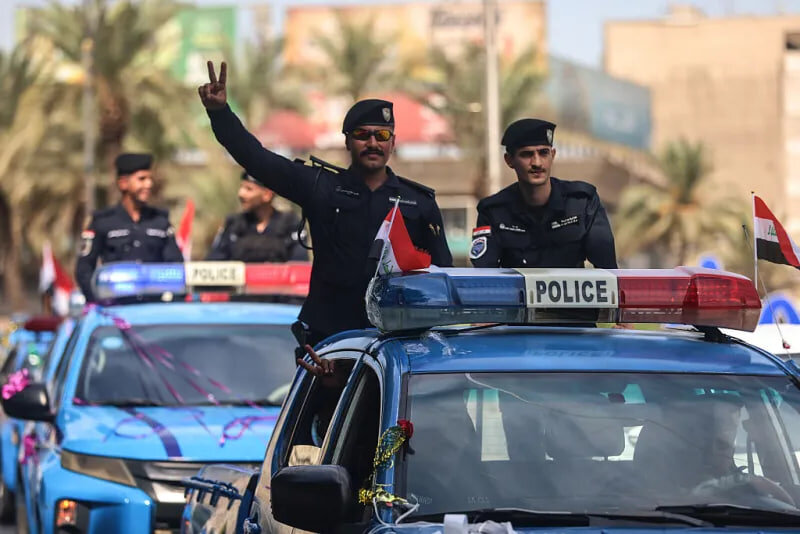
The U.S. military has withdrawn its last remaining forces from Iraq, 23 years after it invaded the country, sparking an insurgency and civil war in Iraq.
After the withdrawal of the U.S. military from the rest of Iraq in January, about 1,500 service members remained in Iraq’s semi-autonomous Kurdish region in the north.
This was not the first U.S. military withdrawal from the country. U.S. forces pulled out in 2011, declaring their mission over amid mounting Iraqi political opposition to the presence of U.S. troops.
The U.S. Central Command (CENTCOM) said in a statement Wednesday the last of its forces had now vacated Erbil Air Base, in the Kurdistan Region of Iraq. The U.S. military withdrew from most of Iraq earlier this year but retained about 1,500 personnel in the Kurdistan Region of Iraq, including the capital Erbil.
At a ceremony in Baghdad Wednesday at what had been the joint military command center across from the American embassy, Iraqi leaders and U.S. military commanders marked the end of the U.S.-led mission in Iraq.
The ceremony was closed to the press but was to be later broadcast by state TV.
“A new phase has begun, characterized by Iraq’s sovereignty, the strength of its institutions, the readiness of its forces, the unity of its decision-making, and balanced partnerships with its friends,” Iraqi Prime Minister Ali al-Zaidi said in a statement.
Iraq’s prime minister declared a two-day holiday to mark the end of the U.S. military presence, dubbing Wednesday “sovereignty day”.
“We are very proud to reach this day. It is due to the sacrifices of the Iraqi armed forces,” Sabah al-Numan, spokesman for the chief of the Iraqi armed forces, told NPR.
He said Iraq was exploring bilateral military agreements with the United States.
“We are moving from working under the umbrella of the coalition to an equal relationship with them,” he said. “We thank all efforts that the coalition did and all the country and we will continue this relationship and that way. But at the end they have to go,” he said.
Sheikh Kadhim al-Fartousi, spokesman for the Kitaib Sayid al-Shuhada resistance group, told NPR in a recent interview that although the departure of U.S. forces was a victory, it was not enough.
“The exit of the occupier does not mean only that soldiers and equipment go,” he said. Fartousi said U.S. control over Iraq’s economy and its interference in Iraqi internal affairs was also a form of occupation. Since 2003, Iraq’s oil revenue has been deposited into accounts at the Federal Reserve Bank in New York, giving the U.S. significant leverage over Iraq’s currency.
Iraq has also opened talks with Turkey on closing its military bases inside Iraq, including the Bashiqa-Zilkan camp near Mosul. Both countries announced last week that Turkey would begin a gradual withdrawal from the base.
The Iraqi military has said Turkey maintains five major bases and almost 100 smaller outposts in Iraq. Turkey for years battled Turkish Kurdish fighters based in northern Iraq before agreeing this year to a peace deal.
Decades of turmoil
Many Iraqis still struggle with the legacy of the U.S. invasion and its eight-year-long occupation that followed. The most conservative estimate of Iraqi civilians killed, derived from morgue entries and other records, is at least 200,000, according to Iraq Body Count, a U.K.-based independent organization that tracks civilian deaths.
Younger Iraqis though, while still dealing with the fallout of a country destroyed and piecing itself back together again, have no memory of U.S. forces. Baghdad and most other cities are now calm for the most part. The Iraqi capital is blanketed with mechanical cranes building huge apartment complexes, malls and glitzy restaurants, although both the apartments and restaurants are unaffordable for most Iraqis.
In the United States, a war the U.S. government portrayed as necessary to destroy weapons of mass destruction and to prevent attacks on U.S. soil is now widely viewed as misguided. The weapons of mass destruction did not exist and Iraq was found to have no connection to the attacks of 9/11.
More than 4,400 U.S. military personnel were killed in Iraq, according to defense ministry figures.
The U.S. invaded Iraq despite insistence by international organizations that Iran did not possess WMDs.
Disclaimer : This story is auto aggregated by a computer programme and has not been created or edited by DOWNTHENEWS. Publisher: tehrantimes.com