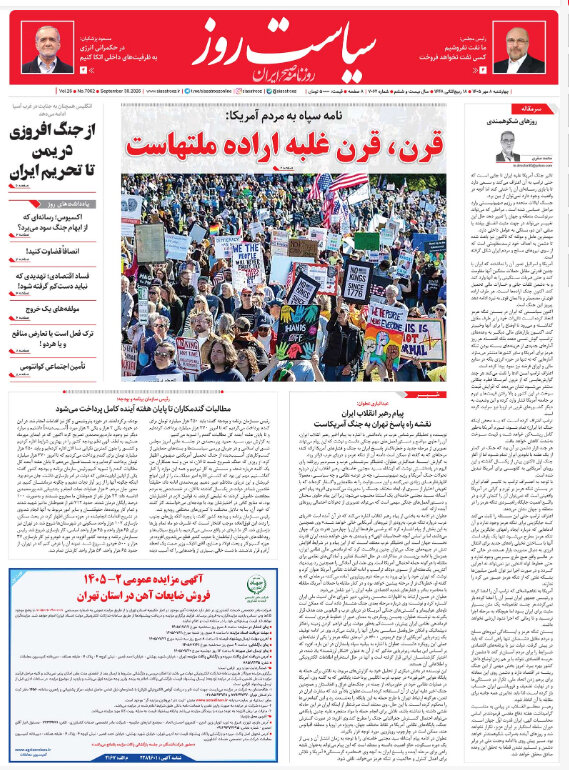
Siasat-e-Rooz devoted its editorial to Trump’s baseless statements regarding the Strait of Hormuz. The paper wrote that more than a year has passed since the start of the conflict, and that the American dream about Iran’s destruction has turned into a nightmare for the United States.
Trump’s acknowledgment of the impact that closing the Strait of Hormuz would have on inflation and rising prices in the United States is a reality that cannot be denied and demonstrates the strategic importance of the strait both regionally and globally. Trump’s recent remarks prove that there is no substitute for the Strait of Hormuz and that claims about alternative routes are merely a bluff. The creation of hypothetical new energy transit routes is seen as an attempt to manage markets, while in reality no rapid alternative plan exists. Closing the Strait of Hormuz and standing firm against enemies through the armed forces and the people is the only path that should be pursued.
Javan: Iran must defend its aviation rights
In an article, Javan discussed an aerial blockade against Iran. Iran cannot limit itself to diplomatic protests in response to the situation. Defending the country’s aviation rights must proceed along several parallel tracks. First is the legal and diplomatic route. Iran can raise the issue of the sanctions’ impact on civil aviation in specialized international forums. Second is regional diplomacy. Neighboring countries are among those most affected by disruptions to the region’s air transportation network. Finding mechanisms to maintain air links, technical services, and passenger transportation could become a shared regional concern. Third, Iran should strengthen its domestic aviation infrastructure and operational capabilities in order to reduce its vulnerability. Iran can and should defend its rights, but such efforts will be more effective if pursued both through legal and diplomatic channels and through reducing technical, financial, and operational dependencies.
Hamshahri: Iran is turning northward
Disruptions in southern Iran’s maritime routes have pushed Tehran toward expanding and activating northern transportation corridors, from ports on the Caspian Sea to land borders with the Caucasus and the International North-South Transport Corridor. At a time when the Strait of Hormuz and southern ports are facing security and logistical constraints, Iran is seeking to redirect part of its foreign trade through routes that previously played a complementary role. This shift has simultaneously increased Azerbaijan’s importance for Tehran. Azerbaijan lies along the route connecting Iran to Russia and Northern Europe, and shared transportation projects, border terminals, and the North-South Corridor have once again become central topics in bilateral discussions. Iran’s trade map may gradually be changing, not through abandoning the south, but by adding a northern axis that was previously regarded primarily as a supplementary route.
Khorasan: The nuclear issue remains the core dispute
In an article examining the main source of disagreements between Iran and the United States, Khorasan wrote that although both sides may have reasons to favor reaching a short-term agreement, the nuclear issue remains the principal obstacle. The Americans do not wish to return to an agreement that lacks nuclear provisions, while Iran is unwilling at this stage to engage in discussions about its nuclear program. As a result, the nuclear dispute could prevent negotiations from succeeding. Some analysts believe Iran may have an opportunity to implement what they describe as a second strategy: launching preemptive attacks and imposing a period of high-intensity conflict on Trump before the US midterm election. Such an approach would offer two advantages for Iran. First, it would seize the initiative from the enemy and prevent it from completing its intelligence and logistical preparations. Second, an escalation of the conflict would accelerate increases in energy prices and, combined with another perceived American setback and humiliation, could have severe and irreversible effects on the outcome of US elections.
Ettelaat: Washington between military pressure and negotiation
Ettelaat addressed the deployment of the aircraft carrier Theodore Roosevelt to the region. Recent developments indicate that US policy toward Iran has reached a complicated juncture. On the one hand, Washington is maintaining its military presence, and the deployment of the Roosevelt is seen as part of that posture. The central disagreement, however, continues to revolve around the conditions for ending the conflict. Tehran wants the easing of military and economic pressure to be part of any return to negotiations, while Washington seeks a broader agreement and additional concessions from Iran. From this perspective, the deployment of the Roosevelt and the continuation of military pressure should be viewed alongside diplomatic efforts rather than as alternatives to them. The United States is preserving its leverage by maintaining military capabilities, while the continuation of talks suggests that the door to a negotiated agreement has not yet been completely closed.
Disclaimer : This story is auto aggregated by a computer programme and has not been created or edited by DOWNTHENEWS. Publisher: tehrantimes.com