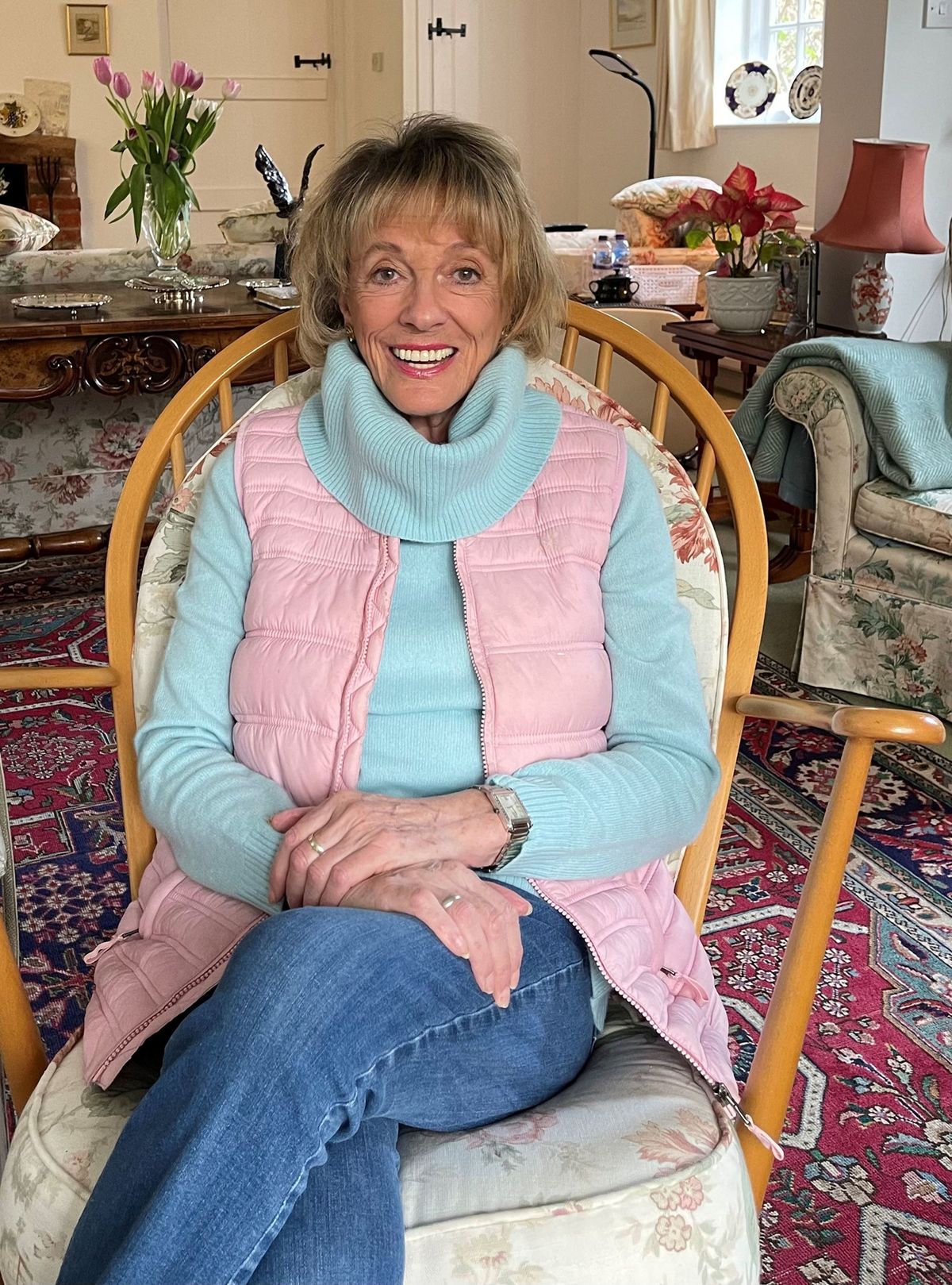
Dame Esther Rantzen was a “brave and brilliant” crusader right until the end.
The TV legend became a huge star when she presented ‘That’s Life!’, a mix of consumer rights, funny shaped parsnips and a dog who said ‘Sausages’.
After 21 years of presenting one of the nation’s favourite all-time shows, regularly seen by 18 million viewers, the campaigning Queen went on to appear on Strictly Come Dancing, survived ITV’s Australian jungle and discovered her family secrets in ‘Who Do You Think You Are.’
She also appeared on Question Time while standing as an independent candidate for Luton South.
The mum-of-three, who has five grandchildren, was awarded seven honorary doctorates, and was a Patron of 19 charities, and divided her time between her home in London and the New Forest.
She once said of the two decades she spent on That’s Life as going by like a “streak of light”.
“Certain things I really remember; the dog who said ‘sausages,’ the little boy called Ben Hardwick (the first child to have a liver transplant in the uk) launching Childline, getting arrested handing out bat stew,” a reference to her arrest by the constable for ‘blocking the pavement’.
But as Terry Wogan said it was Childline that was a “monument” to her, pointing out during one chat how every child in the nation would threaten their parents with the charity.
Amused, Esther told him: “Two of my kids did ring Childline and got jolly good advice and guidance.”
Her daughter Rebecca Wilcox, during a recent interview with The Mirror, described her mum as ‘brave, brilliant, clever and charismatic.’
And she described ‘Childline’ as her mum’s favourite child. On October 26th the charity is 40 years old, an anniversary Esther, 86, desperately wanted to make but heartbreakingly didn’t.
Back in December 2023 she announced she had joined an assisted dying clinic in Switzerland, even paying the hefty bill and filling out all the forms.
But when the end finally came Esther, wanting to spend more time with her family, was too ill to fly. In September as the assisted dying bill went back to the Commons, she told how she was “too physically fragile to make the journey.”
Speaking to the Mirror in the days before her mum’s death, Rebecca Wilcox told us about her love for the children’s charity she founded: “Childline, I would describe as her fourth child, our fourth sibling and it was the preferred child!
“Now I understand why because I’m deputy President and volunteer counsellor. It is the one place that children choose to come and tell us what’s on their mind, be that good, bad or ugly.
“We are approaching our 40th Birthday and it’s still so important to her. She had to step back when her diagnosis took hold but mum really wanted to make it to the 40th, which is October 26th.
“She took calls from the children many, many times. Mum would definitely go off script and was brilliant.”
Esther started the charity – the free confidential helpline for children and young people – after she presented a BBC programme on child abuse which was inundated with calls.
She turned to the then BBC controller, Michael Grade, for help, along with BT and ChildLine was born.
Esther said one of the most memorable endorsements of the charity came at the charity’s 25th anniversary fundraising ball.
“A very attractive, very tall woman came over to me and she was clearly very emotional,” she recalled.
“She took me to one side to tell me she’d rung ChildLine in the first week it opened and then rang every day, sitting on the floor of a telephone box until she got the courage to tell the man who was abusing her that he had to stop.
“And she did. She was 13 at the time and was in tears when she told me about it, so that brought the voice of a child home to me and that made me more determined that every child needs us and they must be able to get through.”
Esther went on to reveal she too was sexually abused as a teenager. The TV presenter spoke for the first time in her 70s about how she was attacked by a male relative when she was 15,
More than 25 years after launching ChildLine, she ended up becoming a crusader for all ages, when she set up the SilverLine Helpline with Age UK.
She said at the time: “Sometimes we OAPs feel like Harry Potter in his magical cloak of invisibility – once we are over 60 we are neither seen nor heard. But if you look for us, you will find us.
“We are the patients who lie neglected in hospital wards, suffering malnutrition, or literally dying of thirst … I believe a telephone helpline for older people could liberate them from their prison of suffering.”
She told of her own loneliness after her husband Desmond Wilcox, the award-winning documentary maker, died aged 69 in 2000 from a heart attack.
She described losing him as like losing ‘the sunshine’ from her life and said she would have given up ten years of her life, just for another 10 minutes with him. In the years that followed her three children flew the nest.
“I first admitted I was lonely in 2011 when I found myself living alone for the first time aged 71, and hating it,” she once revealed, talking about founding Silver Line.
“I knew I was lucky in many ways. I was busy, I was healthy, but all the same at the end of the day I would return to my empty flat. It was dark, it was cold, there was nobody to have a cup of tea with, or plan an evening of television together.”
Age UK’s Silver Line Helpline is the UK’s only free, confidential, 24-hour helpline providing friendship for older people.
Esther was born 1940 and grew up in Hampstead, London. Her father was head of the BBC’s Engineering Designs Department. She attended a school in the US and the North London Collegiate School in Berkhamsted, Hertfordshire before going to Oxford’s Somerville in 1959 to study English.
She wrote ‘irreverent’ pantomimes about senior school leaders: “I had a very irreverent mother and I think I inherited from her,” she once said, revealing that she had started a school tradition.
At Oxford she performed with the Oxford University Dramatic Society (OUDS) and shortly after graduation she was recruited by BBC Radio as a trainee sound effects assistant.
She began her television career as a clerk in the programme planning department and in 1968, she became a researcher for Braden’s Week. She accidentally became a presenter because the producer of the programme decided to put the researchers onscreen.
The BBC later replaced Braden’s Week with That’s Life! with Rantzen as the main presenter.
In 1991, she was awarded an OBE for services to broadcasting and in 2015 she was made a Dame of the British Empire (DBE) for services to children and older people.
Appearing on ‘Who Do You Think You Are? Esther traced her rare paternal surname back to an established Jewish community in Warsaw, Poland, from where her great-great-grandparents emigrated to London’s East End in the 1850s.
Esther has lived her life making things happen, making sure to carry out the motto on her family’s coat of arms ‘if not now, when?’.
This is the same question she asked MPs and Peers as she supported the Terminally Ill Adults (End of Life) Bill.
In one of her last messages to Peers she asked “…What I’m saying to you is: don’t try and sabotage democracy. Give us all the choice that you would want yourself. And then we can die in dignity, pain-free, and leave our families and our loved ones with happy memories. That’s all we ask.”
Disclaimer : This story is auto aggregated by a computer programme and has not been created or edited by DOWNTHENEWS. Publisher: mirror.co.uk