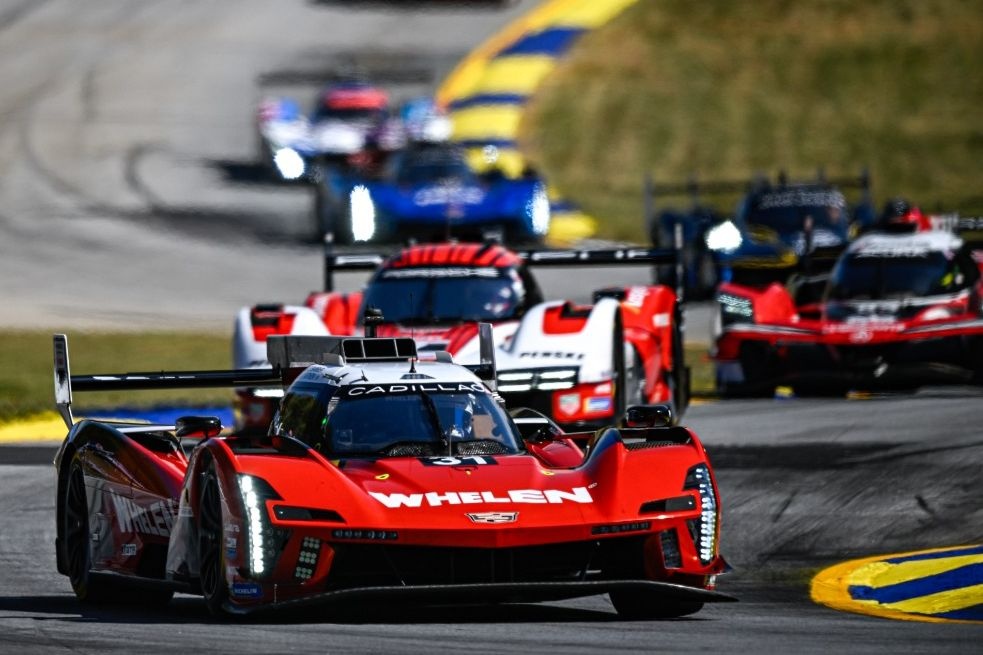
After taking completely different Balance of Performance paths over the course of the season, the title-contending Cadillac V-Series.R and Porsche 963 can virtually shake hands at the season finale: both have been handed nearly identical power-to-weight ratios in the crucial range below 230 kph (143 mph).
Following Porsche’s shock BoP at Long Beach back in April, the two rivals have gradually inched closer together over the course of the season. The #31 Whelen Cadillac continued to deliver strong performances even as its power-to-weight ratio in the low-speed areas gradually increased after Detroit.
In the drivers’ championship battle, Jack Aitken in the Action Express Cadillac and Laurin Heinrich in the #7 Penske Porsche face similar base weights, with Cadillac enjoying a slight power advantage, especially above 240 kph (149 mph).
However, to snatch the title away from Aitken in the final race, Heinrich needs to win. And as the numbers show, that will be no easy task.
Road Atlanta features a little bit of everything in terms of cornering speeds, but apart from Turn 1, it primarily consists of “short” corners with 90-degree angles or less. This gives the track—despite its fast, sweeping, and enjoyable sections—something of a “stop-and-go” characteristic from a BoP standpoint, as cars spend a relatively short time in each turn.
With 54 cars entered, agility in traffic is pivotal at the 2.54-mile venue. This places extra importance on low-speed BoP performance if cars get held up in technical sections like the Esses, making low-speed acceleration capabilities crucial.
Below 230 kph (143 mph)
The power-to-weight ratios for the final race of the season in the low-speed range are as follows:
- Aston Martin Valkyrie – 1.962 kg/kW
- BMW M Hybrid V8 – 2.000
- Acura ARX-06 – 2.051
- Porsche 963 old – 2.055
- Cadillac V-Series.R – 2.086
- Porsche 963 – 2.089
Although Cadillac has nearly caught up, the 2026-spec Porsche still holds the most unfavorable power-to-weight ratio. For the first time since Sebring, the Porsche is no longer the heaviest car in the field—that title now goes to the V-Series.R.
Occupying the midfield are the 2025-spec Porsche—enjoying its best low-speed BoP since Watkins Glen—and the farewell-bound Acura ARX-06, carrying its most unfavorable power-to-weight ratio since Laguna Seca. BMW is back at the 2.000 kg/kW mark following its victory at Indianapolis, while Aston Martin remains at the top thanks to its 1,020 kg minimum weight.
BMW is back at the 2.000 kg/kW mark following its victory at Indianapolis, while Aston Martin remains at the top thanks to its 1,020 kg minimum weight.
Compared to the Battle on the Bricks two weeks ago, we see significant changes:
- Porsche 963 old -0.060 kg/kW
- Porsche 963 -0.009
- Aston Martin Valkyrie +-0.000
- Cadillac V-Series.R +0.013
- BMW M Hybrid V8 +0.019
- Acura ARX-06 +0.028
The 2025-spec Porsche, running without Laurin Heinrich for the second consecutive weekend, has received the biggest break since Indy. Between the 2026-spec Porsche and Cadillac, there is a 0.022 kg/kW swing in favor of the 963, while Acura suffers the biggest hit for its temporary farewell race.
It could definitely be worth keeping an eye on the #5 JDC-Miller Porsche to be back in the mix after a somewhat underwhelming performance at Indianapolis. Meanwhile, BMW’s penalty for WRT’s breakthrough win at the Battle on the Bricks remains relatively minor.
Comparing this year’s power-to-weight ratios to last year’s Petit Le Mans BoP shows a major shift for most cars—much like at Indianapolis Motor Speedway—keeping in mind that all vehicles except the Aston Martin and the 2025-spec Porsche have received updates since:
- Porsche 963 old -0.117 kg/kW
- BMW M Hybrid V8 -0.087
- Porsche 963 -0.083
- Acura ARX-06 -0.079
- Cadillac V-Series.R -0.046
- Aston Martin Valkyrie -0.019
Again, the older-spec Porsche takes the spoils with a massive 30 kW swing compared to last year. The breaks are substantial for BMW, the 2026-spec Porsche, and Acura, while Cadillac receives a notably less impressive reduction in its power-to-weight ratio.
Back in 2025, the BoP values were largely dictated by the Lamborghini SC63 and the Aston Martin Valkyrie, with only the latter returning for 2026. However, as the Valkyrie already had the best possible power-to-weight ratio last year, its only advantage now is the 10 kg reduction below homologation weight that it received prior to Watkins Glen.
The Cadillac V-Series.R gained 20 kW, while most of its competitors gained between 20 and 30 kW. But whereas the weights of its rivals have remained relatively stable compared to 2025, Cadillac is the notable exception with a 20 kg weight increase.
Above 240 kph (149 mph)
The 240 kph threshold is reached three times per lap, but it matters most on the backstretch, where cars spend a significant amount of time above 149 mph. It is also the primary overtaking spot. While not quite as critical as the low-speed figures, high-speed capabilities still play a major role at Petit Le Mans – especially when the win is fought out in a sprint.
Here are the numbers:
- Aston Martin Valkyrie – 1.962 kg/kW
- Acura ARX-06 – 2.004
- BMW M Hybrid V8 – 2.024
- Porsche 963 old – 2.047
- Cadillac V-Series.R – 2.067
- Porsche 963 – 2.093
The only position swap compared to the lower speed range is between Acura and BMW. Aston Martin remains on top, while the gap between the Cadillac V-Series.R and the 2026-spec Porsche 963 increases significantly.
Compared to the Battle on the Bricks, we see the following changes in the high-speed sections:
- Porsche 963 old -0.020 kg/kW
- Aston Martin Valkyrie +-0.000
- Acura ARX-06 +0.012
- Porsche 963 +0.015
- BMW M Hybrid V8 +0.028
- Cadillac V-Series.R +0.030
Except for the 2025-spec Porsche and the Aston Martin (which remains at its baseline), all cars have received a slightly more unfavorable power-to-weight ratio. For most, this is down to added weight, with the exception of the 2026-spec Porsche 963, which lost weight but also almost 9 kW above 240 kph.
Even though its advantage over the 2026-spec Porsche is much larger than in the lower speed range, Cadillac loses out the most compared to Indy, while BMW receives its expected penalty following the win at the Battle on the Bricks.
For our final comparison, we look at the changes relative to the 2025 Petit Le Mans, once again keeping in mind the updates applied to the four current-spec LMDh cars:
- BMW M Hybrid V8 -0.045 kg/kW
- Porsche 963 old -0.040
- Acura ARX-06 -0.023
- Aston Martin Valkyrie -0.019
- Porsche 963 +0.006
- Cadillac V-Series.R +0.037
Despite receiving a somewhat unfavorable BoP adjustment compared to Indianapolis 2026, the BMW M Hybrid V8 still enjoys the largest power-to-weight improvement compared to the 2025 Petit Le Mans, closely followed by the 2025-spec Porsche.
While Acura and Aston Martin received minor breaks, Porsche—and especially Cadillac—face a less favorable BoP above the 240 kph threshold than at the 2025 season finale.
Conclusion
Based on these numbers, the safest approach for Action Express Racing might seem to be driving a clean, controlled race to secure the championship for Jack Aitken. However, the #31 Whelen Cadillac has surprised us several times this year—most recently at Indianapolis, where they nearly took victory despite facing a relatively unfavorable BoP.
It underlines how much progress Action Express Racing has made with the updated Cadillac V-Series.R, leading several paddock voices to question why the naturally aspirated LMDh challenger wasn’t given a BoP comparable to the Porsche 963 much earlier in the season. Challenging for a hat-trick of Petit Le Mans wins looks tough for Cadillac now, but certainly not impossible.
Porsche, meanwhile, should be back in contention for the win for the first time since its strong start to the season. The #7 crew remains on track to secure a hat-trick in the Michelin Endurance Cup, which will be Porsche Penske Motorsport’s primary focus in the early stages of the race.
The other three manufacturers have nothing to lose. Going out with a bang—much like Meyer Shank Racing did in 2023 before its one-year hiatus—remains a real possibility for Acura.
BMW still looks strong on paper but has historically struggled at Petit Le Mans. It remains to be seen whether a still-favorable BoP, the updated car, and the switch to Team WRT can turn their fortunes around.
Aston Martin, meanwhile, will try to end a disappointing season on a high note similar to last year. However, with last year’s highly favorable BoP no longer in place, The Heart of Racing must rely solely on their own development progress with the Valkyrie. The car is slated for updates next season, having been caught somewhat off guard by the substantial upgrades brought by rival manufacturers this year.
BoP Petit Le Mans 2026
(Differences to Indianapolis 2026 / Road Atlanta 2025 in parentheses)
Acura ARX-06
Min. Weight: 1,042 kg (+6 kg / +4 kg)
Max. Power <230 kph: 508.04 kW (-4.16 kW / +20.80 kW); 681 hp
Max. Power >240 kph: 520.00 kW (+0.00 kW / +7.80 kW); 697 hp
Max. Engine Speed: 9,512 rpm
Max. Energy per Stint: 911 MJ (+3 MJ / +10 MJ)
Fuel Replenishment: 22.775 MJ/sec (+0.075 MJ/sec / +0.250 MJ/sec)
Aston Martin Valkyrie
Min. Weight: 1,020 kg (+0 kg / -10 kg)
Max. Power <230 kph: 520.00 kW (+0.00 kW / +0.00 kW); 697 hp
Max. Power >240 kph: 520.00 kW (+0.00 kW / +0.00 kW); 697 hp
Max. Engine Speed: 8,400 rpm
Max. Energy per Stint: 909 MJ (+1 MJ / +2 MJ)
Fuel Replenishment: 22.725 MJ/sec (+0.025 MJ/sec / +0.050 MJ/sec)
BMW M Hybrid V8
Min. Weight: 1,040 kg (+10 kg / +7 kg)
Max. Power <230 kph: 520.00 kW (+0.00 kW / +24.96 kW); 697 hp
Max. Power >240 kph: 513.76 kW (-2.08 kW / +14.56 kW); 689 hp
Max. Engine Speed: 8,000 rpm
Max. Energy per Stint: 905 MJ (+0 MJ / +18 MJ)
Fuel Replenishment: 22.625 MJ/sec (+0.000 MJ/sec / +0.450 MJ/sec)
Cadillac V-Series.R
Min. Weight: 1,062 kg (+9 kg / +20 kg)
Max. Power <230 kph: 509.08 kW (+1.04 kW / +20.28 kW); 683 hp
Max. Power >240 kph: 513.76 kW (-3.12 kW / +0.52 kW); 689 hp
Max. Engine Speed: 8,800 rpm
Max. Energy per Stint: 906 MJ (+0 MJ / +7 MJ)
Fuel Replenishment: 22.650 MJ/sec (+0.000 MJ/sec / +0.175 MJ/sec)
Porsche 963 (2025 Homologation / “old”)
Min. Weight: 1,058 kg (-8 kg / +4 kg)
Max. Power <230 kph: 514.80 kW (+10.92 kW / +29.64 kW); 690 hp
Max. Power >240 kph: 516.88 kW (+1.04 kW / +11.96 kW); 693 hp
Max. Engine Speed: 8,158 rpm
Max. Energy per Stint: 909 MJ (+2 MJ / +14 MJ)
Fuel Replenishment: 22.725 MJ/sec (+0.050 MJ/sec / +0.350 MJ/sec)
Porsche 963 (2026 Homologation)
Min. Weight: 1,059 kg (-11 kg / +5 kg)
Max. Power <230 kph: 507.00 kW (-3.12 kW / +21.84 kW); 680 hp
Max. Power >240 kph: 505.96 kW (-8.84 kW / +1.04 kW); 678 hp
Max. Engine Speed: 8,158 rpm
Max. Energy per Stint: 901 MJ (-9 MJ / +6 MJ)
Fuel Replenishment: 22.525 MJ/sec (-0.225 MJ/sec / +0.150 MJ/sec)
We want your opinion!
What would you like to see on Motorsport.com?
– The Motorsport.com Team
Disclaimer : This story is auto aggregated by a computer programme and has not been created or edited by DOWNTHENEWS. Publisher: motorsport.com