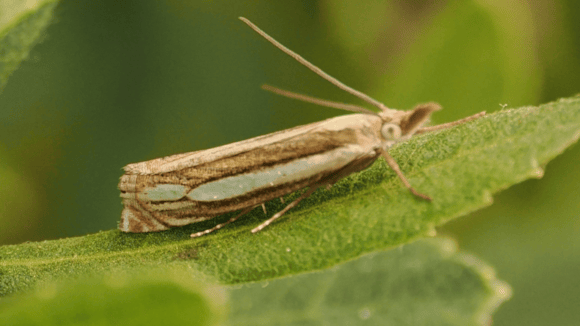
‘Special surprise’ as rare moth found in nature reserve for first time
-
Published
A rare species of moth has been found in north Wales.
The Bog Grass Moth was found at Cors Geirch National Nature Reserve on the Llŷn Peninsula in Gwynedd, as conservationists were surveying the area’s species.
Experts called it a “special surprise” to find the “incredibly sparse moth” in the habitat.
An exact population figure in the UK for the Bog Grass Moth is not known, but they have only been recorded in a small number of English counties, such as Dorset.
The fen, which is an area of low, flat, wet land, is monitored by Natur am Byth’s Llŷn and Ynys Môn project, which aims to protect some of north Wales’ most at risk species.
As experts from the conservation project gathered at Cors Geirch they set up moth traps and in one night 446 moths made up of 91 different species were collected, with 19 of these being Bog Grass Moths – the first time they had been recorded in this area.
Natural Resources Wales said the habitat allowed wet sedges to grow – which is the only food source for the Bog Grass Moth’s larvae.
Sedges are one of the largest plant families in the world and are most common in wet habitats.
Other rare species recorded at the site included the Six Spotted Crane Fly and the Black Nightrunner Ground Beetle.
Steve Palin and Charles Aron, who are both lepidopterists and specialise in the study of moths, said the beauty of trapping moths was “you just never know what’s going to turn up”.
“It’s a significant addition to our knowledge of the region’s winged insects and demonstrates the value of targeted moth recordings in these specialist fen habitats, where there is clearly still much to discover,” they said in a statement.
Clare Sampson, a project manager for RSPB Cymru, said the work of staff, contractors and volunteers had helped to open up the wetland that is “home to these rare invertebrate species”.
 Image source, Getty Images
She added: “While many fens suffered over the hot, dry summer, not only did we find healthy numbers of the Black Nightrunner Ground Beetle and Six Spotted Crane Fly at Cors Geirch this year, but we also discovered this wonderful and rare species of moth.”
Sampson said about 80% of UK peatlands had been lost or damaged, meaning rare species that depend on specific habitats can “struggle to survive”.
Healthy peat is the country’s biggest carbon store but when damaged it releases planet-warming greenhouse gases into the atmosphere.
Peat is formed over thousands of years from partially decayed plants in waterlogged conditions.
“These important fen sites can be managed and maintained so that future generations can continue to make new discoveries,” she added.
More top stories
-
-
Published9 hours ago

-
-
-
Published10 hours ago

-
-
-
Published7 hours ago

-
Disclaimer : This story is auto aggregated by a computer programme and has not been created or edited by DOWNTHENEWS. Publisher: newsrss.bbc.co.uk