BEIRUT — America opened its “forever war” in Iraq more than 23 years ago with “Shock and Awe.” It ended it on Wednesday with little of either, even as the legacy of that conflict — which saw Iraq endure sectarian bloodbaths, civil war and an insurgency that made Baghdad the car bomb capital of the world — continues to cast its shadow on the country today.
President Trump, summing up the U.S. role in Iraq as “a very expensive excursion into Hell,” said, “This day is a victory for the United States, a victory for Iraq…. We’re getting the hell out of there.”
It was the second time U.S. forces have pulled out of Iraq. The first withdrawal took place in 2011, capping the occupation that began in 2003 and toppled Iraqi dictator Saddam Hussein, and which resulted in Iraqi deaths that number 110,000 to four times greater and the loss of about 4,500 U.S. service members.
But three years later, Islamic State jihadis scythed through wide swaths of Iraq, scooping up U.S.-supplied materiel — as Iraqi troops literally ran away — and seizing control of nearly a third of the country. The U.S., this time at the Iraqi government’s request, led a coalition in a campaign — named Inherent Resolve — that by 2017 had destroyed Islamic State’s caliphate and driven most of its fighters into Syria. Since then, Iraqi forces have fought Islamic State remnants engaged in a low-level insurgency around the country’s remote areas.
Most U.S. and coalition forces, which numbered around 2,500, began leaving Iraq in October 2025, so that by Wednesday all that was left to withdraw were a few hundred service members stationed in Irbil air base in northern Iraq, once the operational hub of Inherent Resolve.
“Job well done to the tens of thousands of American service members, diplomats, and civilian personnel who answered the call in Iraq,” said Adm. Brad Cooper, the commander of U.S. Central Command, in a statement.
“Because of your grit, sacrifice and professionalism, ISIS no longer poses a systemic threat to Iraq’s national security and Iraqi security forces,” he said, referring to Islamic State by an acronym for its former name, Islamic State of Iraq and Syria.
Central Command said the anti-ISIS mission would continue, with the coalition now headquartered in Jordan.
“As we step back and hand full primary responsibility for Iraq’s security to the Government of Iraq and the brave people of Iraq, U.S. and Coalition forces stationed across the region will remain ready to respond to any ISIS threats that arise,” Cooper said.
The agreement to end the U.S. presence in Iraq was forged by President Biden in 2024 but was continued by Trump, who had made aversion to foreign entanglements — he called the Iraq war “the worst single mistake ever made in the history of our country” — a centerpiece of his presidential campaigns.
On Wednesday, Trump launched into a broadside on Biden. He compared the United States’ uneventful withdrawal from Iraq to the chaos that marked its pullout from Afghanistan in 2021, which saw the U.S. leave behind tens of thousands of Afghans who had worked with American forces, and abandon much of its materiel.
Trump said he directed the military to safeguard U.S. supplies and equipment. “I said I want every screw taken,” the president said. “I said if there’s a screw lying on the ground, take it, if there’s a canvas tent, take it.”
Seemingly responding to polls showing most Americans oppose the war with Iran, Trump said that the fighting there had gone on for six months with only 18 service members killed.
“By the way 18 is too many, but [the Iranians] lost 4,500, we lost 18, and we have — very soon you’ll see, things happening very soon — but we have a nation that’s been virtually destroyed,” he said.
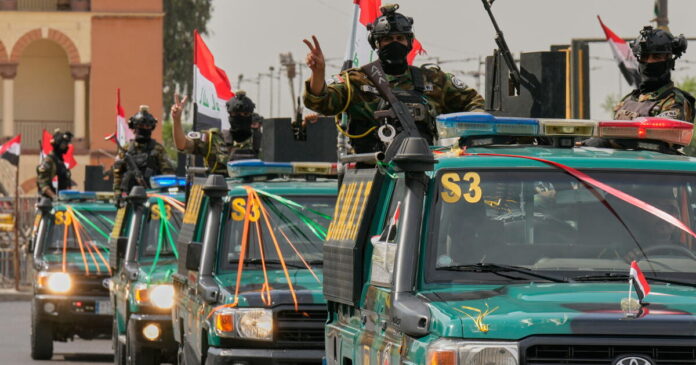
Iraq’s government also marked the moment, announcing a four-day holiday it called “Sovereignty Days” and holding a military parade in Baghdad’s streets.
Speaking at a closed-door ceremony in Baghdad, Iraqi Prime Minister Ali al-Zaidi hailed the moment as “a new phase” defined by “Iraq’s sovereignty, the strength of its institutions, the readiness of its forces, unity of decision-making, and balanced partnerships with its friends.”
All of those elements are likely to be tested as never before in the coming weeks, as Iraq walks a diplomatic tightrope between Washington and Tehran, its two top allies, now locked in a war that shows no sign of abating.
Iran over the years of U.S. occupation built considerable influence in Iraq, nurturing militias there since 2003.
Those factions, which also fought against Islamic State, have embedded themselves into the fabric of the Iraqi state and are now an official part of Iraq’s armed forces. They also wield financial power and are linked to political parties that have long clamored for U.S. forces to leave.
Since the U.S.-Israel war on Iran, the militias have escalated their years-long harassment campaign of U.S. forces in Iraq, lobbing rockets and drones on American bases and facilities. Saudi Arabia also accused them of an attack that shut down its east-west pipeline, a charge the militias deny.
The Trump administration, meanwhile, has pushed Iraq to curb Iranian influence in Iraq and has pressured Al-Zaidi to force the militias to disband or disarm.
On Wednesday, militias portrayed the U.S. withdrawal as a victory of their own making, organizing a parade through Baghdad, with crowds raising the factions’ flags and pictures of slain Iranian Supreme Leader Ali Khamenei to martial music.
At the parade, Jaafar Husseini, a military spokesman for Kataib Hezbollah, a powerful militia that works closely with Iran’s Islamic Revolutionary Guard Corps, said it was the Iraqi resistance that “took up arms against the occupiers, risked their lives and bore the burden of defeating the American occupation for the sake of faith and homeland.”
He added that the factions were not bound by any timetable or agreement mentioned by the government or other political parties.
Kurdish leaders in Iraq’s Kurdistan region also have reason to fear the militias. In recent months, Iran-allied factions have attacked the bases of Iranian Kurdish opposition groups in northern Iraq. A previous confrontation in 2017 between those militias and Iraqi Kurdish forces, known as the peshmerga, ended with the Kurds having to back down.
Another concern for the Kurdish regional government is how the U.S. withdrawal strips the Kurds of air defenses, which had helped intercept more than 1,000 drone and ballistic missile attacks on the region during the U.S.-Iran conflict.
“The departure of the United States from the Kurdistan Region under these complex regional circumstances, without the provision of a defense system, is a matter of concern,” said a statement from the region’s Peshmerga Ministry.
Other Iraqis wonder whether the U.S. withdrawal will trigger a repeat of 2014, when Iraqi forces melted away in disarray.
Al-Zaidi had set Wednesday as a deadline for militias to surrender their weapons, but has since postponed it to June 2027. It is unclear whether the government can adhere to that deadline, especially with the U.S. and Israeli war on Iran still ongoing.
“So long as Iran is at war, it will continue operationally working with these groups in Iraq, and there’s nothing that the Iraqi government can do about it at the moment, and they’re not going to give up their weapons,” said Renad Mansour, an Iraq analyst at the London-based Chatham House think tank.
Mansour noted that in 2008 the Iraqi government tried and failed to rein in militias, even when the U.S. presence and support was near its peak.
“How is this fragmented government with no U.S. support going to be able to fight these groups?” he asked.
A senior U.S. official said Wednesday that Washington has been “clear with Iraq that it is critical that they retain their sovereignty and prevent attacks from within its borders by Iranian-backed militias.” The official added that the United States “fully supports disarmament and transfer of arms to the central government.”
Times staff writer Ana Ceballos in Washington contributed to this report.
More to Read
Disclaimer : This story is auto aggregated by a computer programme and has not been created or edited by DOWNTHENEWS. Publisher: latimes.com