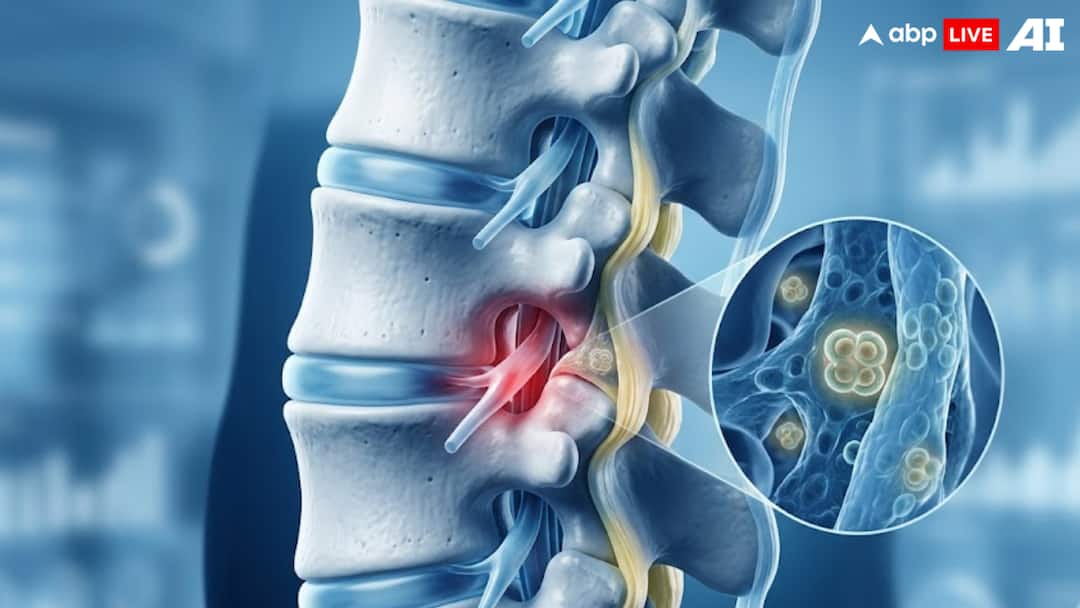
- Researchers identified stem cells essential for building tendons/ligaments.
- These cells contribute to tissue overgrowth in spinal stenosis.
- Calcium signaling drives activity; blockers show potential treatment.
- Findings provide insight for other tendon/ligament disorders.
Scientists have identified a previously unknown population of stem cells that may play a key role in building tendons and ligaments throughout the body. New research suggests these cells can become unusually active in the lower spine and may contribute to the tissue overgrowth associated with lumbar spinal stenosis.
The study, conducted by researchers at Weill Cornell Medicine and Hospital for Special Surgery, also points to calcium signalling as a possible factor behind this abnormal activity. In experiments involving mice, reducing calcium signalling prevented excessive tissue growth.
ALSO READ: India Recorded 1.9 Lakh Infection-Linked Cancer Cases In 2024: Lancet Study
Scientists Identify Stem Cells Linked To Tendons And Ligaments
Researchers had previously identified several skeletal stem cell populations involved in the development and repair of bones. However, finding a comparable stem cell responsible for tendons and ligaments was more challenging because these tissues contain numerous fibroblast-like cells with similar characteristics.
The team analysed thousands of individual cells to identify the population that showed the defining characteristics of stemness — the ability to renew itself while producing mature cells needed to build and maintain tissue.
In mice, the researchers found the cells in a specialised area within tendons and ligaments that appears to function as a reservoir for tissue growth and repair.
The scientists then looked for comparable cells in humans. Samples collected from human ligaments confirmed that the cells could renew themselves and produce ligament cells.
The cells were also found in different parts of the body, including the patellar ligament and Achilles tendon.
“We looked in the kneecap ligament; we looked at the Achilles tendon; and everywhere we looked, we found this cell,” said Dr. Greenblatt. “So, we think this is the universal stem cell for tendons and ligaments throughout the body.”
How The Cells Could Be Connected To Spinal Stenosis
The researchers next examined whether the newly identified cells could be involved in lumbar spinal stenosis, a condition in which thickened ligaments narrow the spinal canal and can put pressure on spinal nerves.
The team compared cells from patients with spinal stenosis with cells taken from spinal ligaments removed from people undergoing surgery for herniated discs who did not have stenosis.
A greater number of the newly identified stem cells was found in ligaments from people with spinal stenosis. When transplanted into mice, these cells generated more tendon cells than comparable stem cells from people without the condition.
“Though spinal stenosis is a complex condition, this really showed us that these cells are contributing to the pathology,” said Dr. Greenblatt, who is also a member of the Sandra and Edward Meyer Cancer Center at Weill Cornell.
The researchers then investigated what might be driving the cells’ increased activity. They found stronger calcium signalling in stem cells associated with spinal stenosis.
Calcium signalling helps cells regulate internal processes, including growth and activity. Increasing this signalling in healthy stem cells triggered excessive tissue growth in experiments, while reducing it in mice with lumbar spinal stenosis prevented abnormal growth.
Could Blood Pressure Drugs Offer A Future Treatment?
The findings raise the possibility that calcium signalling could become a target for future spinal stenosis treatments.
Researchers say calcium channel blockers, a group of medicines already commonly prescribed for high blood pressure, could potentially be investigated for this purpose. However, clinical trials would be required to establish whether such an approach is safe and effective for people with spinal stenosis.
“This is probably the first work that’s shown a potential therapeutic target for one of the most common spine conditions in the world,” said Dr. Iyer.
For patients with severe spinal stenosis, treatment options can become limited once nerve compression worsens. The researchers believe understanding the underlying cellular process could eventually open new avenues beyond surgery.
“Identifying these specialized stem cells unlocks a new area of research that allows us to address this disease much more mechanistically, rather than just waiting until a patient’s condition worsens and requires surgery to relieve the nerve compression,” said study co-corresponding author Dr. Sravisht Iyer, an associate professor of orthopedics at Weill Cornell and a spine surgeon at Hospital for Special Surgery (HSS).
“The findings are exciting for their potential to change the way we deliver spinal care,” added Iyer as quoted by the website.
ALSO READ: Sleeping Less Than 7 Hours Regularly? Know How It Can Affect Your Health
Discovery Could Help Explain Other Tendon And Ligament Disorders
The researchers say the discovery could have implications beyond spinal stenosis. The team plans to examine whether the same stem cells are involved in other connective tissue disorders, including Marfan syndrome.
The findings could also provide new research avenues for injuries and conditions involving tendons and ligaments, including rotator cuff tears, Achilles tendon injuries, ligament reconstruction and chronic tendon degeneration.
“Given that this cell appears to be the ultimate origin of all tendon and ligament cells, defects in this cell are likely at the heart of a wide range of tendon and ligament disorders,” said Dr. Greenblatt.
The study was published on September 7 in the journal Cell.
[Disclaimer: The information provided in this article is based on the findings of a research study and is intended for general informational purposes only. The findings should not be considered definitive medical advice, diagnosis, or treatment recommendations. Further research and clinical studies may be needed to establish the safety, effectiveness, and broader implications of the findings.]
(With inputs from ANI)
Check out below Health Tools-
Calculate Your Body Mass Index ( BMI )
Calculate The Age Through Age Calculator
Disclaimer : This story is auto aggregated by a computer programme and has not been created or edited by DOWNTHENEWS. Publisher: abplive.com