This article has been published in partnership with Kalaari Capital.
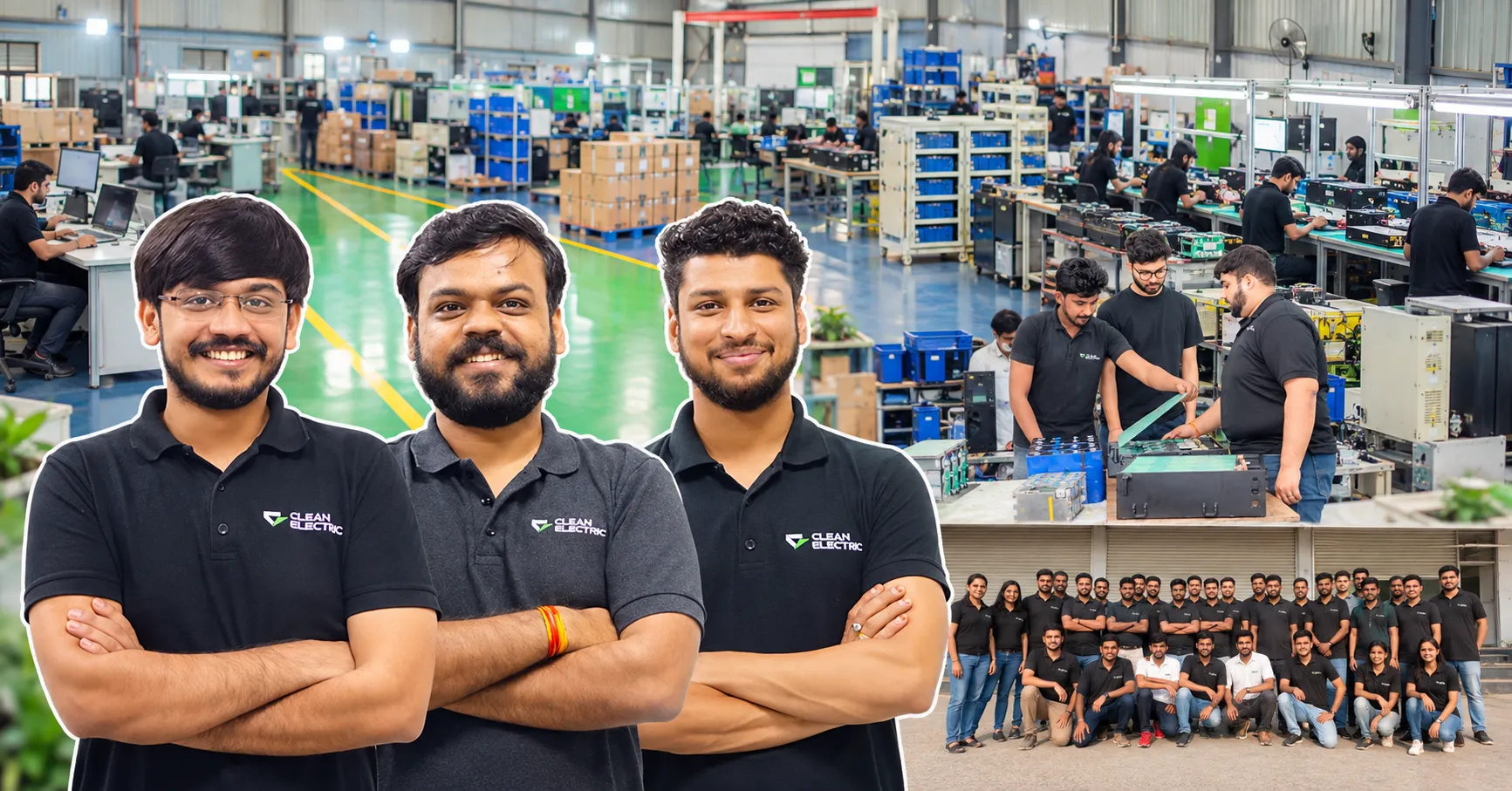
In 2020, Akash Gupta, Abhinav Roy and Ankit Joshi were in a dusty workshop in Bhopal trying to build an electric last-mile delivery truck.
But the more they worked on the truck, the more one problem began to overshadow the rest.
A commercial vehicle earns when it is moving. A diesel truck could refuel in minutes, while an electric one might spend an hour or more plugged in. Then there was range, battery life and safety. Each of those questions seemed to lead back to the same component.
“If refuelling happens in 10 to 15 minutes, why does it need one or two hours to charge a truck?” Akash remembers wondering.
At the time, the three were doing much of the work themselves. “It was three of us,” he recalls. “Ankit used to do all the wiring, Abhinav used to write all the code, and I was doing some welding of our initial prototypes.”
When seven more people joined them, they moved into a basement and painted the floor so the team would have a cleaner place to work.
By then, the insight that would change what they were building had become difficult to ignore. To make the truck they wanted practical, they first needed a battery that could charge quickly, last for years and remain safe without making the vehicle too expensive.
So they stopped trying to build the whole truck and focused on what they believed was the harder problem inside it.
It started with racing cars built in college
The decision to build together in 2020 had been years in the making.
Akash and Abhinav met at IIT-BHU in 2013, where Akash led the automobile club and Abhinav led aeromodelling. Their hours outside class went into racing cars, drones and RC planes.
“We used to build a lot of racing cars in college, and that is where we got our hands dirty,” Akash says. “That is how we got interested in product building, and we got addicted to it in some way.”
/filters:format(webp)/english-betterindia/media/media_files/2026/09/30/founderstogether-2026-09-30-17-29-52.webp)
Ankit, another automobile enthusiast who had worked on electric powertrain technology, later joined them.
The three had already thought about building a company while in college. But they also knew that starting a hardware business would need more than enthusiasm. So after graduating, they spent a few years learning elsewhere.
Akash joined the JSW Group and worked on an electric car project, gaining experience on the business side of EVs. Abhinav worked in robotics and automotive technology. Ankit pursued further studies before deciding that building products interested him more than continuing towards a PhD.
By 2020, their paths opened up again. Akash’s EV project at JSW had been put on hold, while the pandemic interrupted some of the R&D work Abhinav was involved in. The three decided to return to the idea they had been carrying since college, this time full-time.
Those years of experience had also made one gap clearer.
“You can buy a good motor, you can buy a good instrument cluster,” Akash explains. “But you could not buy a battery pack. So that was the realisation in 2020. We thought, rather than building a full truck, let’s just focus on the battery.”
/filters:format(webp)/english-betterindia/media/media_files/2026/09/30/factory-2026-09-30-17-30-28.png)
The problem was not finding battery cells. It was putting them together into a pack that could give a driver good range, charge quickly, stay safe and continue performing for years.
Charging time became their first target. They began with a goal of around 30 minutes and hoped eventually to reach 15. After months of experiments, they achieved that number in the lab.
“It was 15-minute charging, but it was lab results,” Akash says. “Then you have to make a product out of it. If a 15-minute battery is heavier, people will not buy it. You need range, fast charging, safety and cost to work together.”
Trying to make all four work at once led them to another problem. The faster a battery charges, the more carefully its heat has to be managed.
How do you keep a fast-charging battery cool?
A battery pack contains many smaller cells. If one cell overheats badly, that heat can reach the cells beside it and, in the worst case, trigger a chain reaction.
The team chose immersion cooling to manage this. The battery cells sit surrounded by a special liquid that does not conduct electricity but can absorb and carry away heat.
/filters:format(webp)/english-betterindia/media/media_files/2026/09/30/clean-electric-1_11zon-2026-09-30-17-32-01.jpg)
“If you have a good cooling system, you can charge the battery faster while still keeping it cool enough,” Abhinav explains. “It also helps with safety. If something goes wrong in one cell, you want to cool it quickly so the issue stays there instead of spreading to the next cell.”
Choosing immersion cooling was only the beginning.
“What we were doing was unconventional,” Akash says. “We were flooding batteries with battery coolant for better thermal management. But it also has its own challenges. Your weight goes up, your cost goes up, your leakages go up.”
That liquid had to remain inside the battery for years, even though wires and electrical connections still needed to pass through the casing. Abhinav says the team had to develop its own connectors to bring those connections out while keeping the battery sealed.
Making five or 10 prototypes work was one challenge. Making every pack coming off a production line equally reliable was much harder.
/filters:format(webp)/english-betterindia/media/media_files/2026/09/30/plantphoto5-2026-09-30-17-32-31.png)
“Getting that sealing consistent was a problem,” Abhinav says. “In the lab, the engineers are doing the sealing themselves. Then you have to transfer that process to a production line, where someone else can also make a leak-proof pack.”
Cooling alone was not enough either.
The individual cells inside a battery can behave slightly differently. One may heat up faster, store slightly less energy or age differently from another. If those differences grow over time, one weaker cell can begin affecting the performance of the entire pack.
Clean Electric therefore began selecting and matching cells more carefully and developed its own battery management system to keep track of what was happening inside.
Its 0Kelvin technology combines immersion cooling with software that looks at information such as temperature, voltage and current while the battery is being used or charged. The system can adjust the charging rate as conditions change, rather than waiting for the battery to become too hot. Clean Electric calls this Smart Temperature Modulation.
/filters:format(webp)/english-betterindia/media/media_files/2026/09/30/factorypic1-2026-09-30-17-33-03.png)
The company also built Hive, a platform that collects data from batteries already operating in the field. That information is used to monitor battery health, diagnose problems and understand how packs are performing over time.
Its SONIC charging system fits into the same approach: battery and charger are designed to work together rather than treating charging as a separate step.
The challenge, therefore, was no longer simply reaching 15 minutes once in a laboratory. The battery had to repeat that performance safely across different vehicles, climates and years of use.
The road quickly showed the team how difficult that could be.
In colder regions, for instance, water sometimes separated from the coolant and interfered with electronics inside the pack.
/filters:format(webp)/english-betterindia/media/media_files/2026/09/30/factory3-2026-09-30-17-33-33.png)
“It was an intermittent issue,” Abhinav says. “It would happen sometimes and not happen at other times. So you first have to recreate the problem, trace the root cause and then figure out how to solve it.”
Could the battery survive an autorickshaw’s working day?
That question became even more important when the batteries began going into commercial three-wheelers.
An electric autorickshaw in India is often a source of daily income. Its battery can be put through a far more demanding routine than one inside a privately owned car.
“In India, especially in the three-wheeler segment, these vehicles can do about 200 kilometres every day,” Abhinav says. “The range is also typically around 200 kilometres, so they may use one full charge every day. We also pack in less battery to keep the product affordable.”
That means the same battery may be charged, used through a full working day and charged again, day after day.
For the driver, battery life and charging time are therefore more than specifications on a brochure. An early replacement is a major expense. An hour spent charging is an hour when the vehicle cannot be carrying passengers or earning money.
/filters:format(webp)/english-betterindia/media/media_files/2026/09/30/plantphoto3-2026-09-30-17-33-58.jpg)
Years of everyday use are now giving the team information that short lab tests could never provide. Abhinav says some early vehicles have travelled around 70,000 to 80,000 km while their batteries show roughly four percent degradation.
“The degradation numbers were somewhat better than what we were even expecting,” he says.
Safety was tested in a much less controlled way.
Abhinav recalls an autorickshaw being charged using what he describes as an improvised wiring arrangement. According to him, the fault began outside the battery: the charger caught fire, and the flames eventually spread through the vehicle.
“The whole vehicle got burned. The battery was still intact,” he says. “The connectors had melted, but the battery was still intact. You could change some plastic bits and reuse the battery.”
The incident damaged components around the pack, but the failure did not spread through the battery cells themselves.
For Abhinav, that mattered because it showed how the battery behaved in exactly the sort of uncontrolled situation that is difficult to reproduce fully inside a laboratory.
/filters:format(webp)/english-betterindia/media/media_files/2026/09/30/clean-electric-17_11zon-2026-09-30-17-34-29.jpg)
“It was a good validation that whatever we had built actually takes the abuse in the real world,” he says.
From 3 batteries to thousands of kilometres
Clean Electric’s first outside order had been far smaller. In 2021, Bounce Infinity ordered three battery packs.
Around the same period, reports of electric two-wheelers catching fire were making battery safety a visible concern for Indian EV buyers.
“Safety got us the entry point,” Akash says. “Cycle life takes years of data to prove, but safety was something you could test much sooner.”
Over time, vehicle manufacturers began adding another perspective.
Omega Seiki Mobility says it first tested Clean Electric’s batteries at its Pune factory and then in vehicles, increasing volumes gradually as their performance remained satisfactory.
“The battery enables a higher-range offering, with approximately 230 to 250 km of actual on-ground range,” OSM says. “This supports customers who prefer longer continuous running and do not want repeated charging during the day.”
The company continues to push for improvements too, including further work on the electrical architecture and battery management system.
Baxy, another manufacturer using the packs, says its vehicles fitted with Clean Electric batteries have travelled approximately 30,000 to 48,000 km without customers raising specific degradation concerns.
/filters:format(webp)/english-betterindia/media/media_files/2026/09/30/factory2-2026-09-30-17-34-57.png)
“We have not observed functional or safety hazards with the packs,” the company says, adding that it has received “responsive service, training and field support” from Clean Electric.
That feedback feeds back into the same process that began in Bhopal: build something, see how it behaves once people start using it, and return to the engineering.
“Some key decisions have to be right because you will live with them for a long time,” Abhinav says. “But many smaller decisions are reversible. You can pick an answer, test it, and if it is wrong, come back and change it. You learn by doing and keep iterating.”
The dusty Bhopal workshop has since given way to a larger operation in Pune. Clean Electric says more than 6,000 of its batteries have now been deployed across over 100 locations and have collectively covered more than 20 million kilometres.
Yet the larger problem remains much the same.
/filters:format(webp)/english-betterindia/media/media_files/2026/09/30/plantphoto4-2026-09-30-17-35-26.png)
For an EV to become a practical alternative at scale, its battery has to charge quickly without creating new safety risks, survive years of repeated use, offer enough range and remain affordable.
For a commercial driver, all of that engineering eventually comes down to something much simpler: whether the vehicle can spend more of the day on the road and less of it charging, being repaired or worrying its owner.
When Abhinav is asked which single piece of technology makes him proudest, he does not choose one.
“A lot of things have to work right,” he says, “and they have to work together to deliver a balanced product.”
/filters:format(webp)/english-betterindia/media/media_files/2026/09/30/img_4686-2026-09-30-17-35-47.jpg)
That may be the larger challenge Clean Electric is trying to solve. The aim is not simply to make electricity enter a battery faster, but to make the battery itself less of a compromise in choosing an electric vehicle.
The truck that brought Akash, Abhinav and Ankit into that dusty Bhopal workshop was never the product they ultimately built. Instead, it helped them find the problem that could determine how useful that truck, an autorickshaw or any other EV would be once it reached the road.
Disclaimer : This story is auto aggregated by a computer programme and has not been created or edited by DOWNTHENEWS. Publisher: thebetterindia.com