
A radicalised Queensland doctor who fled Australia in 2016 to join Islamic State fighters in Syria supplied violent extremist material to an “influential” Melbourne IS propagandist, a court has heard.
The details of the ongoing investigation into fugitive Dr Omer Elamin were aired in the Melbourne Magistrates’ Court on Thursday during Mohamed Musse Bakit’s lengthy bail application.
The court heard Elamin was a key figure in Bakit’s alleged role as an Islamic State member, supplying him with a cache of extremist material and creating a WhatsApp group chat that Bakit allegedly used to send thousands of files to other radicalised extremists, some of whom live in Queensland.
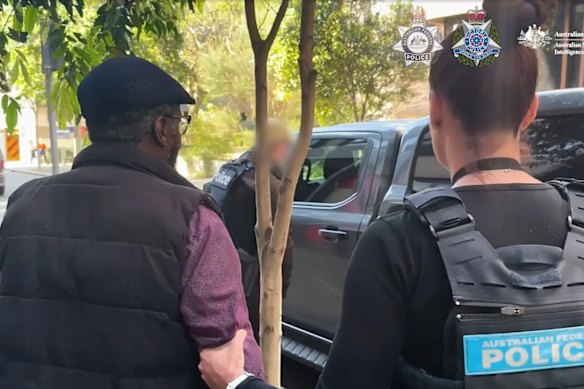
Counter-terrorism police charged 65-year-old Bakit last week following a years-long surveillance operation into the Carlton man’s alleged role as a key propagandist for the terrorist organisation.
The charges against Bakit primarily relate to material he is said to have sent into the WhatsApp group chat, where he is accused of sending nearly 10,000 files of violent extremist material and Islamic State propaganda between November 2015 and July 2020.
Authorities said Border Force officers tipped off counter-terrorism investigators after searching Bakit’s luggage ahead of a flight he took to Egypt in November 2020.
The Victorian Joint Counter Terrorism Team (JCTT) launched the covert investigation in 2021 when Batik returned six months later.
Bakit allegedly told authorities upon his return that he had met Elamin, a medical doctor, at Queensland’s Kuraby mosque. He said Elamin gave him a yellow USB containing extremist material, which he then sent on to other members, the court heard.
The other group members are not being treated as suspects and have not been charged with being part of a terrorist organisation, the court was told.
Bakit’s lawyer, Michael McGrath, said the prosecution had provided no evidence regarding the size of the group chat. “It could’ve been three [members] or 300 [members].”
JCTT detective Katharine Dillon told the court Elamin flew to Libya in 2016 with a plan to join IS fighters in Syria. Dillon said there were ongoing investigations into Elamin’s whereabouts, but authorities were unsure if he ever arrived in Syria.
The court heard Bakit was responsible for 67 per cent of the WhatsApp group’s content, sending 9754 messages, 391 images, 1609 audio files, 811 videos and more than 400 documents.
He allegedly sent troves of material “glorifying” Islamic State, including battlefield footage, speeches, executions, depictions of dead people and other extreme content.
In response to a message that said, “Omer has arrived in [Libya] and is rallying the youth”, Bakit allegedly said: “Allah is the greatest, Allah is the greatest, Allah is the greatest …”
Dillon said digital analysis of Bakit’s devices showed he was a prolific distributor of official IS publications, including the terrorist group’s weekly magazine, al-Naba, as well as the English version of the publication, designed to target Western supporters.
The material also allegedly included information on avoiding detection by law enforcement and how-to guides on carrying out mass casualty attacks, the court heard.
Material allegedly discovered on Bakit’s mobile phone during a 2024 raid included the notorious beheading of American businessman Nick Berg, who was abducted in May 2004 by Islamist militants. The graphic five-minute video shows executors holding Berg to the ground while he is beheaded with a small knife, the court heard.
Dillon said the group chat’s members showed appreciation for Bakit, and that he enjoyed status and influence among the group. In one message, Elamin called Bakit “our esteemed river”, while other group members said he was the “voice that shouts the truth” and “the hero”, the court heard.
The court was told Bakit was a passive member of 12 other related WhatsApp group chats. He was interviewed by police in August 2025 and again in January this year. Dillon said the interviews were voluntary and Bakit participated willingly.
During those interviews, the court heard, Bakit denied knowing about the group chat, denied making a pledge of allegiance to IS, denied sending the messages and said he had suffered memory loss from a stroke in 2023.
The court heard he is permanently disabled and receives more than three hours of assistance a day from carers who help him shower and dress.
Defence lawyer McGrath said Bakit was not a risk to the community given his poor health, and that the alleged offending is said to have taken place years ago.
Bakit was supported by his brother and wife in court.
Magistrate Gerard Lethbridge will hand down a decision on bail at a later date.
Start the day with a summary of the day’s most important and interesting stories, analysis and insights. Sign up for our Morning Edition newsletter.
 Carla Jaeger is a journalist for The Age. Got a tip? Email carla.jaeger@theage.com.au or message carlajaeger.62 on Signal.Connect via X or email.
From our partners
Disclaimer : This story is auto aggregated by a computer programme and has not been created or edited by DOWNTHENEWS. Publisher: www.smh.com.au