
The number of Queues I Have Joined by Accident is small (one), but what that list lacks in length it more than makes up for in quality. I’d been not five minutes inside Osaka’s Super Nintendo World, my hyped-up eight-year-old dragging me by the wrist, when we found ourselves in a long, nondescript corridor. A line of fellow theme park attendees stretched ahead, and we were curious to discover the attraction drawing such interest.
We reached the end of the corridor to find it opened onto a vast room in which guardrails marked out the long, snaking path that queue-members were to follow. By this point, the line behind us was equally interminable. We’d passed the point of no return, and a digital display informed me that we were two hours away from the virtual Mario Kart ride we’d accidentally signed up for. To misquote the world’s most famous video game plumber: “It’s a-me! Mortified!”
Queues are anathema to modern life. The robotic voice announcing you’re 125th in line before a human operator can take your call. The slow-motion crawl down a soggy-carpeted hallway when nature’s call grows louder than the nightclub’s sound system. The inescapable column of vehicles giving off visible heat while someone scrabbles to find their car-park exit chit. But come on: none of that holds a candle to two hours with a pre-teen high on Pocky sticks and lemonade, a phone low on reception, and no real notion of what lies ahead. TLDR: we had a grand old time.
We live in a moment of Me first! The cult of productivity demands that even our downtime be filled with self-improvement, side hustles and whatever-maxxing. A screen freezing up for a second can induce a fight-or-flight cortisol spike, while cutting someone off in traffic can give rise to physiological reactions that are much more dangerous.
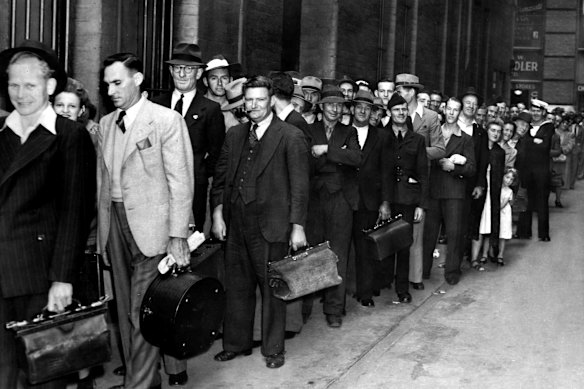
Contrast that dog-eat-dog world with the subtle democracy of the queue. When you join the end of a line, you’re entering a gentle lottery in which everyone wins, each slowly advancing towards your shared goal, regardless of ability or background. There’s a kindness to the queue that’s part of the social contract: nothing creates solidarity in a group of strangers faster than one person attempting to cut ahead of the rest.
“Shuffle like ya mean it!” shouted no film director ever because queues aren’t dramatic. They reward patience and civility and a polite nod of the head to say: we can all move up a spot now. Their stakes are usually as low as a banh-mi from that place everyone’s raving about or a decent ticket to the Radiohead concert. And in that period of enforced waiting, we sometimes catch a glimpse of how pleasant a spell of pointlessness is, and how our culture of endless scrolling and distraction robs us of that.
Perhaps our patience for queues is culturally specific. There’s an entire mythology around queueing in Britain, for instance, where the ability to withstand long waits is seen as a key to the nation’s stoicism in the face of mundane inconveniences. A two-hour queue in Japan, too, seems more manageable when train stations show you where to line up for each carriage door to minimise social friction during your commute.
It’s tempting to contrast these attitudes with the more individualistic ethos of the US, where looking out for number one takes precedence over forming an orderly line. That’s probably generalising, though, or at least affording too much weight to the less generous members of the nation.
It might not be cultural, of course. Most eight-year-olds have learnt the importance of turn-taking, even if many of their elders have forgotten those lessons. Life is not fair, but on the playground and in the classroom we experiment with ways to make it more so. That’s our genius.
“It takes a lot of time to be a genius, you have to sit around so much doing nothing, really doing nothing,” wrote Gertrude Stein. She was the kind of irascible, contrarian wit who understood that stepping out of the rat race of money, fame and success was a liberation. Another writer, Lin Yutang, advanced a similar sentiment: “If you can spend a perfectly useless afternoon in a perfectly useless manner, you have learned how to live.”
A queue can feel perfectly useless (who dares squander my precious time?!) but therein lies its secret power. It’s a submission to a force bigger than us, a call to reconcile ourselves to the fact that some things are beyond our control. It’s a minute – or two hours – that might initially send us into a red rage, but that ultimately insists we find the internal resources to make it through to our final destination.
It’s even there in the word “queue”: the first letter does all the work, yet trails in its wake a frankly unnecessary number of vowels. But that’s the kind of pointless thought you’ll only have when waiting in line, trying to remember the first thing about Mario, finding that an unplanned few hours chatting with someone you love is perfectly useless and perfectly pleasant, a lesson in how to live.
Want more Verdicts?
 John Bailey is a contributor to The Age and The Sydney Morning Herald.Connect via email.
From our partners
Disclaimer : This story is auto aggregated by a computer programme and has not been created or edited by DOWNTHENEWS. Publisher: www.smh.com.au