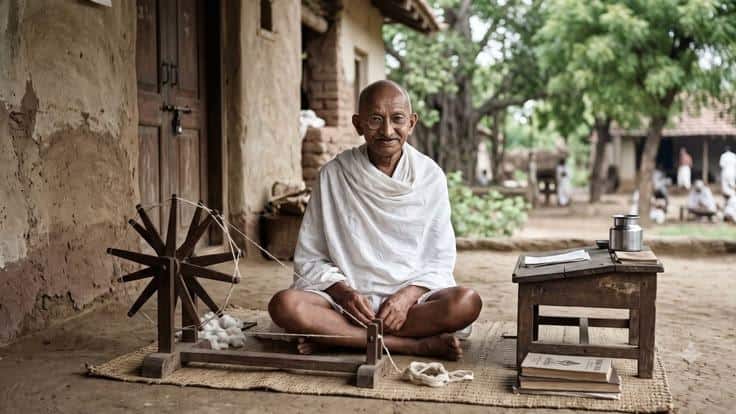
Mahatma Gandhi remains one of the most recognisable figures in Indian history, remembered for his philosophy of non-violence, simplicity, and role in India’s freedom struggle. While his public life and political movements are widely discussed, several lesser-known details about his life often remain outside the spotlight. From his childhood nickname and early marriage to his years in South Africa, legal career, and unexpected connection with football, these facts offer a different glimpse into Gandhi’s life and legacy.
1. His Family Called Him Monu Or Moniya
Before he became known around the world as Mahatma Gandhi, he had affectionate childhood nicknames. His family and close ones reportedly called him Monu or Moniya. These names reflected the more personal side of Gandhi’s early life, long before he emerged as a major political and social leader.
2. He Married At The Age Of 13
Gandhi married Kasturba Gandhi when he was 13 years old, while Kasturba was 14. Their marriage took place in 1883, following the social customs prevalent in their community at the time. Kasturba later became an important figure in Gandhi’s personal and public journey, participating in several movements associated with India’s freedom struggle.
ALSO READ | Happy Gandhi Jayanti 2026 Wishes: 500 Messages, And Quotes To Share For Friends, Family And Loved Ones
3. He Travelled To London During The Jack The Ripper Era
In 1888, Gandhi travelled to London to study law at the Inner Temple. Interestingly, this was also the year in which London was gripped by the infamous Jack the Ripper murders. Gandhi’s time in Britain marked an important stage in his education and exposure to Western society.
4. Gandhi Had A Connection With Football
Gandhi’s association with football is one of the lesser-known aspects of his life. During his years in South Africa, he reportedly helped establish three football clubs, which were associated with the Passive Resistance movement. His interest in the sport was also linked to his efforts to bring people together and promote physical activity.
ALSO READ | Budget Traveller | Gandhi Jayanti 2026: 10 Countries Where You Can Spot Bapu’s Statues
5. He Had A Successful Legal Career
Before becoming synonymous with India’s independence movement, Gandhi worked as a lawyer. During his legal practice in South Africa, he reportedly earned a substantial income. Accounts suggest that his earnings reached around $15,000 a year, a considerable amount for that period. His professional experience in South Africa also played a major role in shaping his political ideas.
6. A Railway Station Is Linked To His Famous South African Incident
Gandhi’s famous encounter with racial discrimination took place at Pietermaritzburg railway station in South Africa in 1893. He was removed from a train despite holding a first-class ticket. The incident became an important turning point in his life and contributed to his later activism against racial discrimination. The station is now closely associated with his legacy.
7. Rabindranath Tagore Is Widely Credited With The Title ‘Mahatma’
Gandhi is universally remembered by the honorific Mahatma, meaning “great soul”. The title is widely attributed to Rabindranath Tagore, although historical accounts around the earliest use of the term are more complicated. The name eventually became inseparable from Gandhi’s identity and public image.
8. He Was Time Magazine’s ‘Person Of The Year’
In 1930, Gandhi was named Time magazine’s Person of the Year. The recognition came during a crucial period of India’s freedom struggle. His leadership of the Salt March that year had drawn international attention to British rule in India and Gandhi’s method of non-violent protest.
9. He Never Received The Nobel Peace Prize
Gandhi was nominated for the Nobel Peace Prize five times, but he never won the award. His nominations came between 1937 and 1948. Although the Nobel Committee did not ultimately honour him with the prize, Gandhi’s philosophy of non-violent resistance went on to influence movements and leaders around the world.
10. October 2 Is The International Day Of Non-Violence
Gandhi’s birth anniversary, October 2, is observed globally as the International Day of Non-Violence. The United Nations established the observance in 2007 to promote the message of non-violence through education and public awareness. In India, October 2 is celebrated as Gandhi Jayanti, commemorating Gandhi’s birth and his enduring contribution to the freedom movement.
From an ordinary childhood nickname to his transformative years in South Africa and his global influence, Gandhi’s life contains many details that extend beyond the familiar stories of India’s freedom struggle. These lesser-known facts offer another perspective on the man whose ideas about non-violence, civil resistance, and social change continue to be discussed around the world.
Disclaimer : This story is auto aggregated by a computer programme and has not been created or edited by DOWNTHENEWS. Publisher: abplive.com