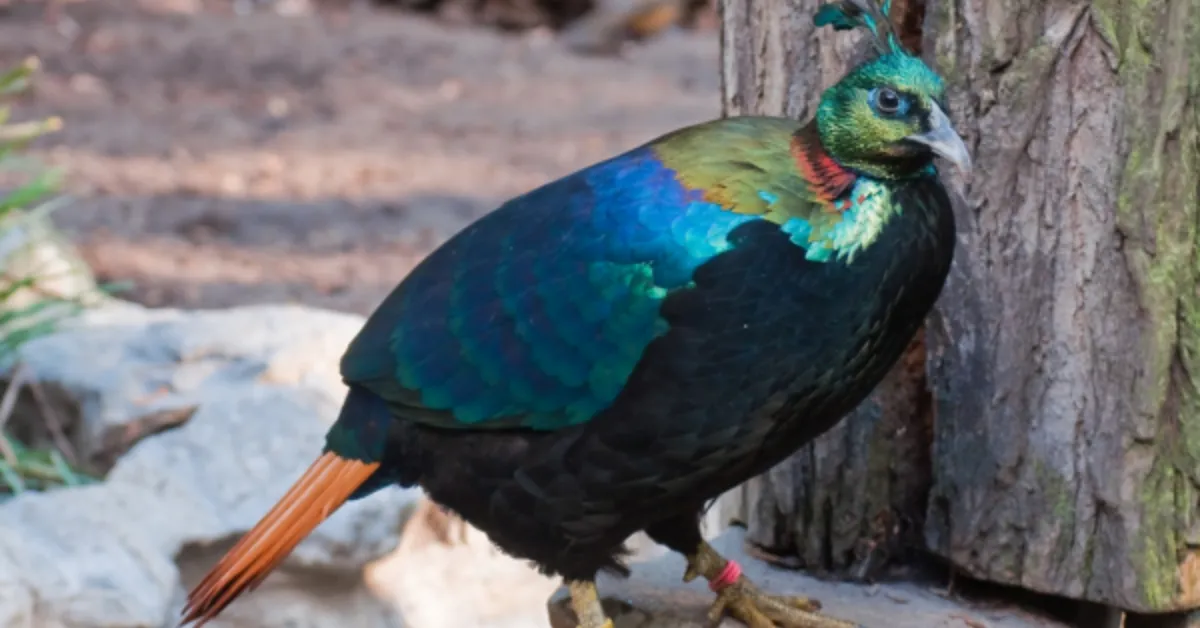
This story is part of The Better India’s new wildlife series, Species in Focus: 52 species. 52 stories. 52 reasons to protect India’s wildlife. One species at a time, the series explores India’s rare, endangered and lesser-known wildlife, their habitats, behaviour, ecological roles and conservation status.
The Himalayan monal, the state bird of Uttarakhand, is calling at higher frequencies in parts of the Himalayas where traffic, tourists, pilgrims and other human activity have made the landscape noisier.
Researchers at Hemvati Nandan Bahuguna Garhwal University recorded 719 monal calls between April 2023 and June 2024, comparing a relatively quiet stretch of Madmaheshwar Valley with the busier Chopta Valley in the Kedarnath Musk Deer Sanctuary.
Published in Behavioural Processes in August 2025, the study by Rajeev Lochan, Dinesh Kumar Sharma and Anand Kumar found that in the noisier landscape, the birds produced calls with higher peak frequencies and slightly longer durations.
The likely reason is that the birds are trying to be heard.
A call helps a bird communicate, find mates and defend its territory. So when that call changes, it is worth paying attention. The finding suggests that human-generated noise is reaching far enough into the monal’s habitat to make the bird alter the way it communicates.
The monal has not moved away. It appears to be changing its voice to cope with a landscape that is getting louder.
And scientists do not yet know what that adjustment could cost the bird.
For a bird adapted to high-altitude forests and alpine landscapes, the changes are happening both around it and, now, in the soundscape through which it communicates.
Two valleys, two soundscapes
To understand how noise was affecting the monal, the researchers listened to it in two very different settings.
Madmaheshwar Valley provided the quieter comparison. The area has relatively little human activity and no road.
Chopta Valley, within the Kedarnath Musk Deer Sanctuary, is more frequently visited. Roads bring vehicles through the landscape, while pilgrims, trekkers, tourists and birdwatchers add to the human presence.
The researchers used directional microphones and passive acoustic monitoring devices, including AudioMoth recorders, to capture the birds’ calls across seasons. The recordings were collected between April 2023 and June 2024, particularly during the morning and evening periods when monals are more vocal.
They analysed 719 calls.
The difference between the two soundscapes showed up in the calls.
Monals in the noisier habitat used higher peak frequencies than those recorded in the relatively undisturbed habitat. The difference was especially pronounced towards the upper end of the birds’ vocal range. The study also found a slight increase in call duration in noisier conditions.
At the median level, the peak frequency in the quieter habitat was around 171 Hz lower than in the noisier habitat.
The pattern was strongest at the upper end of the range: at the 95th quantile, the researchers’ statistical model explained about 73.4% of the variation in peak frequency.
Why would a bird raise its voice?
There is a concept in ecology called acoustic masking.
When background noise overlaps with an animal’s communication signal, it can make that signal harder for another animal to detect. For a bird, that can mean a call travelling less effectively through its habitat.
Photographer captures the flight of the Himalayan monal, known as the “bird of nine colors.”
📸 Aditya Chavan pic.twitter.com/cVL5uqfcXw
— World’s Amazing Things (@Hana_b30) August 28, 2026
Human-generated noise from roads, vehicles and other machinery can produce persistent sounds that occupy frequencies used by wildlife.
The monal appears to be responding by shifting its calls towards higher frequencies.
The researchers interpret this as a possible way of reducing the effect of acoustic masking. A slightly longer call could also provide another way of maintaining communication when background noise interferes with the signal.
But there is a distinction between adapting to noise and being unaffected by it.
The study does not establish that the changed calls are reducing the monal’s mating success or affecting its population. It also does not show that the birds will be able to compensate indefinitely for increasing noise.
When noise becomes a habitat problem
For animals that communicate through sound, habitat is more than trees, grass, water and shelter.
In a separate 2025 study published in Scientific Reports, Lochan, Sharma and Kumar examined the species’ future habitat using species-distribution modelling and 5,122 occurrence records. The researchers looked at present conditions and projected habitat suitability under three climate scenarios extending into the future.
The model found that precipitation during the coldest quarter was an important factor in determining habitat suitability. Under one scenario, more than 14% of previously suitable habitat was projected to become unsuitable by 2041–2070. Under another high-emissions scenario, habitat losses were also projected towards the end of the century.
Birding Goals 🦚
Himalayan Monal, watching its territory at Khaliya Top. A phone shot—the very first glimpse I ever had, last year
The chances of spotting one around Munsyari are lower, not because they’re scarce, bt because much of the terrain is rocky and difficult to access pic.twitter.com/rcelEdzWb9
— Saurabh🦚 (@monal_2111) September 28, 2026
The monal occupies alpine and subalpine areas, oak-mixed forests, rhododendron vegetation and steep mountain slopes, generally between about 2,400 and 4,500 metres. Climate change, land-use change, infrastructure and tourism can all alter these environments.
The bird is currently classified as Least Concern on the IUCN Red List. But conservation status at the global level does not capture every change taking place within individual habitats.
Listening to the Himalayas
The researchers’ work also leaves several questions for future studies: whether the altered calls affect mate attraction, whether prolonged exposure creates behavioural or physiological costs, and whether other Himalayan birds are making similar adjustments.
Source:
‘Noise-induced vocal shifts in the Himalayan Monal (Lophophorus impejanus) vocal distribution in two different habitats’: By Rajeev Lochan, Dinesh Kumar Sharma, Anand Kumar, Published on 8 July 2025
Disclaimer : This story is auto aggregated by a computer programme and has not been created or edited by DOWNTHENEWS. Publisher: thebetterindia.com