
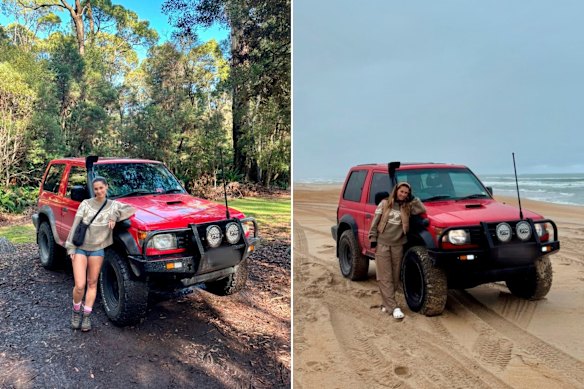

Bonnie didn’t know she had a dream car until she first laid eyes on it.
The 27-year-old Pilates instructor, who has chosen to withhold her surname for privacy reasons, had previously driven a series of small hatchbacks that were perfectly serviceable, if a little forgettable.
“I was driving a Mazda 3, and there was nothing wrong with it, but I was sick of it,” she recalls.
“I’d been talking to my partner for a while about what I wanted in a car, and I couldn’t really verbalise it. But when I saw the Pajero, I knew it was my dream car.”
She fell head over heels for a bright red short-wheelbase Mitsubishi Pajero that’s older than she is. The two-door, diesel-powered 4WD from 1992 has a manual transmission and not much else.
“When I bought it three years ago, it didn’t have seats or carpet on the floor, and the speedometer and the tachometer didn’t work,” Bonnie laughs. “It still doesn’t even have airbags.”
While her friends drive modern SUVs with cruise control and blind-spot monitoring, Bonnie says she wouldn’t trade her vintage ride for all the mod-cons in the world.
“Honestly, I don’t think I was a very good driver in the past, and now, having a connection to my car, I’m a much better driver,” she admits.
“Because I really enjoy it, I’ve asked my partner lots of questions about how it works and how to fix things. He’s taught me how to service it, so I do that on my own too.”
Bonnie is one of an increasing raft of young women opting for old, off-road-focused cars over modern SUVs, hatchbacks and electric vehicles.
In June, a headline in The Wall Street Journal declared, “The Expensive Accessory Every ‘Hot Girl’ Wants: An Old, Loud SUV”, with journalist Chavie Lieber pointing to the booming market for secondhand Ford Broncos and Land Rovers, driven by affluent young women.
It turns out a similar phenomenon is playing out in Australia, but swap Ford Broncos for Toyota LandCruisers and “affluent young women” for savvy creatives with a thirst for serious adventure.
An antidote to ‘disposable culture’
Stuart Amm, owner of Sydney-based restoration company Aussie Motor Group, has witnessed this trend in real time over the last two years, and says young female owners now account for roughly 25 per cent of his company’s work.
“Specifically for women, they’ve been exposed to the car scene via social media, and they see the beauty, the design and the story of these vehicles and want to be involved,” Amm says.
“They love to continually refine and update their vehicles, so they’re falling into that pattern of the old-school revhead, but coming at it from a different angle.”
Amm says his female customers tend to be successful business owners with a creative background who are heavily involved in their car’s design and customisation.
Most recently, Amm worked with Ngoc Dang, the owner of Melbourne-based events company Ed&Ed Studio, to customise her 2015 Land Rover Defender.
“One of the biggest things that drew me to my car was that it was a manual, and it’s really difficult to buy a manual car new,” Dang explains.
“But the first time I actually drove it, I was like, ‘What was I thinking?!‘. It has such a heavy clutch, and it’s clunky to drive, but you get used to it. Those are the things that make you feel like you’re really driving.”
While Dang has kept the manual transmission, she’s worked with Amm to add Apple CarPlay and sound dampening so she can take work phone calls on the go, and has had the interior fitted out in a striking caramel-coloured leather.
“I don’t think I’ve stopped – the best thing about the Defender is you can continually keep working on the small details.”
Amm concurs: “These cars are the antidote to disposable culture. And there’s something beautiful about bringing something back to new – there’s a pride there.”
It doesn’t hurt that cars like the Defender or Toyota LandCruisers are just as capable as they are aesthetically pleasing.
“It’s a cool car to take to the beach or to your highlands farm, but it looks just as good parked outside a hotel next to a modern Range Rover – they cross worlds really well,” Amm says.
Going off-road and offline
For Madelyn Holmes, a 31-year-old photographer from Queensland, it was this duality that kick-started her love affair with vintage Land Rovers.
“My original interest was photography and nature, and I realised that 4WDs are the perfect way to access the more remote locations,” she says.
“It’s great to have a capable vehicle, but they’ve also got such a character to them, and they’re photogenic too,” she says.
For Holmes, the bare-bones design was a plus rather than a minus, allowing her to disconnect from her screen-heavy lifestyle.
“I work in photography and graphic design, and I’m surrounded by cameras and phones and computers, so I like that it’s stripped back.”
Holmes is a seasoned Land Rover enthusiast – she’s owned three in total and currently runs a 2015 Defender 110 and a 1973 Land Rover Series III – but says she’s faced backlash from male enthusiasts not ready to welcome young women into the fold.
“At the start of my experience in Land Rover world, I had a lot of people saying ‘Wow, I really like your boyfriend’s car,’” she recalls.
“When I was trying to buy my Series III I had some people push back and say, ‘I’m not going to sell this car to you,’ purely based on my profile picture and name.”
Holmes started her popular Instagram account @ladyinalandy as a tongue-in-cheek response to the sexist comments.
In reality, it’s younger buyers like Holmes that are seeing models like the Land Rover Defender and Toyota LandCruiser hold their value incredibly well on the used market.
Impressively, a 2012 Land Rover Defender on average retains more than 100 per cent of its original value when sold on today’s used market, according to data from automotive intelligence firm AutoGrab.
Toyota LandCruisers are a similarly solid buy, with data showing two-to-four-year-old models are regularly selling for the same amount as they cost new.
For Jaycee Wilson, a LandCruiser Troop Carrier or “Troopy” was the only option when buying her first car.
“I fell in love with Troopy because I saw the possibility and capability. I grew up camping and my family is very outdoorsy, so I wanted something that could take me anywhere and that I could sleep in – like a little house on wheels,” she explains.
The Sunshine Coast local purchased her 2006 LandCruiser Troop Carrier from a French tourist when she was just a 17-year-old with freshly minted P-plates.
She worked with her father, a cabinet maker, to slowly turn it into the portable home of her dreams, complete with a fridge, oven, pop-up tables, a pantry and even a bathroom with outdoor shower.
Looking back on her early days as a novice driver, Wilson admits the Troopy “wasn’t the most sensible choice of car”.
“It’s pretty big for a first car. I’m quite limited as to where I can park a lot of the time – underground carparks are always a no for me. And it’s not the most economical car to run,” she admits.
“I don’t see it as a sacrifice though, I’d much rather have the experiences I’ve had.”
The ultimate statement purchase
Wilson has driven her car – nicknamed “Saltee the Troopy” in full – almost 400,000km in four years. Like Bonnie, she’s learned to service the car herself and has grown accustomed to the manual roll-down windows (which occasionally require WD-40) and the air con system, which sporadically breaks down.
“I definitely get a lot of comments and reactions to my car,” she admits. “People are surprised that it’s actually my car and I’ve done all the stuff to it myself.”
Thankfully, the reactions have been overwhelmingly positive.
“I have my Instagram handle on the back, so lots of people post and tag me if they see me on the road,” she says.
However, the best interactions are always with other young women her age.
“My favourite is that I get a lot of car-fulls of young girls driving past me,” Wilson explains.
“I’ll look over and they’re waving at me, and then I’ll see they’re holding up messages on their phone saying things like, ‘WE LOVE YOUR CAR!’”
That, Amm says, is perhaps the crux of the trend – the ability to stand out from an increasingly homogenous crowd.
“I still think a big part of this anybody can buy a brand-new SUV, but a restored classic makes a bigger statement,” he says.
“Generally, most people will look at that and say, ‘Now that’s cool’.”
Make the most of your health, relationships, fitness and nutrition with our Live Well newsletter. Get it in your inbox every Monday.
 Susannah Guthrie has worked in print, online and television for over a decade, covering everything from world news to fashion, travel, health and now cars. Having held senior roles at The New Daily, ELLE, Harper’s BAZAAR, People Magazine and Cosmopolitan, she enjoys reaching as many people as possible. These days, Susannah relishes testing cars with the help of her husband and two children, bringing automotive news to a broad audience and helping consumers make sense of the car-buying process.
From our partners
Disclaimer : This story is auto aggregated by a computer programme and has not been created or edited by DOWNTHENEWS. Publisher: www.smh.com.au



