
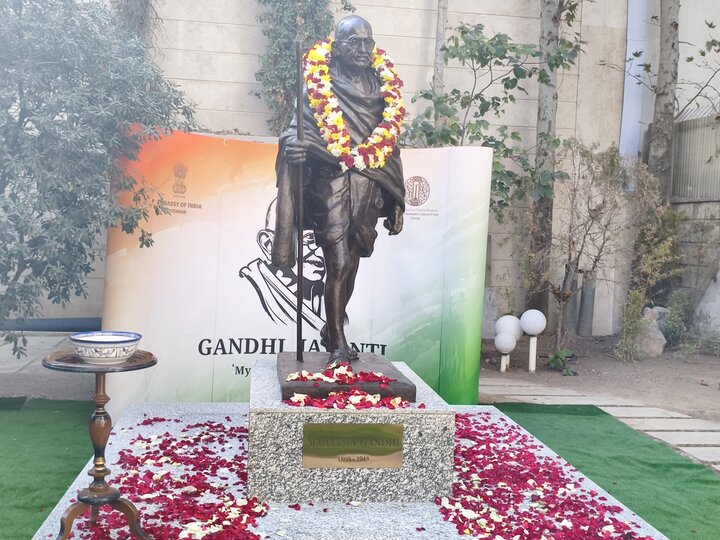
TEHRAN – The Indian Embassy in Tehran hosted a commemorative ceremony on Friday to mark the 157th birth anniversary of Mahatma Gandhi. The event, held at the Indian Embassy’s Cultural Center, was attended by Ambassador Vishwesh Negi, prominent Iranian cultural and municipal figures, media representatives, and embassy staff.
The proceedings began with the unveiling of a statue of Mahatma Gandhi on the grounds of the Cultural Center. Following the unveiling, Ambassador Negi and distinguished guests paid tribute to the iconic leader with floral offerings.
Mohandas Karamchand Gandhi(Mahatma Gandhi), born on October 2, 1869, remains one of the 20th century’s most influential figures. His philosophy of Satyagraha (truth-force) and Ahimsa (non-violence) played a pivotal role in India’s struggle for independence from British colonial rule. His efforts were not merely political but deeply ethical, emphasizing the power of mass civil resistance, self-discipline, and the moral authority of the oppressed. October 2 is observed globally as the United Nations International Day of Non-Violence, serving as a testament to the universal relevance of his teachings.
During the ceremony, Iranian cultural and municipal figures reflected on the enduring legacy of Gandhi, highlighting his contribution to global peace through his peaceful struggle against tyranny.
Taking the podium, India’s ambassador underscored the global significance of Gandhi’s legacy.
“We gather today to remember Mahatma Gandhi — the Father of the Nation — on his 157th birth anniversary. October 2 is not only a national holiday in India. It is also observed worldwide as the United Nations International Day of Non-Violence. That dual meaning is the heart of this day: a tribute to one man, and a reminder of a method that still speaks to a divided world,” Negi said, pointing to Gandhi’s leading role in India’s freedom struggle through “non-violence, self-discipline, and mass civil resistance.”
Ambassador Negi further elaborated on the virtue of sacrifice, illustrating it with a meaningful anecdote.
“A poor woman once gave Gandhi a single copper coin — all she had. Rich donors gave thousands. Gandhi kept the copper coin separately and said it was more valuable because it represented total sacrifice. He often used this story to remind people that the size of the gift matters less than what it costs the giver. For Mahatma Gandhi, the spirit of service and sacrifice was the key to leadership. For the spirit of service to materialize we must lay stress on our responsibilities and duties and not on rights,” the ambassador noted.

In the contemporary context, Gandhi’s principles continue to shape India’s global outlook under the leadership of Prime Minister Narendra Modi. The current Indian government frequently references Gandhian ideals as the bedrock of its diplomatic policy, advocating for strategic autonomy and mediation in global conflicts.
Underscoring how this legacy continues to guide India’s principled call for peace, dialogue, and diplomacy in a troubled world, Ambassador Negi stated: “Our Hon’ble Prime Minister’s message to the world that ‘today’s era is not an era of war’ reflects India’s enduring commitment to this Gandhian ethos, the conviction that differences must ultimately be addressed through dialogue and diplomacy, and that peace must remain humanity’s shared objective.”
Against this backdrop, the ambassador highlighted the deep civilizational bonds between India and Iran—two ancient nations whose shared values of peace, dialogue, and cultural exchange have endured across centuries. “And there is perhaps no more meaningful place than Iran to reflect upon the civilizational dimension of this message. India and Iran are heirs to two ancient civilizations whose paths have crossed for millennia. Our relationship has been enriched by language, literature, philosophy, art and the movement of people and ideas. Persian found a home in India, just as Indian stories and philosophical traditions travelled into the Persian-speaking world. Across centuries, our civilizations did more than encounter one another; they conversed with one another.”
Ambassador Negi also noted the special place Gandhi’s name holds in the Iranian capital, serving as a meaningful symbol of the enduring friendship between the two peoples. “The Gandhi Street, along with the Gandhi Hospital and other institutions bearing his name, makes Gandhi a familiar presence in this city. For an Indian walking through Tehran and encountering the name of Mahatma Gandhi, it is a small but deeply meaningful reminder of the bonds of affection that connect our peoples.”
Reflecting on the significance of the statue that was unveiled at the start of the ceremony, Ambassador Negi observed: “And today, with the Mahatma Gandhi statue we have just unveiled, another symbol has been added to this enduring relationship. May it stand as a symbol of friendship between India and Iran, of two ancient civilizations that have conversed across centuries, and of our shared hope for a world where dialogue prevails over confrontation, compassion over hatred, understanding over prejudice, and peace over violence.”
The statue, now installed at the Indian Cultural Center, serves as a dedicated landmark for reflection on Gandhian philosophy. The enduring legacy of Gandhi also provides a common ground that reinforces the ongoing cultural and diplomatic dialogue between Iran and India.
Disclaimer : This story is auto aggregated by a computer programme and has not been created or edited by DOWNTHENEWS. Publisher: tehrantimes.com







