I came across a letter the other day, written by Charles Darwin during his trip to Australia. Sorry, that sounds like I found the letter in my desk drawer, rather than the more conventional place to find such a letter, which is halfway through the Oxford Book of Australian Letters. All the same, the letter excited me.
Here was one of the world’s greatest naturalists, on the verge of formulating his theory of evolution, and he’s describing how he and a friend “went with a gun in search of the Platypi and actually killed one”. Killing the platypus was a delightful experience: “I consider it a great feat, to be at the death of so wonderful an animal.” We are all a product of our time, I suppose, but here is Darwin, famous for upending humanity’s certainties, and he was still imprisoned by the conventional attitudes of his time. Killing animals was fun.
In every period, most people cling to the common attitudes of the age. I’ve spent the past year or two researching the history of Australian parenting for a new book, out this week. In each period, nearly every “expert” marched to the same drum. They shamelessly copied each other’s ideas. They used the same phrases. The beliefs of each age become certainties by being endlessly repeated, usually on the basis of nothing at all.
And then, very occasionally, there was a person able to break free.
When writing about sex, for example, the guidebooks of the past always used euphemisms. The womb was “a wonderful room”, according to a Sydney parenting guide from 1913; the vagina, in 1941, was the “hallway of life”; while sex, according to a 1968 pamphlet from Australia’s Father and Son Welfare Movement, was “the means whereby a man and a woman can get together with God in His ongoing work of creation”.
Which, I must say, is what I’ve always called it.
Then, one day in the State Library of NSW, I stumbled into the company of a Sydney doctor with a wonderful name: Gertrude Buzzard Dunlop. Her 1928 guidebook lists the correct names for various anatomical features, including the clitoris which she describes as “the seat of erotic sensation”. In a book mainly about breastfeeding, weaning and childhood ailments, she says women should be more active participants when it comes to sex, with the aim of always achieving orgasm. Go, Gertrude!
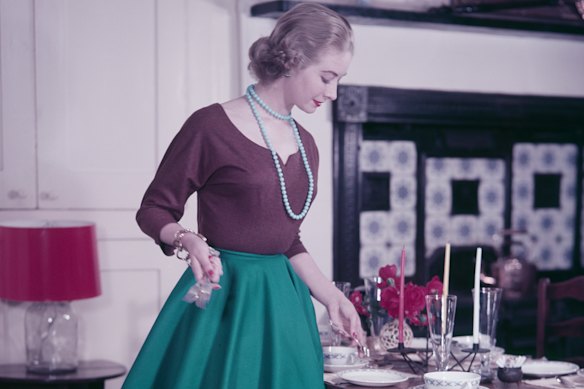
“Others blamed the decline in table manners on the practice of allowing one’s maid to supervise the children’s mealtimes.”
The early parenting experts also assumed every child lived in a middle-class home. If an example is given of a father’s workplace, it is “in the city” or “at the office”; never “in the factory”, or even “on the farm”. In the Catholic guidebook The Choice of a Husband, published in 1964, the father returns home each evening exhausted from a day spent with “professional contacts in a harsh and austere business world”. That’s why he needs his wife to be soft and loving as he walks in the door.
Sydney’s Muriel Danvers Power, in her 1913 guidebook Mother and Child, assumes the household has a cook and a maid, and at one point even mentions the “servant’s bell” and the need to hang onto staff. She also sounds a warning about the evil habit of “the solitary vice”, speculating that it often takes hold after the child has enjoyed “the sensation caused by sliding down bannisters” in one’s two-storey house, perhaps not a hobby available in every home.
Most writers assume there will be a separate bedroom for each child, and some insist on a playroom as well. “A playroom can be regarded as a necessity,” according to a 1932 booklet by Victoria’s Miss Mary Lush, proving yet again you can’t be an Australian parenting expert if you don’t have an eye-catching name. It’s also anticipated that every house will have running water, electricity and refrigeration, in an era before such things were commonplace. Meanwhile, others blamed the decline in table manners on the practice of allowing one’s maid to supervise the children’s mealtimes. Again, not a problem faced in every home.
Then, just as with Gertrude Buzzard Dunlop, there’s a thrill when you encounter someone willing to break ranks. Melbourne’s Vera Scantlebury Brown (again, the name!) had a nice house in Hawthorn with a maid and a nanny but also understood not everyone lived that way. In her 1947 guidebook for nurses, she gave various formulas for modifying cow’s milk when breastfeeding had proved impossible. She recommended adding lactose, derived from milk, but noted that cane sugar is not so bad – and “has the advantage of cheapness where this factor must be considered”. She also gave details of how to construct a Coolgardie safe – a low-tech way of keeping milk cold in households that lacked electricity. She could imagine the life led by others, a feat of empathy managed by so few of her fellow writers and officials.
Whether you are reading a letter from Charles Darwin or a parenting guide from a century ago, you are often left to wonder about the certainties of our own time – and whether you are one of those rare people who find a way to march to a different drum.
How to Ruin a Child by Richard Glover is out now.
Need more Richard Glover in your life? Read these:
From our partners
Disclaimer : This story is auto aggregated by a computer programme and has not been created or edited by DOWNTHENEWS. Publisher: www.smh.com.au