
For a city built around lakes, Bengaluru has spent years trying to answer: how do you bring a lake back?
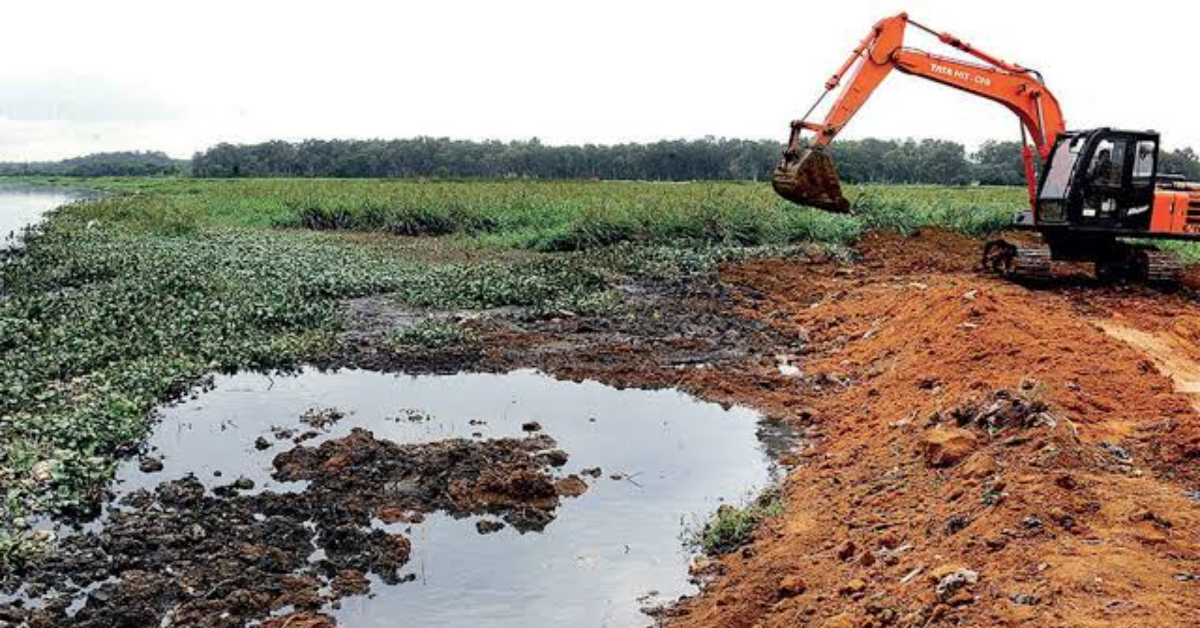
The answer usually lies with the physical things that are easiest to see: remove the silt, repair the bund, clear the weeds, fix the feeder channel, and make the edges accessible.
Now, Karnataka is preparing to do this at scale.
The state has drawn up a Rs 150-crore plan to rejuvenate 500 lakes across seven water-stressed districts, PTI reported on 22 September 2026. Of these, 135 are in Bengaluru Urban and Bengaluru Rural.
The proposed works include desilting, strengthening and raising bunds, repairing canals and feeder channels, and beautification. The project is planned with World Bank assistance.
The 500 lakes are spread across Bengaluru Rural (68), Bengaluru Urban (67), Bidar (44), Chikkaballapur (90), Kalaburagi (49), Tumakuru (96) and Kolar (86).
But Bengaluru’s experience with its restored lakes suggests that bringing back water is only one part of bringing back a lake.
So, what should a healthy urban lake actually look like?
There are at least three tests.
The first test: What enters the lake?
Stand beside a Bengaluru lake, and the first thing to ask is: what is flowing into it?
Historically, Bengaluru’s lakes formed a connected cascade. Water moved from one tank to another across the city’s natural terrain. The World Bank’s 2025 technical assessment of the Karnataka Water Security and Resilience Programme describes the remaining lake network as having the potential to help the city manage both floods and droughts.
But that function depends on the quality and quantity of water entering the system.
Sewage is one of the biggest complications.
⚠️ North Bengaluru: Historical Doddagubbi Lake is overflowing after a massive 138.5 mm hit the area!
Horamavu – 99 mm
Jakkur – 83 mm
Yelahanka – 78 mm🌊 Waterlogging is severe at Kannuru Junction, heavily stalling traffic heading toward Bagaluru Road and Hennur.… pic.twitter.com/qmylvQfyYN
— Naveen Reddy (@navin_ankampali) October 1, 2026
A 2026 study published in Frontiers in Water examined eight urban lakes in Bengaluru and looked at different ways of dealing with wastewater entering them. The researchers found that diversion channels could improve water quality within a lake by keeping wastewater out. But there was a catch: the pollution does not disappear because it has been diverted.
Wastewater can be pushed downstream, potentially affecting fisheries, groundwater recharge and flood regulation.
The researchers therefore identified effective wastewater treatment as the preferred solution, while also pointing to constructed wetlands and other local interventions that can support biodiversity and ecosystem services.
This matters for the 135 Bengaluru lakes on the revival list because a lake can be desilted and its bund repaired, yet remain under pressure if sewage continues to enter it.
So the first sign of a healthy lake is not simply that it has water. It is that the water coming into it is being managed.
The second test: What happens inside the water?
A lake can look different after restoration without becoming ecologically healthy.
The shoreline may be cleaner. But what is happening beneath the surface?
Researchers at the Indian Institute of Science have assessed Bengaluru’s lakes using parameters including dissolved oxygen, biochemical oxygen demand, chemical oxygen demand, nutrients and temperature, alongside biological indicators.
In one assessment of restored lakes, the researchers found that only Jakkur, Devasandra 1, Ullal and Handrahalli recorded good water quality under their Water Quality Index assessment. Several other restored lakes remained in poor or very poor categories, with continuing sewage inputs identified as one of the problems.
This points to a distinction that is easy to lose when lake restoration becomes a civil-engineering exercise.
Restoration is not the same as construction.
IISc researchers have cautioned against approaches centred on what they describe as a “cement bowl”, where natural vegetation and wetlands around the lake are removed in favour of hard surfaces.
That vegetation is not merely decoration.
Riparian plants can absorb nutrients and provide breeding and feeding habitat for birds, insects and other organisms. Wetlands can also play a role in filtering water before it reaches the main lake.
Which brings us to the next big question: if the lake has been restored, what has returned to it?
The third test: What comes back?
A healthy lake should support life.
That makes birds, insects, aquatic organisms and native vegetation more than pleasant additions to the landscape. They can provide clues about what is happening inside the ecosystem.
IISc researchers studying Bengaluru’s wetlands have examined biological communities including diatoms, molluscs, aquatic insects, butterflies and birds alongside water-quality parameters. Their work has shown associations between water quality and the organisms found in these wetlands, with pollution-tolerant species more likely to persist in heavily contaminated waters.
Recent rains washed plastic into #DoddakallsandraLake—a recurring issue across #Bengaluru lakes. This breaks down into #Microplastics, polluting lakes & threatening groundwater.@RLR_BTM Sir, request you to direct @karnatakakspcb to act against lake pollution in #Bengaluru. https://t.co/Rtik0auezCpic.twitter.com/4gG9xP4FQN
— LakeEcosystem (@EcosystemLake) September 19, 2026
There are also examples where restoration has been accompanied by measurable ecological changes.
At Venkateshpura Lake, ATREE’s restoration work combined water-quality monitoring with native vegetation, floating islands, habitat creation, and aeration. ATREE reported that average dissolved oxygen increased from 1.74 mg/L to more than 5 mg/L after submersible aerators were deployed.
The lake also recorded the return of species including the Pied Kingfisher and Oriental Darter, along with butterflies and amphibians.
The return of a fish-eating bird such as the Pied Kingfisher can indicate that the lake is supporting the food chain the bird depends on. In other words, the lake is beginning to function as an ecosystem rather than simply holding water.
So, what does “healthy” mean?
A healthy urban lake should have cleaner inflows, functioning feeder channels, adequate dissolved oxygen, functioning wetlands and native vegetation, aquatic and terrestrial biodiversity, and a connection with the wider water system.
It should be able to store water, slow runoff, support groundwater recharge and provide habitat.
That does not make desilting, bund repairs or channel restoration unimportant. These can be necessary parts of lake management.
But research from Bengaluru suggests they are only part of the job. The real test will come when the rains return.
Sources
‘K’taka govt to rejuvenate 500 lakes at Rs 150 crore: Minister Khandre’: By PTI, Published on 22 September 2026
‘Ashoka Trust for Research in Ecology and the Environment (ATREE)’: Annual report 2024-25
‘Efficacy Of Rejuvenation Of Lakes In Bengaluru, India’: By Ramachandra T.V A, Sincy Va, Asulabha K.S, Published On 18 July 2020
‘Evaluating the effectiveness of inlet-focused interventions on the water quality and ecosystem services of urban lakes in the tropics’: By Sumita Bhattacharyya, Priyanka Jamwal, Laurence Carvalho, Published on
Disclaimer : This story is auto aggregated by a computer programme and has not been created or edited by DOWNTHENEWS. Publisher: thebetterindia.com




