
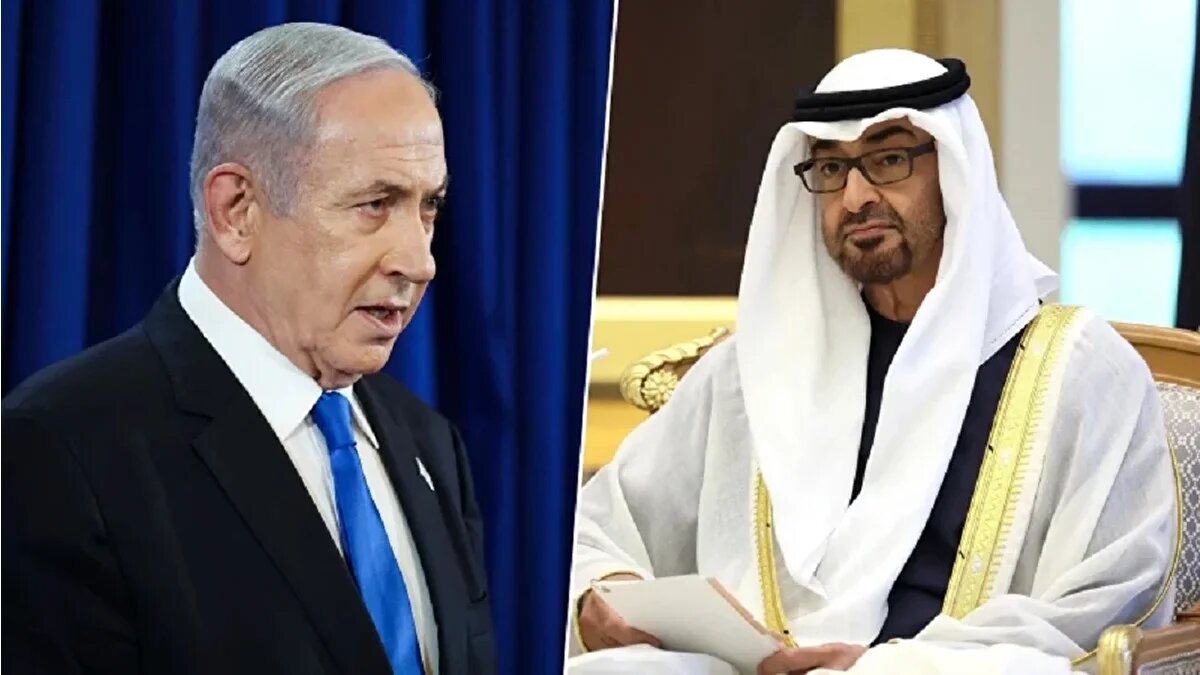
TEHRAN – Israeli media sought to explain Netanyahu’s surprise visit to Abu Dhabi as an effort to ease the tension between him and Mohammed bin Zayed.
Reports emerged last month that bin Zayed, the ruler of Abu Dhabi and President of the United Arab Emirates, had warned Benjamin Netanyahu that Hamas was preparing to launch the October 7 attack.
According to Israeli Channel 14, which is close to Netanyahu, representatives from several Arab countries, Saudi Arabia, Morocco, Libya, Jordan and the UAE, took part in the meeting hosted by Abu Dhabi on September 27. The channel reported that Israeli and U.S. representatives also attended the talks.
The Israeli channel reported that the meeting covered developments in Yemen, Iran, Lebanon, and the region as a whole.
Just hours after Netanyahu left Abu Dhabi, he held talks with Mohammed bin Zayed. The Emirati capital then witnessed extensive and important discussions between bin Zayed and Turkish Foreign Minister Hakan Fidan. Fidan later met with UAE Vice President Mansour bin Zayed and National Security Adviser Tahnoun bin Zayed.
This underscores the importance of the talks. They took place almost immediately after Netanyahu’s visit to Abu Dhabi. This is particularly significant because Turkey is part of the “Mecca alliance” that Saudi Arabia wants to target Yemen.
Fidan’s visit drew further attention after Mansour bin Zayed made a surprise visit to Riyadh. There, he met Crown Prince Mohammed bin Salman and his brother, Defense Minister Khalid bin Salman.
During the meeting, they discussed whether the UAE could join the Mecca alliance after repairing its relations with Riyadh. Relations between Saudi Arabia and the UAE had worsened over the situation in Yemen. Earlier this year, the UAE ended its military intervention in Yemen after Saudi Arabia intervened directly. UAE-backed forces were defeated and forced to withdraw from southern areas in humiliation.
Although Hebrew media sought to portray Netanyahu’s surprise visit to Abu Dhabi as an attempt to repair relations with Mohammed bin Zayed, the participation of representatives from other countries, Hakan Fidan’s visit to Abu Dhabi, Mansour bin Zayed’s visit to Riyadh, and Tahnoun bin Zayed’s visit to Muscat point to a different picture.
These developments strongly indicate that Tel Aviv and Washington are planning a new scenario for the region. They are doing so in coordination and cooperation with the countries mentioned above, especially the UAE, which hosted all of these trips.
As it has long been a hub for what critics describe as suspicious activities in the region, Abu Dhabi has carried out these efforts with the Zionist regime’s support. Representatives of the participating countries also met with the Israeli prime minister. It was reported that Netanyahu issued guidelines to those taking part in the Abu Dhabi meeting. He is also said to have sent guidelines to Turkey through the Emirati leaders who met with Hakan Fidan.
Reports suggest that Turkish-Israeli relations could improve in the near future. The two sides have experienced periods of tension, partly because of clashes between Netanyahu and Turkish President Erdogan. Their interests also conflict over Syria, Lebanon, and the region as a whole.
Many are aware of Turkey’s role and influence in Libya. It was reported that Libyan military officer Saddam Haftar attended the Abu Dhabi meeting. Somalia was also part of the discussions. The Zionist regime has expanded its presence in the breakaway region of Somaliland, which declared independence from Somalia with the support of Tel Aviv, Washington, and the UAE.
According to Ethiopian military chief Birhanu Jula, the three parties also support Ethiopia in its war against the Tigray People’s Liberation Front, which is backed by Egypt and Sudan.
All this is happening while Ethiopia, backed by the UAE, continues its efforts to destabilize neighboring Eritrea and overthrow President Isaias Afwerki. Afwerki is supported by Egypt and Saudi Arabia. It has been reported that he recently established close relations with Russia, China, and Yemen’s Ansarallah. Western intelligence reports have also referred to Yemeni activity in Somalia and Djibouti. These countries border the Red Sea, as do Saudi Arabia, Egypt, and Sudan. Egypt and Sudan are also facing tensions with Ethiopia over the dams it is building on the Nile with Israeli encouragement.
The UAE, together with its strategic ally the Zionist regime, also supports the Rapid Support Forces in their war against the Sudanese army. The Sudanese army is backed by Egypt and Saudi Arabia. Recently, and particularly following the Zionist-American aggression against Iran, Saudi Arabia has gained political, military, and psychological advantages over Abu Dhabi.
At the same time, with Washington’s backing, Netanyahu is seeking to reconcile Mohammed bin Salman and Mohammed bin Zayed. He wants both rulers to serve Zionist-American plans and projects in the region.
This is particularly important following the American withdrawal from Iraq and the developments it is expected to trigger in Iraq and the northern Kurdish region. Mohammed bin Zayed has complex personal and political ties with the Barzani family. The family, in turn, has close personal connections with Syria’s President Ahmed al-Sharaa. Nechirvan Barzani met al-Sharaa in Damascus on August 3.
Meanwhile, there continues to be talk of possible new tensions in Lebanon and Iraq under the slogan of “bringing all weapons under state control.” This comes despite disagreements among the countries of the region, particularly the Persian Gulf states, over what they see as the UAE’s dangerous and provocative role across the region.
This was also the case when Qatar faced threats of invasion from Saudi Arabia, the UAE, and Bahrain in June 2017, with support from Egypt and Sudan. Doha appealed to President Erdogan, who sent Turkish troops to protect the Al Thani family. Sheikh Tamim gave him his private jet as a gift, just as he later gave President Trump a similar aircraft, perhaps in recognition of America’s role in protecting Qatar through the military bases located there, Al Sailiya and Al Udeid. Yet neither base took action against the Israeli attack on Doha on September 9 last year.
None of these developments, however, necessarily mean that Abu Dhabi will achieve everything it seeks. This was also the case before, during, and after the Israeli-American aggression against Iran. Abu Dhabi has pursued these goals through its alliance with the Zionist regime and its allies in the East and West.
Experts argue that Israel views the UAE as a Trojan horse for creating problems for its neighbors, especially Egypt. They say the Israeli regime seeks to take revenge on Egypt by invoking religious and mythical claims. Netanyahu occasionally refers to these narratives when speaking about the “religious right” of Jews to Arab lands beyond Palestine.
These lands extend east of the Nile in Egypt and west of the Euphrates and Tigris in Iraq. They then extend through Lebanon and Syria as far as Damascus, which is mentioned 67 times in the Torah. They ultimately include Mecca and Medina.
Regional experts caution those who do not want to understand, recognize, and remain aware of the ultimate objective of the Zionist project. Observers say that the rulers of the UAE have consistently served this project since Britain granted them independence on December 1, 1971. Since then, the region has witnessed one catastrophe after another. Critics accuse Abu Dhabi of consistently playing a very broad, devious, and dangerous role.
Disclaimer : This story is auto aggregated by a computer programme and has not been created or edited by DOWNTHENEWS. Publisher: tehrantimes.com




