Martin Evans, Victoria Ward and Tom Parry
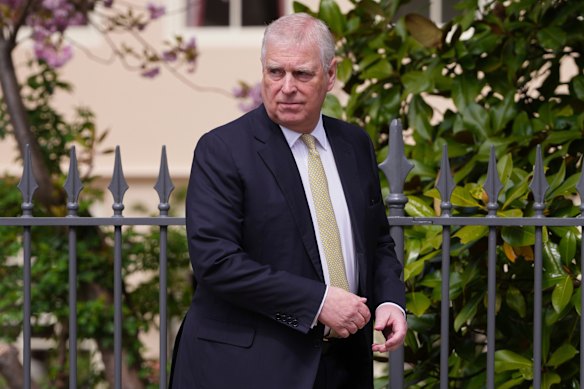
Andrew Mountbatten-Windsor has launched legal action against Thames Valley Police over his arrest in relation to the Epstein files.
The former Duke of York, who was detained in a blaze of publicity eight months ago, has asked a judge to determine whether the force’s action towards him was lawful, according to British masthead The Telegraph.
He has lodged a judicial review in connection with the search warrants that allowed police to raid his home on the Sandringham Estate and his former residence at Royal Lodge in Windsor.
It is the first time a member of the Royal family has challenged the lawfulness of criminal proceedings against them since the trial of Charles I in 1649.
The former prince was arrested in February at Marsh Farm in Norfolk on his 66th birthday.
After being driven to Aylsham Police Station, about 40 miles away, he was questioned for almost 12 hours on suspicion of misconduct in public office, before eventually being released under investigation.
A photograph taken as he was driven away from the police station showed him looking shell-shocked and exhausted.
Detectives also spent days searching Marsh Farm and Royal Lodge, removing documents and other items as part of the investigation.
But it is understood that his legal team is keen to examine whether the search warrants – granted by an Old Bailey judge following an application from Thames Valley Police – were lawful.
Mr Mountbatten-Windsor asked for permission to judicially review the decision earlier this year, and his application was subsequently granted by a High Court judge.
The Telegraph reported that there is to be a private hearing at the High Court later this week to determine whether to release certain court documents relating to the judicial review.
Mr Mountbatten-Windsor’s arrest followed the publication of material in the Epstein files suggesting he may have shared sensitive information with the convicted sex offender Jeffrey Epstein when he was the UK’s trade envoy between 2001 and 2011.
It was alleged Mr Mountbatten-Windsor forwarded reports to Epstein about visits he made to Hong Kong, Singapore, Vietnam and China and allegedly sent him a confidential briefing note on investment opportunities in Afghanistan’s Helmand province.
He is being investigated on suspicion of misconduct in public office, a notoriously complex common law offence that covers public officials who abuse their power for some sort of advantage.
But there are claims the police investigation is in grave difficulty after the US department of justice refused to hand over the unredacted versions of the Epstein files.
A formal letter of request for access to the relevant material could take more than a year to respond to, with no guarantee the US authorities will comply.
Meanwhile, friends of Mr Mountbatten-Windsor have said he feels he is “living in limbo” as he waits for the long-running investigation to conclude.
The former duke has effectively been in exile at Sandringham since his arrest, and earlier this year was allegedly chased and harassed by a man wearing a balaclava, while out walking his dogs.
In May, Thames Valley Police announced the investigation would also look at allegations of sexual misconduct and appealed for anyone with information to come forward.
But this was interpreted by some as a sign of desperation by senior officers at the force, worried they had overplayed their hand by arresting the King’s younger brother.
He is the most senior member of the Royal family to be arrested in modern times – an unprecedented development for the House of Windsor.
One senior Metropolitan Police source has since expressed surprise at the arrest, questioning why Thames Valley Police did not simply invite him in for questioning under caution.
He told The Telegraph: “I am not sure if the Met had been leading this investigation they would have taken the same approach.”
Allies have long suspected the decision to arrest him at his own home, and on that particular date, was orchestrated to cause maximum humiliation.
Buckingham Palace has insisted the monarch did not receive any warning of the arrest. At the time, the King issued a written statement, saying “the law must take its course” and expressing his “deepest concern” about the allegations.
“What now follows is the full, fair and proper process by which this issue is investigated in the appropriate manner and by the appropriate authorities,” he said.
Since then, Mountbatten-Windsor is understood to have had no contact with the King, although his two other siblings, the Princess Royal and the Duke of Edinburgh, have been supportive.
Mr Mountbatten-Windsor alleged in his infamous Newsnight interview in 2019 that he last saw Epstein in early December 2010 to tell him he was breaking off their friendship.
However, emails released by the US department of justice showed that on Christmas Eve that year, he messaged Epstein and sent him a confidential briefing about investment opportunities in Afghanistan’s Helmand Province, where reconstruction was being funded by the UK government.
In October 2010, he had forwarded official reports of his visits to Singapore, Vietnam, Hong Kong and Shenzhen in China written by Amit Patel, his then special assistant. The reports were sent to Epstein by Mr Mountbatten-Windsor just five minutes after he had received them from Mr Patel.
It emerged that the Duke of York and Epstein planned to launch a business together in China, years after Epstein was convicted of a child sex offence and while Mr Mountbatten-Windsor was still a trade envoy.
Business discussions between the pair, which were conducted through a liaison called David Stern, apparently continued for more than five years after Epstein was released from prison.
Mr Stern, an aide to Mr Mountbatten-Windsor, first floated the business venture to Epstein in an email on July 24, 2010, when the paedophile was still under house arrest.
Mr Mountbatten-Windsor also appears to have shared an internal government memo about the Icelandic financial crisis with Jonathan Rowland, his close friend and the former chief executive of Banque Havilland, a bank that had bought assets from a failed Icelandic lender a year earlier.
It follows a separate high-profile court case earlier this year involving the Duke of Sussex, who sued the Daily Mail publisher Associated Newspapers over allegations of phone hacking.
A judge found against the Duke and his fellow claimants on all the allegations.
From our partners
Disclaimer : This story is auto aggregated by a computer programme and has not been created or edited by DOWNTHENEWS. Publisher: www.smh.com.au