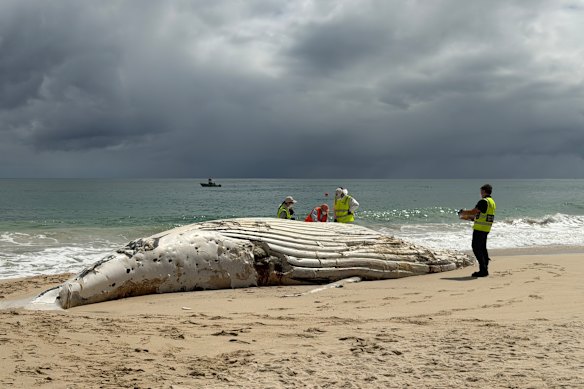

“Unusual” sample results have forced the closure of several popular Perth beaches after a whale carcass washed ashore at City Beach last week.
The whale was finally taken to Red Hill tip on Thursday, having washed ashore days earlier, drawing hungry sharks and curious onlookers to the busy metropolitan beach.
On Monday, the Town of Cambridge revealed all beaches in the local government’s boundaries would remain closed for another 24 hours after water samples taken at the end of last week revealed high levels of the bacteria E. coli at City Beach, City Beach North and Floreat Beach.
Officers returned to the beaches for further testing on Monday, before a Town of Cambridge spokesperson said the community was asked to not enter the water at any of the local government’s beaches, and to keep dogs out of the water as well.
“While the Town undertook water sampling as a precautionary measure, we did not expect the water sampling undertaken following removal of the whale carcass to return these unusual results,” the spokesperson said.
“Based on advice from the Department of Health, all Town of Cambridge beaches will remain closed to water activities until further testing confirms the water quality is satisfactory.”
E. coli bacteria is found in animals’ guts and is often harmless, however some strains can cause diarrhoea, vomiting and fever in humans. Symptoms often start between one and 10 days after exposure.
The tests revealing the E. coli levels were conducted on Friday.
The 31-tonne whale carcass washed ashore on Monday last week, but had been spotted floating in the waters off Perth’s coast in the days prior.
Its presence drew sharks to the coast, and a 3.7-metre great white was caught and tagged just hours after Fisheries officers deployed drum lines off the Floreat Groyne on Tuesday.
Heavy machinery was brought in to shift the carcass, which was taken to a tip over fears towing it out to sea could lead to it breaking up, washing back ashore and drawing even more sharks to the area.
The week’s events reignited debate over WA’s shark mitigation strategy, with retired Fisheries scientist Dr Jim Penn estimating there could be as many as 10,000 great white’s off the WA coast.
Penn said the state’s tagging program was “always a good thing to do”, but it was also expensive, and had already shown the population of sharks on the west coast was separate from those on the east coast.
“It’s useful information, and it should be done, [I’m] not suggesting it’s reduced, but a lot of it is needed to be able to get enough DNA samples to do a better estimate [of shark numbers],” he said.
Penn said there was an “increasing trend” in fatal shark attacks in WA.
“This year … the reason I came out of retirement, pretty much, to look at the shark data was the attacks earlier this year, and then one at Sorrento, near where I live,” he said.
“And I just find it appalling that that’s still happening.
“My first time in front of the TV cameras was when Ken Crew was killed at Cottesloe [in 2000], and I was down there having to say, ‘This is a terrible situation, but tough. You know, it’s a protected species, and we can’t even dispatch that shark’.
“I think what’s needed is a hard relook at this, and the numbers and the methodology, particularly looking to do it with an unbiased approach.”
From our partners
Disclaimer : This story is auto aggregated by a computer programme and has not been created or edited by DOWNTHENEWS. Publisher: www.smh.com.au