
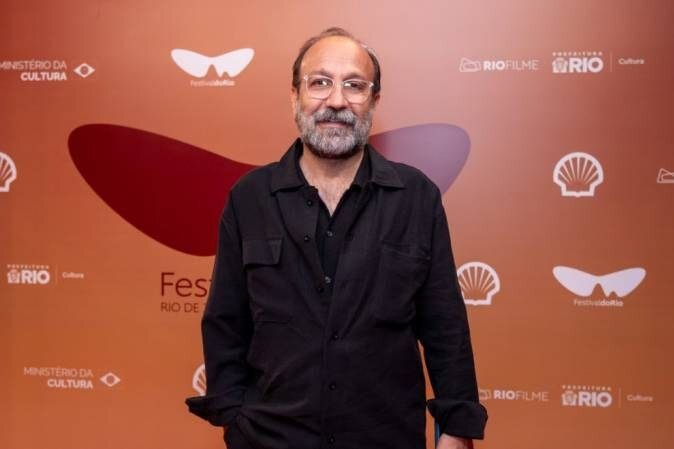
TEHRAN – Renowned Iranian filmmaker Asghar Farhadi discussed the perceived dominance of American cinema and cautioned against viewing Hollywood as a reliable source for authentic portrayals of foreign cultures.
Farhadi, who is in Brazil for the presentation of his latest film “Parallel Tales” at the Rio Film Festival, made the remarks during a panel, ISNA reported.
The two-time Oscar winner was asked about “Argo” winning Best Picture just a year after “A Separation” won Best International Film at the Oscars. “I watched the film at the time it came out and felt it was a ‘Hollywood thing’,” Farhadi said.
In “Argo,” loosely based on a true story, director Ben Affleck plays a Latino exfiltration specialist who masquerades as a Hollywood producer to rescue six Americans held captive in Tehran during the US hostage crisis in Iran.
“The problem with these kinds of films in Hollywood [and] some people in the United States [is that] they look at the world from up to down,” he added. “Someday you should ask them: Why do you feel you’re up and we’re down? I don’t understand why they have this ego that they’re up.” The Iranian director then said Americans often claim to “have democracy,” but they don’t. “You don’t have democracy. It’s a lie.”
Farhadi then recalled spending time in the US a few years ago when working on a project and, during research, travelling to San Francisco to speak with incarcerated men. “I met some people in prison who are Black, [some who come] from other countries, and the real America was there. But people in the world don’t see that part of the United States.”
“I have this problem when they feel they are up and they think, ‘[others] should be like us,’” he continued. “Even if it’s in a good way and they want to be kind to you, they wish ‘one day you’ll become like us,’ and no, I don’t want to.”
Still on “Argo,” the director said movies like that “are not deep.” “They make these movies for money; it’s a business. And in these films, it’s always a white guy from the United States saving others. My question is: Why? Why does an American go to Cuba or Iran to save people? People understand they can save themselves. Who asked you to come and save us?”
Asked about how he broaches politics in his films, the renowned filmmaker said that, whenever “you talk about society, you are talking about politics.” “Even when you talk about family life, their relationships, their difficulties and problems, indirectly you are talking about politics. In my films, I always try not to talk about politics directly because, to me, that is a bit far from cinema. The cinema that I believe is the kind of cinema that gives space to audiences to discover things about themselves.”
The director then brought up Abbas Kiarostami’s “Fellow Citizen” as Iran’s “most political film.” The 1983 documentary heavily trails drivers across the streets of the Iranian capital. “He made a documentary about car drivers in Tehran, but when you see people, the way they talk to the police, the layers are very political.”
“Media and cinema don’t give you a complete image of people’s ordinary life,” he added. “But the thing about empathy is that, all around the world, people are similar to each other. Cinema is based on hate and love. And [when it comes to] hate and love, everywhere is the same. A love between a mother and child in Brazil and in Tehran is the same. The way they express it is different, but the core is the same.”
Farhadi said that when he watches a Brazilian film, he soon forgets he is watching a story from another place in the world, and feels it is a “film about us” as people. “If one day people can travel to other countries, and if they shake hands, that’s the best way to know people, not through media. I don’t believe media can give us the whole image.”
On this, the filmmaker emphasized how his last two films, “A Hero” and “Parallel Tales,” are about how we see others and how we are seen in return. They are also heavily influenced by “how social media has shaped our lives.”
“When we see something in the media, we should be careful,” he continued, adding that most information replicated by mainstream media about Iran, for example, comes from “very simple knowledge” of real life in the country. When a singular discourse is perpetuated, the director implied, it means people are “ready to accept” when someone says “they are the enemy.” “This is something the media is doing, because the most powerful media belongs to powerful people. This is the problem.”
Farhadi spoke very briefly about his next film, reiterating it will be shot in Persian. Enquired as to whether the film might deal with the current war in Iran and the conflict in Palestine, the director said: “Not directly,” suggesting the current political climate might have an underlying effect on the story despite not being the subject of his project.
“The Salesman” helmer also recalled how “Parallel Tales” was supposed to be shot in the US: “I stayed there for three years, writing, searching, casting. I did casting in the US with American actors, very big names. But every day that I came back to my home, I told myself: I cannot connect with this. Something is wrong. It was a big problem. One night I decided to change.”
SS/SAB
Disclaimer : This story is auto aggregated by a computer programme and has not been created or edited by DOWNTHENEWS. Publisher: tehrantimes.com




