
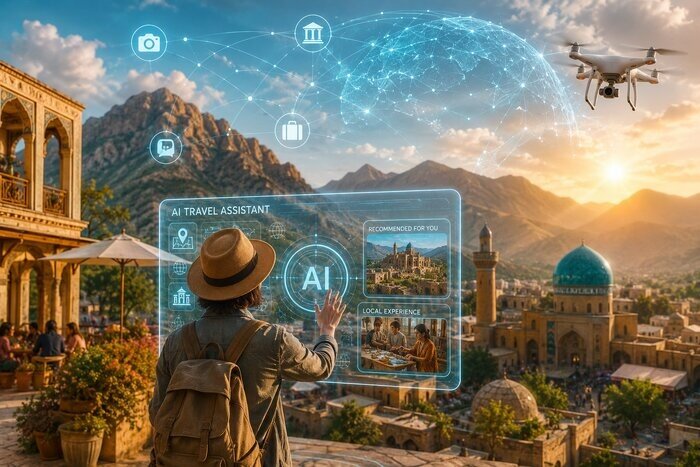
TEHRAN – Artificial intelligence is moving beyond digital tools and online services to reshape the structure of the tourism industry, influencing how travelers choose destinations, how experiences are designed and how destinations are managed, an Iranian researcher has said.
The theme of World Tourism Day 2026, “Digital Agenda and Artificial Intelligence (AI) to Redesign Tourism,” reflects a broader shift in the industry’s approach to technology, Habib Mahmoudi-Chenari told in an interview with Miras Aria news agency published on Wednesday.
Mahmoudi-Chenari said the emphasis on digital transformation, innovation, artificial intelligence, smart tourism, data governance, skills development and ethical technology use points to the need to rethink how tourism systems operate.
He distinguished tourism digitalization, which largely involves transferring traditional processes to online platforms, from tourism redesign, which questions whether existing structures should be rebuilt around new technological capabilities.
Online reservations, electronic payments, websites, mobile applications and digital marketing have helped digitize tourism services. However, artificial intelligence could influence the entire travel process, from inspiring a trip and selecting a destination to planning an itinerary, booking services and analyzing post-trip feedback, he said.
AI could influence destination choices
Artificial intelligence could become a major gateway through which travelers discover tourism products and destinations, Mahmoudi-Chenari said.
Rather than simply answering where to travel, intelligent systems can help travelers identify the experiences they want and match destinations with their interests, budgets, schedules and personal circumstances.
Such systems could recommend accommodation, transport routes, attractions, restaurants and activities based on individual preferences. Travelers interested in cultural heritage, nature, food, agricultural experiences or low-carbon travel could receive tailored itineraries, while families could account for children, older adults or dietary restrictions when planning their trips.
This shift could also affect destination visibility. While tourism promotion has traditionally relied on advertising, branding, location, travel agencies and search engines, a destination’s representation in digital data and AI-driven recommendation systems could increasingly influence whether potential visitors discover it.
Connected data essential for smart tourism
Mahmoudi-Chenari cautioned that smart tourism cannot be achieved simply by introducing mobile applications or chatbots.
Information on flights, accommodation, transportation, attractions, events, payments, destination capacity and tourist behavior must be connected and capable of being exchanged across systems, he said. Without such integration, even advanced AI systems may struggle to provide a comprehensive and reliable picture of the travel experience.
He also called for destinations to be redesigned around data-driven management rather than the mere presence of digital infrastructure.
By continuously collecting and analyzing information on visitor flows, attraction capacity, accommodation availability, traffic, water and energy consumption, weather conditions and demand patterns, destination managers could anticipate congestion and resource pressures before they escalate.
Such systems could also help distribute visitors across lesser-known areas, manage pressure on popular attractions and reduce tourism’s impact on natural resources and infrastructure.
Data governance and digital inclusion
The researcher said artificial intelligence offers opportunities to improve productivity, personalize services, expand market access for small businesses and support more effective destination management. However, its benefits will depend on how the technology is governed and deployed.
If data and digital infrastructure are controlled primarily by a small number of major platforms, he warned, market power could become more concentrated. Algorithms that repeatedly recommend established destinations could also make it harder for emerging or lesser-known places to gain visibility.
Small rural destinations, family farms, guesthouses and local producers may offer distinctive tourism experiences but remain largely invisible online if they lack digital content, usable data and marketing skills, he said.
Addressing this imbalance requires investment in digital infrastructure, training, data security, common standards and fair access to technology. Tourism workers, local communities, small businesses and emerging destinations should also have a role in shaping the industry’s digital future.
Keeping technology human-centered
Mahmoudi-Chenari stressed that tourism redesign should not aim to replace people with machines. Instead, technology should strengthen human capabilities, improve service quality and support the resilience and sustainability of destinations.
He described a smart destination as one that continuously collects data, converts it into information, analyzes the findings, uses them to inform decisions and evaluates the results.
Artificial intelligence can serve as a powerful analytical and decision-support tool in this process, he said, but sustainable transformation requires high-quality data, appropriate infrastructure, shared standards, data security and skilled personnel.
Ultimately, he added, tourism redesign extends beyond technology to encompass economic, social, human, environmental and governance considerations.
AM
Disclaimer : This story is auto aggregated by a computer programme and has not been created or edited by DOWNTHENEWS. Publisher: tehrantimes.com




