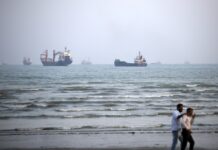
TEHRAN — The US president insists the Strait of Hormuz is open. Tanker captains, charter markets, insurers, and motorists in the US tell a different story.
That gap — between what the White House announces and what actually moves through the world’s most critical energy chokepoint — is now the central front in the information war accompanying the seven-month conflict that began on February 28.
Trump has personally repeated the claim several times in recent weeks. At a White House energy briefing last month, he said the strait was “fully open, totally open” thanks to US naval power. Days later, in a campaign-style speech in Oklahoma, he again declared that “we opened Hormuz” and that oil was “flowing beautifully.” Last week, in remarks to reporters before departing for a fundraiser, he repeated that US forces had “kept Hormuz open” and that Iran could no longer “use the strait as blackmail.”
The formulation reached its peak when Trump at one point referred to the waterway as the “Trump Strait,” suggesting that US escort operations had effectively renamed and reclaimed it.
Maritime reality does not match the rhetoric.
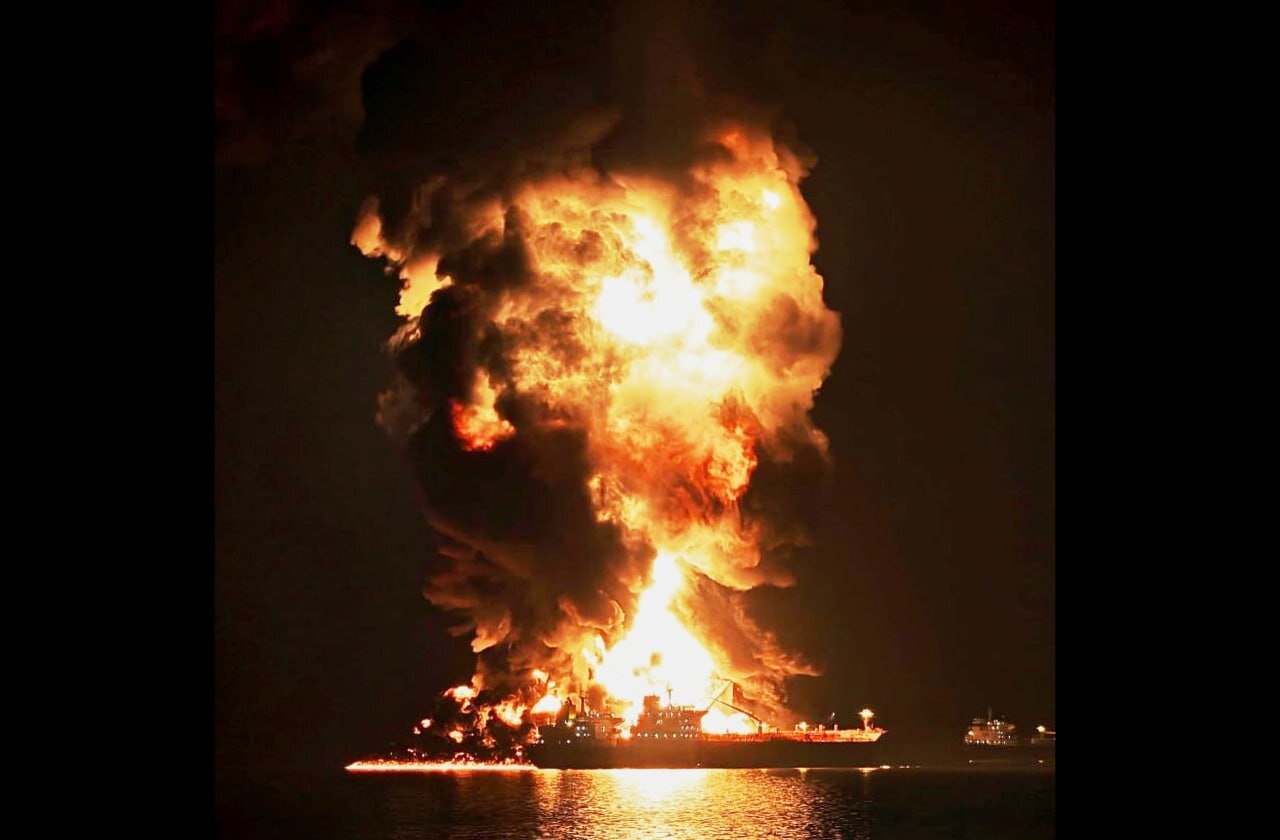
A recent Bloomberg account, based on testimony from a commercial captain transiting the area, described what “open” currently means in practice: a southbound passage attempted in darkness, under radio silence, without normal AIS transparency, and under direct US naval escort — procedures designed for a combat zone, not a commercial lane. Even under those conditions, the report noted, tankers have remained exposed to attack.
That is not a definition of normal traffic. That is the definition of a contested strait.
Charter markets confirm the assessment. Daily hire rates for large tankers operating in the Persian Gulf, which market sources previously placed at around $50,000 per day, are now cited at up to $1.3 million per day for high-risk voyages, once war-risk premiums, security costs, insurance surcharges, and crew bonuses are factored in. No functioning, open strait produces a 26-fold spike in the cost of using it.
Insurers have effectively redrawn the map. Most mainstream cover excludes the northern and central channels without special war-risk approval, forcing traffic into a narrow southern corridor that is congested, slow, and heavily militarized. Delays of days, last-minute voyage cancellations, and owners refusing Gulf orders have become routine.
The security incidents explain why. In recent weeks, at least three commercial vessels have been hit or narrowly missed while approaching or exiting the strait — including a VLCC struck by an unmanned system that forced an emergency diversion, a product tanker damaged by a proximity explosion that injured crew members, and an unarmed bulk carrier and tanker pair that came under fire in an incident the US described as defensive but regional media described as an attack on civilian shipping.
The pattern is consistent: even escorted, even silent, even in darkness, passage is not guaranteed.
The consequences are now visible inside the US itself.
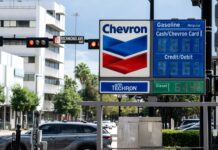
Diesel boards at some US gas stations have displayed $9.99 — not because the price is $9.99, but because legacy signage cannot display double digits. In California, the Midwest, and parts of the Southeast, diesel has in practice exceeded $10 per gallon, while regular gasoline has surged to levels not seen in US history. Trucking companies have warned of cascading food and logistics costs.
Trump has tried to contain the fallout with a familiar toolkit: emergency releases from strategic reserves, public pressure on refiners and retailers to cap margins, temporary waivers on fuel blends, and repeated promises — including a much-publicized pledge of $5,000 payments to voters — to offset the pain. So far, none has restored confidence.
Polling shows fuel prices and inflation are now the top concern for US voters ahead of the midterm elections. Within Trump’s own base, the seven-month war — sold initially as a days-long operation, or at most a four-to-six-week campaign — is increasingly described in US media as the most unpopular US military engagement in decades. Republican strategists openly warn that energy prices could cost the party Congress.
It is in this context that Iran has floated a seven-day plan for the full reopening of the strait: a phased, verifiable de-escalation involving a mutual ceasefire on commercial shipping, withdrawal of offensive strike assets from the immediate vicinity of the traffic separation scheme, joint monitoring through regional intermediaries, and a return to normal insurance and AIS operations within one week.
Tehran presents the initiative as proof that closure is a reversible, political decision — not a military fait accompli by the US. Washington has so far dismissed it as a stalling tactic, while continuing to insist the strait needs no reopening because it is already open.
That insistence is the point, analysts in Tehran argue. The conclusion emerging here is twofold:
First, by declaring Hormuz open and traffic normal, Trump seeks to calm US fuel markets psychologically even when he cannot calm them physically. If voters and traders believe the corridor functions, panic buying eases and prices may be contained at the margins.
Second, and more strategically, Washington wants to signal to Tehran that the Hormuz card is already burned — that Iran’s principal leverage has been neutralized by US naval power, and that Tehran therefore has no choice but to concede and accept US terms.
In other words, “open” is not a maritime description. It is a political operation.
But a strait where captains sail dark and silent, where charter rates rise from $50,000 to $1.3 million, where civilian ships are still hit under escort, and where US motorists stare at $9.99 signs that cannot tell the truth, is not open by any professional standard.
Trump may have opened his own strait. Hormuz remains closed.
Disclaimer : This story is auto aggregated by a computer programme and has not been created or edited by DOWNTHENEWS. Publisher: tehrantimes.com