GUNMA –
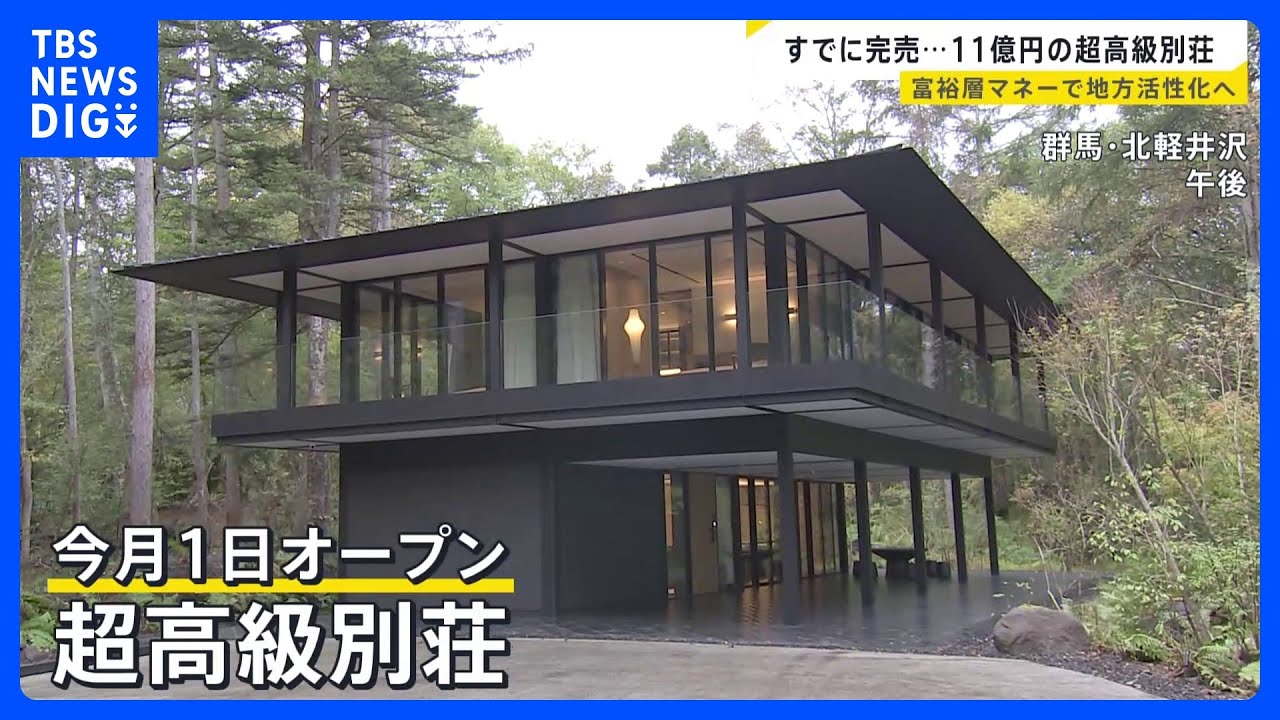
A newly opened luxury villa in Kitakaruizawa, Gunma Prefecture, has already sold out under a shared-ownership model that allows buyers to purchase annual stays rather than an entire property, highlighting a growing push to draw wealthy visitors and investment into regional Japan.
The property, which opened on October 1, sits in a forested area of Kitakaruizawa and features a spacious living room overlooking the surrounding woods, along with a hot spring bath, cold-water bath and sauna.
The villa was developed by NOT A HOTEL, which operates high-end accommodation properties across Japan. One of the company’s main features is a shared-villa system in which multiple owners hold rights to the same property.
Buying the entire Kitakaruizawa property would cost about 1.1 billion yen. Under the shared model, however, ownership covering 10 nights a year can be purchased from about 36 million yen, giving the buyer the right to stay for 10 nights annually over a 50-year period.
Despite opening only this month, the property has already sold out, according to the company, which said the response had given it confidence in demand for the model.
On October 5, the company announced a broader business strategy centered on raising the value of regional Japan by turning little-known areas into destinations through architecture and other forms of creative development.
NOT A HOTEL has developed shared villas at 10 locations nationwide and plans to expand beyond accommodation into areas including luxury services, mobility and community development.
The company says its strategy is to build striking architecture in places traditionally regarded as difficult tourism destinations, transforming them into locations that people from around the world will want to visit.
Regional expansion is becoming increasingly important as Japan’s population outside major metropolitan areas continues to shrink. Cabinet Office projections indicate that regional populations could fall by about 30% by 2060.
Companies see an opportunity to generate new demand by attracting affluent visitors whose spending can support local restaurants, retailers and service businesses, while also creating a new market for high-end travel and real estate.
One example is Aoshima in Miyazaki City, where NOT A HOTEL opened a property in 2022. Hotels, stores and other businesses have opened in the surrounding area in recent years, while the rate of land-price growth has risen to the highest level in Miyazaki Prefecture.
The company has also expanded to Sagishima, an island in Mihara, Hiroshima Prefecture, with a population of about 560 people.
The island can be reached only by boat, a characteristic that has often been viewed as a disadvantage for tourism. NOT A HOTEL instead sees the limited access as part of the destination’s appeal.
Ownership rights covering 30 nights a year at the Sagishima property were priced at about 400 million yen, yet those shares also sold out.
The project was actively encouraged by Mihara Mayor Yoshihiro Okada, who directly approached NOT A HOTEL President Shinji Hamauzu about expanding to the island.
Okada said turning Sagishima into a destination could encourage visitors not only to spend time on the island but also to travel to surrounding communities, spreading the economic benefits more widely.
The expected impact extends beyond accommodation.
At the Kitakaruizawa property, locally produced ingredients are used in meals served to guests. Vegetables are purchased directly from local farmers and prepared in different ways to give visitors a sense of the region’s food.
The development is also creating employment. The company said all part-time cleaning staff at the Kitakaruizawa property have been hired locally.
Efforts to attract visitors to regional areas are not limited to ultra-expensive shared villas.
SANU, which operates membership-based second homes across Japan, opened a villa-style accommodation facility on Amami Oshima in Kagoshima Prefecture in May.
Non-members can also stay at the property, with reservations available from about 30,000 yen per building per night. The company aims to create a place that visitors come to regard as a second home.
Experts say the shared-villa model reflects changing demand because buyers can enjoy access to a second home without taking on the full long-term burden of maintaining and eventually disposing of an entire property.
Traditional vacation homes can become difficult to maintain or sell as owners age, potentially turning into unwanted real estate for future generations.
For local communities, shared villas can bring a different benefit. Visitors staying in the properties spend money on food, shopping and activities, creating additional consumption that can support regional economies.
Source: TBS
Disclaimer : This story is auto aggregated by a computer programme and has not been created or edited by DOWNTHENEWS. Publisher: newsonjapan.com