
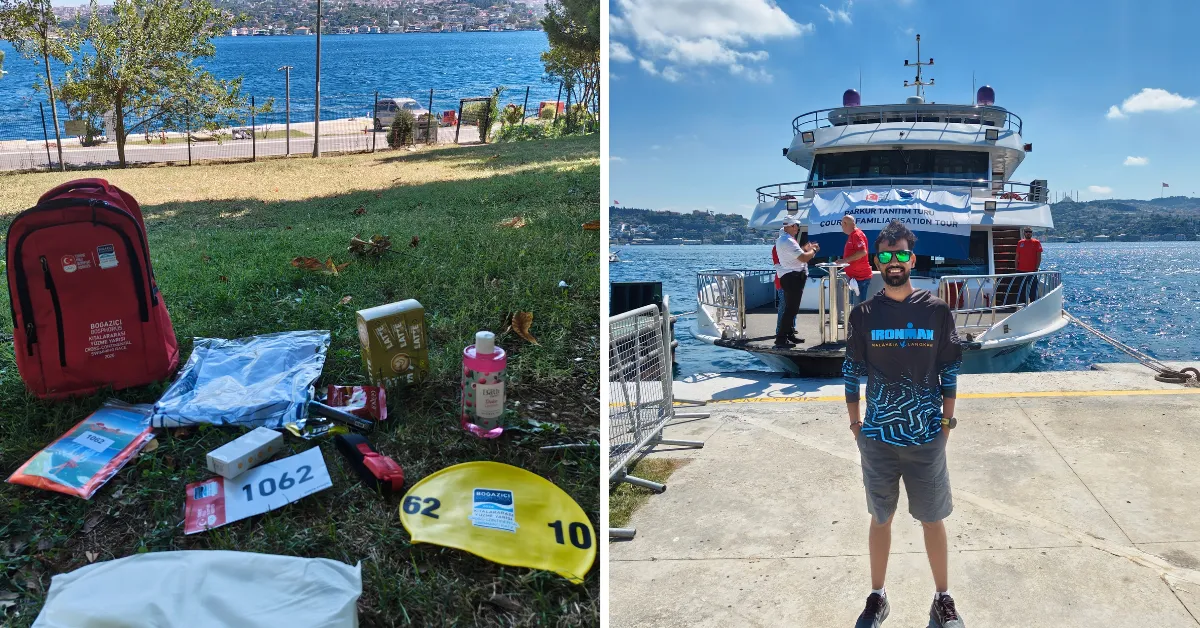
“I understood that if I can stay calm and keep moving, I can get through it.”
That thought came to Akshay Sharma during one of the hardest stretches of his latest endurance challenge.
On 23 August 2026, the 34-year-old senior cybersecurity engineer from Bengaluru was swimming across the Bosphorus in Istanbul, moving from the Asian side of the city towards Europe. Around him, open water, shifting currents, and waves could push a swimmer off course.
There were no smartwatches or GPS devices to guide him. The route was not marked out with navigation buoys. Outside the annual race, swimming in the Bosphorus is not permitted because it is a busy shipping route.
He had never trained in those waters before.
However, after 1 hour and 32 minutes, he reached the European side after completing the 6.5-kilometre Bosphorus Cross-Continental Swimming Race, finishing within the event’s two-hour cut-off.
For someone who had started running only in January 2023, the swim was another demanding chapter in a journey that has already taken him through an Ironman, high-altitude climbs and long-distance endurance training, all while continuing with a full-time career in IT and cybersecurity.
It started with running
His endurance journey was not something he had mapped out years in advance.
He initially took up running because he wanted to travel to Mount Everest Base Camp. At the time, even running one kilometre was difficult for him.
He began training on 1 January 2023 and set himself an easy target of running 10 kilometres in under an hour. By March, he had managed it.
That same year, he completed the Everest Base Camp trek. In April 2024, he climbed Lobuche East, a 6,119-metre peak in Nepal.
By then, running had expanded into cycling and swimming. He was no longer training for one particular event. He was learning what his body could handle.
In October 2024, he took on his first triathlon at Ironman 70.3 Goa. The race involved a 1.9-kilometre swim, 90-kilometre cycle and 21.1-kilometre run. He finished it in 7 hours, 30 minutes and 30 seconds.
A year later, he went much further.
On 1 November 2025, he completed the full Ironman in Langkawi, Malaysia. It involved a 3.8-kilometre swim, 180-kilometre cycle and a full 42.2-kilometre marathon.
He finished the race in 15 hours and 40 minutes, within the 17-hour cut-off.
The preparation for it had required him to fit long training sessions around his corporate job. He worked in IT and cybersecurity for more than 12 years, and his training had to happen before or after work.
The Ironman also changed the way he looked at endurance.
“Endurance is not something that you are born with. It is something that you build over time,” he tells The Better India. “You have to be consistent, and you have to be comfortable with discomfort.”
That experience became important when he decided to attempt the Bosphorus.
From Malaysia to Istanbul
The idea of swimming between two continents appealed to Akshay for a different reason.
He had already completed a full Ironman. This time, he wanted to see what he could do if swimming alone became the challenge.
The Bosphorus Cross-Continental Swimming Race takes swimmers from Asia to Europe across the strait in Istanbul. The annual event is the only time swimmers can legally take on the route, as the waterway normally carries heavy maritime traffic.
The endurance athlete reached Istanbul four days before the race. He could watch the water, but he could not get in and practise the route. That meant much of his preparation had to happen in Bengaluru.
He began specific training for the race towards the end of May 2026, giving himself about three months.
He generally swam three to four times a week, covering around 10 to 15 kilometres each week. His longest sessions could last about two and a half hours. On other days, he ran, cycled or did strength training.
Most of the swimming happened in a 50-metre pool in Bengaluru, particularly because of the monsoon and the difficulty of getting regular open-water practice.
“I had to rely on my previous open-water experience from the Ironman,” he says.
Unlike his Ironman preparation, there was no need to divide his attention between swimming, cycling and running. The Bosphorus required him to put most of his training time into swimming.
He also trained largely on his own.
/filters:format(webp)/english-betterindia/media/media_files/2026/10/05/akshay-sharma-bosphorus-swim-2026-10-05-08-28-39.png)
“I did not have a coach or a training group specifically for the Bosphorus. I watched a lot of videos and relied on my previous Ironman experience,” he says.
The morning of the race
On race morning, the excitement came with some nervousness. Swimmers from different countries gathered on the Asian side of Istanbul before being taken to the starting point.
Once the race began, he entered the water knowing that he had no GPS or smartwatch to tell him exactly where he was.
He had to read the water and maintain his tempo.
The Bosphorus has currents that behave differently at different points. Near the shores, reverse currents can pull swimmers in the opposite direction, while the main current moves from the Black Sea towards the Sea of Marmara.
For the athlete, managing those currents was one of the most difficult parts of the swim. At one point, a wave and current pushed him roughly five feet backwards.
Instead of trying to fight directly against it, he moved away from the reverse current and continued swimming.
There were also moments when he questioned what he was doing.
He thought about the mountains he had already climbed. He remembered Lobuche Peak. He remembered the full Ironman in Malaysia. Those experiences reminded him that he had already been through periods when continuing had appeared difficult.
The difference was that this time he was alone in the water, with no road markers, no course arrows, and no watch telling him how far he had left to go.
Keeping the pace steady
For a long swim, Akshay says, the biggest challenge is not only physical strength.
It is maintaining momentum.
He focused on his breathing and tried not to spend energy unnecessarily. Hydration was also important. During some of his earlier long swims, he had underestimated how much fluid he needed and experienced dizziness.
For the Bosphorus, he paid closer attention to hydration and carbohydrates during training and the race. The aim was to keep enough energy for the entire distance rather than push hard in the early stages.
Eventually, the European shore came into view.
After swimming for 1 hour and 32 minutes, he completed the 6.5-kilometre crossing.
His certificate recognised him as an intercontinental certified swimmer.
For the athlete, however, the importance of the swim was less about a certificate and more about what the challenge represented. He had travelled from Bengaluru to Istanbul alone because getting a Turkey visa for his family and friends was difficult. Usually, he has people close to him around during major events.
This time, he had to manage the trip, preparation, and race by himself.
A 5.30 am start before a 10-hour workday
The training behind the swim had to fit around his regular working life.
/filters:format(webp)/english-betterindia/media/media_files/2026/10/05/akshay-sharma-bosphorus-swim-2026-10-05-08-31-20.png)
On a typical training day, he wakes at around 5.30 am. After eating and getting ready, he leaves home at about 6.30 am for the swimming pool, which is around 10 kilometres away.
He arrives at roughly 7.15 am and can spend about two and a half hours swimming. On some days, he adds a run. He returns home around 11 am, has breakfast and starts work at about 1 pm.
His working day can continue until around 10 pm, after which he sleeps at approximately 10.30 or 11 pm.
He also goes to the office three times a week. The office is around 15 kilometres away, and the commute can take about an hour and a half each way. Finding time to train has therefore been less about having free time and more about fitting training into an already full schedule.
That is one reason he does not see endurance as something separate from his professional life. “Consistency beats intensity,” he says.
For him, one difficult day at work, one bad project, or one training session that does not go according to plan does not decide the outcome of the larger journey.
From training himself to training others
Akshay’s interest in endurance sports has also started influencing people around him. Some of his friends registered for the Goa Ironman after seeing what he had done. He says around five to seven friends are taking part in the event this year.
In May 2026, he also began training working professionals who wanted to take up endurance sports.
Over the past four months, he has trained eight people. They include people working as brand and sports CEOs, neurosurgeons, chartered accountants, an IAS officer, and IT professionals. He has also started building TriUrge, an endurance coaching initiative.
For him, the purpose is not restricted to training people for races. He wants more working professionals in India to make fitness part of their lives.
His own approach has always been to start before everything is perfectly planned.
“Do not wait until you feel ready. Your first step does not have to be perfect. Just take it, keep going, and stay consistent. That is what really makes a difference,” he advises.
What comes next
The Bosphorus swim is not the end of Akshay’s list.
His next major goal is Mount Everest.
He has already completed Everest Base Camp and climbed Lobuche East at 6,119 metres. After completing a full Ironman and crossing the Bosphorus, he now wants to attempt the summit of Everest.
For now, though, the pattern remains the same.
He works in cybersecurity. He wakes before sunrise to train. He swims, runs, cycles, and strength trains around a demanding work schedule. Then he sets another physical challenge for himself.
/filters:format(webp)/english-betterindia/media/media_files/2026/10/05/akshay-sharma-bosphorus-swim-2026-10-05-08-33-44.png)
He describes his achievements as personal experiments, ways of finding out what he is capable of rather than a list of things to collect.
That is perhaps why the Bosphorus mattered to him.
The swim was only 6.5 kilometres. But those kilometres took him from one continent to another, through unfamiliar currents and without the equipment he normally uses to measure distance.
And when the water pushed him backwards, he kept going.
To read about his first Ironman, the challenges that shaped his endurance journey, and what motivated him to take on the race, read his earlier story here. And as he prepares for his next challenge, follow his journey on Instagram @athlete.akshay.
All pictures courtesy Akshay Sharma.
Disclaimer : This story is auto aggregated by a computer programme and has not been created or edited by DOWNTHENEWS. Publisher: thebetterindia.com




