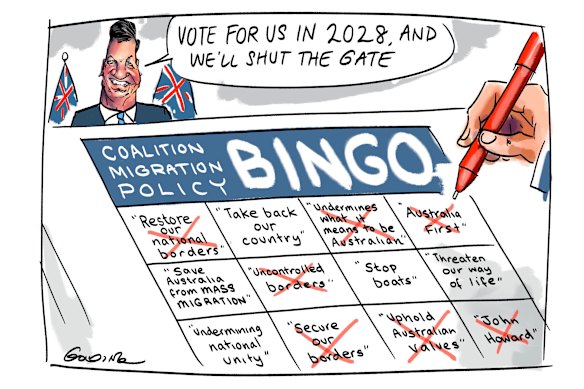
What nonsense (“Coalition plans for huge migration cut”, October6). Taylor and Hanson and co are wasting time trying to outbid each other for the biggest cut in migration when what Australia needs is well-thought-out plans to increase our economy and improve productivity. This ridiculous numbers game steals the oxygen from any debate about important issues. Bill Clinton’s memorable words years ago that “It’s the economy, stupid” are what we should be demanding these politicians focus on. It’s time to grow up before we sink into an even worse political outcome where a rabble influences policy. Ian Ferrier, Long Jetty
” loading=”eager” src=”https://static.ffx.io/images/$zoom_0.265%2C$multiply_0.7725%2C$ratio_1.5%2C$width_756%2C$x_36%2C$y_0/t_crop_custom/q_86%2Cf_auto/16dff7dc843752c3e45a263bfa1c2efb5f3b59ee” srcset=”https://static.ffx.io/images/$zoom_0.265%2C$multiply_0.7725%2C$ratio_1.5%2C$width_756%2C$x_36%2C$y_0/t_crop_custom/q_86%2Cf_auto/16dff7dc843752c3e45a263bfa1c2efb5f3b59ee, https://static.ffx.io/images/$zoom_0.265%2C$multiply_1.545%2C$ratio_1.5%2C$width_756%2C$x_36%2C$y_0/t_crop_custom/q_62%2Cf_auto/16dff7dc843752c3e45a263bfa1c2efb5f3b59ee 2x” class=”sc-d34e428-1 ldCIuB”>
It is an oxymoron for the Coalition to call for driving migration down as low as possible without damaging the economy. It’s a fallacy. Economic prosperity and the standards of living are directly related to the level of immigration, and if the numbers are slashed as the Coalition wants, it effectively is saying that previous governments of both stripes were foolish to have increased immigration. The strange policy of number of housing built with the immigration numbers is just logistically impossible to implement. Once shadow minister Jonno Duniam was trying to work with the government to neutralise the One Nation attack but unfortunately, both major parties couldn’t come to agreement. A race to the bottom on immigration is not a smart policy. If you want to be taken seriously, come up with a policy to increase productivity – not a one-liner about reducing the red tape, but the real implementation of a policy with a timeline. Mukul Desai, Hunters Hill
It seems the political parties are in a race to the bottom in espousing racist and xenophobic mantras. The frightening thing is that voting Australians appear to be lapping it up. Jonathan Hornibrook, Newtown
It seems the Liberal Party in an attempt to remain relevant is following One Nation into the abyss. I realise that there is widespread dissatisfaction with the cost of living and the economy. However, the entire planet is struggling under the same conditions as a result of Trump’s disastrous war on Iran. None of this is the fault of immigrants, and to blame them for the current state of the economy is a blatant lie – the same lie that was perpetrated in the 1930s by a European country with disastrous consequences for the group blamed and vilified. Barrington Salter, Elanora (Qld)
Angus Taylor’s final attempt to out-Pauline Pauline in his migration policy will lead, inevitably, to his replacement by Andrew Hastie as people value original and strong voices, while devaluing copies and mimics.
Rowan Godwin, Rozelle
It is very disappointing the Albanese government and the opposition are reacting to One Nation in cutting back visas for backpackers and international students. These groups have brought major benefits to the Australian economy and are only a minor factor in the housing shortage. Tony Simons, Balmain
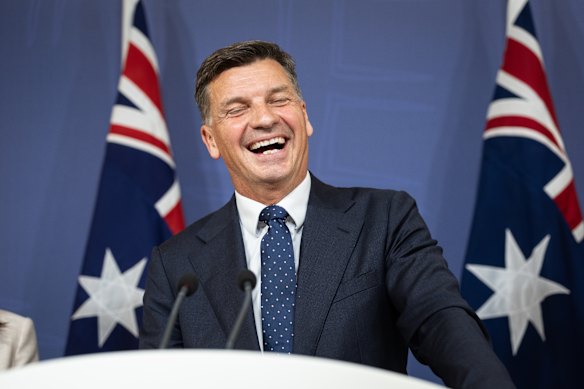
The Coalition is surely joking about cutting migration to 100,000 per year? Why shoot Australia’s economy in the foot just as we are entering a period of time anticipated to be a recession? Our economy has only grown over recent decades because of immigration. Philip Dowle, Wickham
Shoebridge nonsense
The Greens, under new leader David Shoebridge, are demonstrating yet again why they will not become a major political party (“Greens ‘shameful’ over Ukraine war aid”, October 6). His opposition to Australia providing military assistance to Ukraine is the latest walk in the proverbial fairy garden. Ukraine is a democracy defending itself against invasion by a ruthless authoritarian neighbour attempting to reverse history. What exactly do the Greens expect it to defend itself with? It appears they have learned nothing from the fate of former leader Adam Bandt, whose prioritisation of a range of progressive causes diluted the party’s central climate change focus. It resulted in the loss of his lower house seat and that of two others. Perhaps David Shoebridge’s energies would be better directed towards the conspicuous absence of major countries from the pre-COP climate meeting in Fiji and paying more attention to the German Greens Party, which has pressed the German government to increase its military support for Ukraine. Salvatore Sorbello, Campsie
Disastrous design change
Philip Vivian (“Town Hall Square is a legacy for future generations”, October 6) missed the point entirely. The question is not whether there should be a square; it’s about the lacklustre design – an unmitigated disaster – currently proposed for Town Hall Square. A previous axial design composed of a high parasol shade along the southern edge and trees bordering Park Street on axis, symmetrical with Town Hall, was admirable and met user requirements. Council needs to explain the change in design from excellent to bad. Philip Drew, Annandale
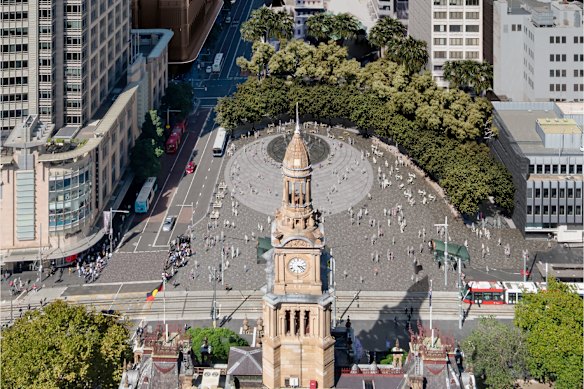
Philip Vivian makes a persuasive prosecution of the case for Town Hall Square, however imperfect it may be. The problem is not the design per se, it’s the politics of the prevalent powers. Public space is, by its nature, common space where all citizens may gather and enjoy it. An urban space, as the great urbanist and my mentor, Professor Jan Gehl, would remind us (I’m paraphrasing here) is to be a place for casual social communing, quiet reflection and a busy marketplace, as well as a place for celebration, and, when times and events demand, a place for protest. Could the proposal for Sydney’s town square attract political criticism and backlash because it provides a much greater central arena for its citizens to gather for protest? Could the backlash of what is essentially a wonderful city-making project be a political backlash to the politics of our troubled times? Cleveland Rose, Dee Why
Integrity unaffordable
The next time Chris Minns and Paul Scully say a proposed development will be subject to full consultation with the public before being approved, remember this headline: “Paddington luxury project approved despite objections” (October 6). And the next time they boast about how many affordable homes they are creating, remember that this development will see more than 27 existing relatively affordable homes replaced with 44 luxury dwellings, only 11 of which will be “affordable”, meaning they will be offered at a small discount on market rent, and then only for 15 years. Ross Duncan, Potts Point
Economy highs and lows
I am looking forward to a graph demonstrating the relationship over time between our “voracious” consumption of recreational drugs and falling productivity (“Underworld ‘weaponising’ AI tech to help bring in drugs”, October 6). Over to you, Alan Kohler. Dorin Suciu, Eleebana
Village vulnerable
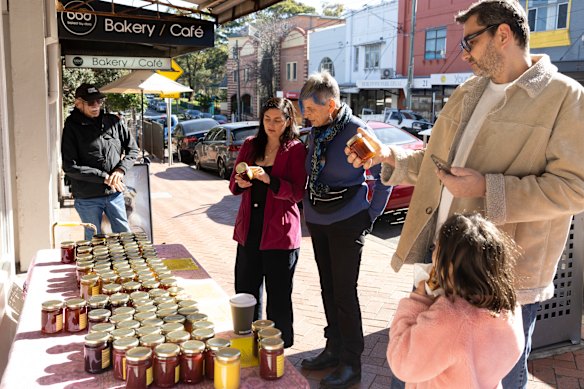
I share the love of the secret oasis that is Hurlstone Park (“HP is still defying the urban sprawl”, October 6). I call it my little Brigadoon, the famed mythical Scottish village that remained unchanged by the onslaught of “progress”. That Gaelic connection is further enhanced by street names such as Duntroon, Kilbride and Dunstaffenage and, like Brigadoon, HP seemingly doesn’t exist – there is no postcode other than a codeshare with Canterbury, but that invisibility doesn’t worry the inhabitants. We need to keep this special village safe in the hope that, unlike Brigadoon, it doesn’t disappear into the mists of time. Janet Argall, Hurlstone Park
AI is just like any other religion
Peter Hartcher writes (“AI is God to some but not the Pope”, October 6) that the Pope’s moral clarity leaves AI, for all its usefulness, exposed as “a new mindset of extraction” conducted in “the idolatry of profit”. In response, I give you the Vatican, cathedrals, churches and a massive real-estate portfolio that the Catholic Church has amassed by duping and gouging a trusting citizenry. For thousands of years, various gods and their prophets have been invented by humans to suit their own ambitions. AI worship is just as valid as any of these and just as irrational. Dave Watts, Avalon
The fact that some people worship the output of a Large Language Model says more about religion than AI. Neville Turbit, Russell Lea
A few days ago I sent a letter to the Herald, which wasn’t published, saying, “As I see it, the major threat we face from AI is the possibility that it creates a new fundamentalist religion.” Allow me to feel vindicated. John Boddington, Dalton
AI is the looming phenomenon that the Israeli military historian and science writer Yuval Noah Harari has called “the end of human history”. Data centres, job losses and the like are critical matters but rising above this is the fact that what it means to be human is under threat. We must not go down without a fight. Brian Haisman, Winmalee
With all the discussion of AI benefits, who is planning for and calculating the social and financial cost of resultant job losses? How will people earn a living? Who will bear the cost of redundancies, continuing income and social needs for those discarded? What chance of those profiting – the global tech billionaires and their companies – accepting this cost when they refuse to pay taxes or respond to the laws of countries where they operate? Walking blindly into this new world is not intelligent, much less super-intelligent; it is a complete abdication of the social contract. Jennifer Katauskas, Turramurra
There is much debate on nuisance emails, unwelcome adverts, scams and excessive screen time of children. Compounding is a shrinking revenue source for the government to deliver essential services, for example, power and water for data centres. Apply a duty, say 1 cent, on every email sent, and 10 cents for every hour of internet logged in. Especially charge international users, the source of many scams. Provide a facility of replied paid emails for those organisations that genuinely value our feedback. How can it work? Ask artificial intelligence. John Woodward, Ashfield
Rag trade truths
Your correspondent is wrong in asserting that “nobody gave a rat’s” about the mostly female workers when Paul Keating deregulated the textile, clothing and footwear (TCF) industries (Letters, October 6). The government introduced extensive retraining programs for the affected workers, many of whom had limited English language skills. The program was administered by the then Commonwealth Employment Service (CES) and delivered by not-for-profit organisations such as TAFE and the Adult Multicultural Education Services (AMES). In the lead-up to a workplace closure, CES officers would visit the site and provide workers with information about training and employment opportunities. While the effectiveness of those programs may be open to debate, it is simply untrue to say the workers were ignored. That said, it is hard to see a program such as this having any chance of success in today’s fractured and dollar-driven employment and training environment. Malcolm McCallum, Dulwich Hill
E-bike vigilante
As an avid 68-year-old e-biker (Letters, October 6), I see myself as a sexagenarian vigilante keeping an eye on younger, reckless riders. I’m all for fining those who purchased the bike, in the event of an accident or antisocial behaviour. Mine was a gift from my son. Peter Snowden, Orange
Surcharge repercussions
In all the coverage of card surcharges (Letters, October 6), one aspect has not been canvassed – the increasing need for cash and the decreasing number of ATMs. All banks seem to have removed the majority of these machines. Will they now reverse their decision and have them reinstalled as a necessary service? At the same time, all four big banks have closed many of their branches, which has further exacerbated the situation. It seems that the banks view their customers as an unwanted intrusion into their profit-making ambitions and once again it is the customer who is the loser. Alan Plumb, Milsons Point
I have always paid cash for my coffee and other purchases to avoid the card surcharge. Now, with surcharges banned, certain cafes are recovering those transaction costs elsewhere. A policy intended to make payments fairer risks doing the opposite: disguising the cost of card transactions in higher prices for everyone — another well-intentioned rule that leaves the cash customer paying the price. Vivien Clark-Ferraino, Duckmaloi
Honestly, what was the point of banning card charges? Did the government think someone was going to give up the $1.6 billion at stake? No one understands the new rules. Why they’re so complicated is anyone’s guess. All that’s happened, it appears, is gouging by vendors as a form of “cost coverage”. It seems we – the consumer – might have been better off with the card surcharges in the first place. How ridiculous. Ted Bush, North Epping
There is no shortage of cafes in Sydney. If your correspondents are annoyed that their regular coffee has increased in price, they should go to the next cafe. Samantha Chung, Kensington
Book of knowledge
I thought I was the only person in the world who still had Arthur Mee’s Children’s Encyclopaedia (Letters, October 6). My father bought ours in about 1958 at the Newcastle Show and I spent hours on our lounge-room floor with volumes scattered around me. I learnt heaps of odd information such as English wildflowers and Isambard Brunel. I also still have a 4th-class book prize. Judy Burge, Kelso
- To submit a letter to the Sydney Morning Herald, email letters@smh.com.au. Click here for tips on how to submit letters.
- The Opinion newsletter is a weekly wrap of views that will challenge, champion and inform. Sign up here.
Disclaimer : This story is auto aggregated by a computer programme and has not been created or edited by DOWNTHENEWS. Publisher: www.smh.com.au