NEWYou can now listen to Fox News articles!
FIRST ON FOX: Researchers at the University of Wisconsin-Madison overlapped on work with China’s powerful police ministry developing vehicle technology capable of tracking cars and overtaking driving functions, according to findings from a report shared exclusively with Fox News Digital ahead of its release.
Beijing has already begun deploying the systems across China.
The technology, known as “vehicle-road-cloud” integration, links cars with roadside cameras and sensors and centralized cloud platforms, allowing authorities to monitor traffic in real time and, at its most advanced levels, send commands to connected vehicles.
The implications of connected vehicles have alarmed U.S. officials.
The Commerce Department moved last year to restrict certain Chinese and Russian connected-vehicle technology in the United States, warning that foreign adversaries could potentially collect sensitive information about American drivers or remotely manipulate their cars.
An outside view of Bascom Hall on the campus of the University of Wisconsin on October 12, 2013, in Madison, Wisconsin. (2013 Getty Images)
HARVARD, NYU AMONG 30 UNIVERSITIES HIT WITH PENTAGON FOREIGN-TIE AUDIT DEADLINE
In 2016, then-UW Vice Provost Jeffrey Russell traveled to Southeast University, where the schools signed agreements covering research, faculty exchanges, student training and plans to create a joint institute. The following year, Southeast University’s president traveled to Madison to formally establish the Joint Research Institute, according to university records cited by Strategy Risks.
The institute focused on intelligent transportation, connected and autonomous vehicles and vehicle-road-cloud technology. UW-Madison’s own College of Engineering wrote in 2019 that the institute had “launched in late 2017.”
Two years later, UW researchers appeared on technical work that also involved an institute of China’s Ministry of Public Security.
Five UW-Madison researchers were among 46 contributors to a Chinese industry report on vehicle-road cooperative automated driving, according to Strategy Risks. The UW-SEU joint institute was listed first among the report’s drafting units, while the Traffic Management Research Institute of China’s Ministry of Public Security was listed seventh.
The extent of UW-Madison’s institutional involvement in the joint institute is disputed.
Counsel for a UW professor told Strategy Risks that the contemplated arrangement was never implemented and that the institute was never operational, funded or staffed by UW. Strategy Risks said it has not independently resolved that dispute, pointing to public records from both universities describing the institute as established.
UW-Madison did not immediately respond to Fox News Digital’s request for comment.
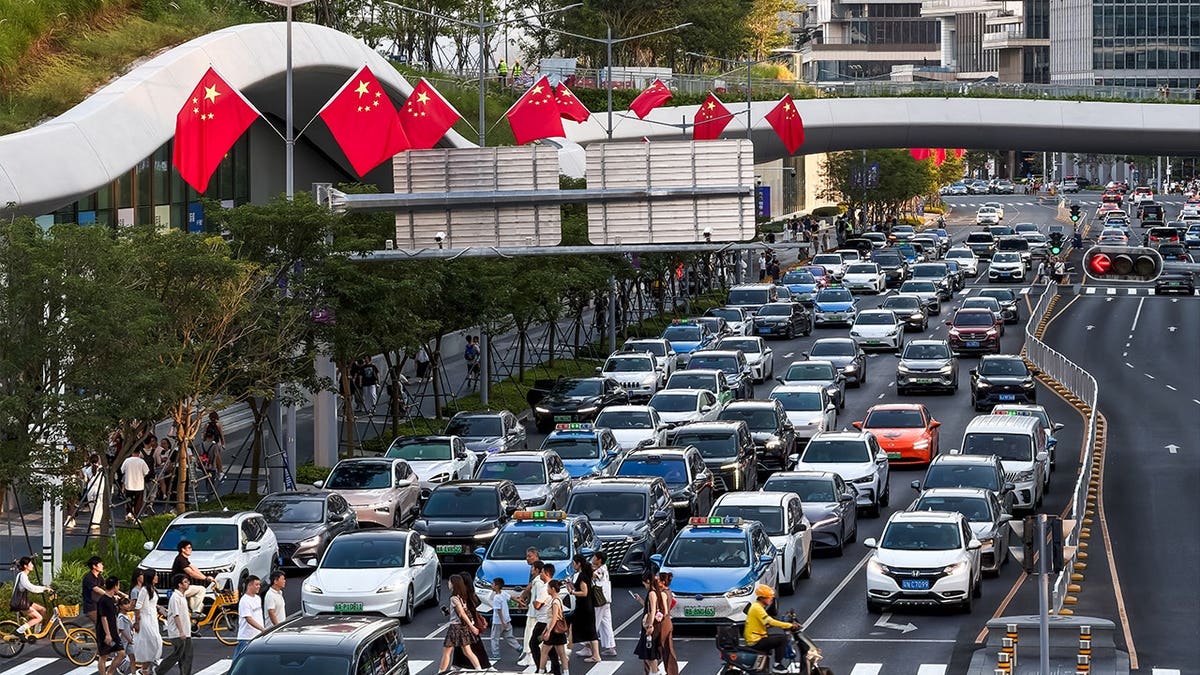
Pedestrians cross a road as vehicles wait at traffic lights along a street lined with Chinese national flags for National Day celebrations on October 4, 2026, in Shenzhen, Guangdong Province, China. (Cheng Xin/Getty Images)
Related vehicle-road-cloud technology was, meanwhile, becoming part of China’s national connected-vehicle push.
In 2023, three major Chinese transportation and communications standards bodies published a framework for vehicle-road-cloud integration. Southeast University was among the drafters alongside the Road Traffic Safety Research Center of China’s Ministry of Public Security.
The following year, the MPS joined four other Chinese ministries in launching a vehicle-road-cloud pilot program across 20 cities and regional groupings.
Under the government plan, participating cities are to install connected roadside equipment and sensing systems and build city-level cloud platforms capable of communicating with vehicles. The platforms can provide information to vehicles and assist with decision-making, planning and control, while safety-monitoring systems track participating vehicles in real time.
Chinese authorities describe the program as an effort to improve traffic safety, advance autonomous driving and accelerate the country’s connected-vehicle industry. But those same capabilities have raised security concerns in Washington, where officials have warned that connected-vehicle systems could be exploited to collect sensitive data or remotely manipulate vehicles.

Campus of the University of Wisconsin, Madison, Wisconsin. (Photo by: Robert Knopes/UCG/Universal Images Group via Getty Images)
Strategy Risks stressed that it is not accusing UW-Madison of intentionally transferring technology to China’s security apparatus.
“Strategy Risks does not allege that UW-Madison, either on its own or through the JRI, deliberately channeled U.S. technology into Chinese surveillance or military systems,” the report states.
But the group argues the research nevertheless contributed to technology that later took on broader applications in China.
CLICK HERE TO DOWNLOAD THE FOX NEWS APP
“The available evidence indicates that research conducted by scholars affiliated with the JRI contributed to the development of a civilian-framed dual-use technology in technical areas that also received U.S. institutional and federal research support,” the report states.
“When Beijing incorporated this technology into national standards, the state absorbed a system that has significant surveillance, military, and human rights dimensions.”
Disclaimer : This story is auto aggregated by a computer programme and has not been created or edited by DOWNTHENEWS. Publisher: moxie.foxnews.com