
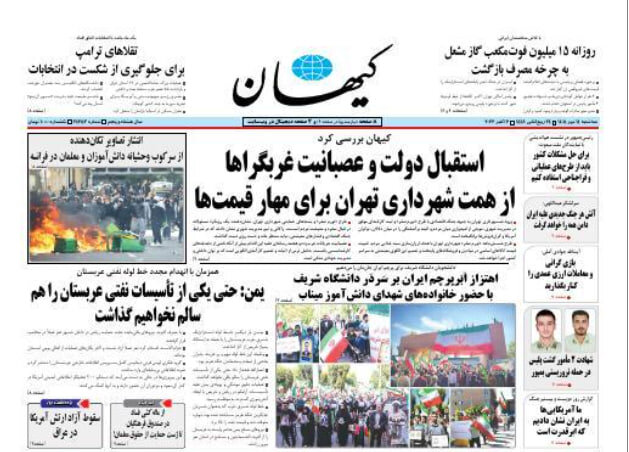
In an editorial, Kayhan discussed the reopening of channels for bypassing financial sanctions through Russia’s banking system. Iran’s Central Bank has so far transferred more than $1.5 billion of its funds through the Russian banking network, thereby utilizing the Russian route to circumvent US financial sanctions.
Available information indicates that, in addition to China, Russia’s banking infrastructure can be used to settle trade with countries such as India, Brazil, African nations, etc. However, despite the effect of sanctions and external pressure, exchange-rate increases cannot be explained solely by outside factors. Therefore, one of the government’s most important tasks under current conditions is to manage foreign pressure while simultaneously abandoning and revising its economic adjustment policies.
Shargh: Diplomacy backed by strength and readiness for defense
In its analysis of Araghchi’s meeting with foreign ambassadors, heads of diplomatic missions, and representatives of international organizations in Tehran, Shargh argued that Iran’s foreign minister sought to present a clear picture of Tehran’s evolving foreign policy. The central message was that the door to diplomacy remains open, but it is now supported by a stronger readiness for defense. The core message of Araghchi’s remarks is neither negotiation alone nor resistance alone, but rather the simultaneous pursuit of both. Viewed from this perspective, Araghchi’s recent statements can be seen as an effort to define Iran’s foreign policy at a stage when war, negotiations, the Strait of Hormuz, and regional relations have become more interconnected than ever.
Jam-e-Jam: It was the enemies, not Iran, that chose war
In a commentary, Jam-e-Jam highlighted Iran’s ethical outlook and its approach to international engagement. While Western governments accused the Islamic Republic of warmongering and alleged that Iran sought to eliminate certain regional countries and resolve disputes through military force, Iran consistently stated that it preferred understanding and negotiation in dealing with contentious foreign-policy issues, including the nuclear question. The newspaper pointed to numerous rounds of negotiations and serious dialogue with global powers and neighboring countries as evidence that Iran favors engagement over confrontation. In particular, over the past year and several months, Iran repeatedly demonstrated its willingness to negotiate on nuclear matters by accepting proposals for talks. Nevertheless, Iran’s adversaries chose the path of conflict and imposed two, or arguably three, wars on the country during the past 18 months. Iran’s ethical and humanitarian view of power was once again distinguished from what it characterized as the aggressive and inhumane approach of its opponents.
Khorasan: Iran is fully prepared
In an article examining current Iranian and American policies, Khorasan argued that Iran’s foes have entered a phase of “operational patience,” seeking to select the most effective and least costly option from among various scenarios. However, this patience stems not from caution but from weakness, and Trump knows that losing one or both chambers of Congress would significantly complicate his position. Military limitations continue to constrain any potential action by the US military. While Iran’s opponents may view the situation as static, realities on the ground remain dynamic and subject to change. Under these circumstances, it predicted that war could eventually begin. However, it emphasized that Iran remains committed to serious negotiations, though not in a manner that would imply surrender or deception. The article concluded that Iran is preparing for the worst-case scenarios, harbors no optimism regarding future developments, possesses a broad range of response options, and regards maintaining public calm as the most crucial element of national security.
Ettelaat: Escalating crisis in the region
Ettelaat discussed that indirect communication between Tehran and Washington is continuing, but even more significant are the military and political signs suggesting a growing possibility of a new conflict. According to the paper, Iran says it has received the US response to Tehran’s seven-day trust-building proposal concerning the reopening of the Strait of Hormuz and is currently reviewing it. At the same time, Washington is reinforcing its forces in the region and Donald Trump has spoken of a decision regarding Iran that could proceed through either an “easy path” or a “hard path.” Meanwhile, Iranian military and political officials have spoken of greater readiness for any future conflict and of improving missile capabilities. The newspaper noted that the principal disagreement between the two sides remains clear: Iran views the reopening of Hormuz, an end to pressure on shipping, and sanctions relief as the main pillars of negotiations, whereas the United States continues to place the nuclear issue at the center of its proposals. According to the article, this disagreement, combined with the growing US military posture in the region, has created a situation in which diplomacy has not entirely collapsed, yet discussions about the possibility of political pressures evolving into a new confrontation are becoming increasingly frequent.
Disclaimer : This story is auto aggregated by a computer programme and has not been created or edited by DOWNTHENEWS. Publisher: tehrantimes.com




