
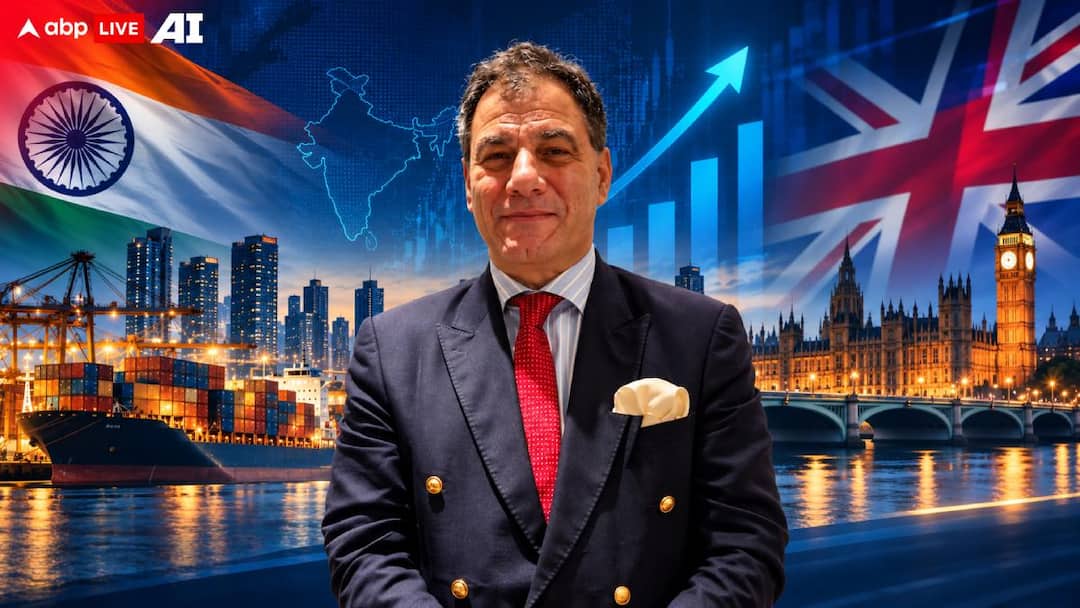
- India exhibits strong growth and resilience amidst global economic flux.
- Global instability and outdated UN demand institutional reform.
- India’s pro-business leadership and policies foster economic growth.
- India-UK FTA aims to double trade, strengthening bilateral ties.
India has shown what it takes to be “resilient in an age of flux”, with strong growth amid global economic upheavals, an inclusive agenda and business-centred leadership. To become a developed economy by 2047, it must continue to encourage investment and entrepreneurship, advises Lord Karan Bilimoria, Member of the UK House of Lords and Chair of the International Chamber of Commerce, in a conversation with ABP Live English on the sidelines of the Kautilya Economic Conclave.
Q: What are your key takeaways from the 5th Kautilya Economic Conclave amid the huge geopolitical disruptions?
Bilimoria: Last year’s theme was “thriving in an uncertain world”, or something like that, and this year it is “resilience in an age of flux”. So the uncertainty continues. In fact, it is compounding. In the geopolitical environment we live in, we are getting accustomed to black swan events, which are supposed to happen once in a while, happening all the time. This time last year, did we know that the Iran war would happen? That has changed everything. Before that, it was the tariff wars started by America. At every step, we are confronted by uncertainty across the board.
The Ukraine war is now four and a half years old. It needs to stop. India is constantly doing its best to keep the focus on that. I really value what Prime Minister Narendra Modi is doing, given his relationship with President Putin, to try to get that war stopped. It is not only in the interest of Russia and Ukraine that the war stops. It has affected all of us, from energy prices to supply chains and food supply.
Similarly, the situation in the Middle East began in February this year, and now it is October. The Strait of Hormuz is still not free, and there is now the Red Sea situation as well. The Suez Canal is a very important pinch point, and this has to be resolved. It is affecting not just the region but the whole world, not just in terms of oil and gas but also fertilisers, and we are talking about food shortages and starvation. We have to be wary of these situations. They are not only tragic but also affect the whole world.
Second, look at energy prices. India imports most of its supplies. We in the UK have some of our own oil and gas, but on the whole we import. So it affects everybody, from the cost of living to inflation. That is the geopolitical backdrop, which is the biggest challenge the world has to face. Linked to that is the reform of global institutions.
The United Nations, as it has shown in this situation, has not been effective at all. It needs wholesale reform. It is an institution set up after the Second World War, and the whole construct is outdated. The P5 is out of date. How can you have a five-member Security Council? Many of the allies of that time are not allies anymore. Each one has a veto, so you can just stop everything from happening. If that is the situation, where is the global community with the ability to act in such drastic scenarios? That is what the UN is for: to resolve situations like this.
ALSO READ: UPI MDR: RBI Governor Sanjay Malhotra Says Small Fee Unlikely To Hit Transaction Volumes
Q: What do you think of India taking a place in the UN Security Council?
Bilimoria: The whole Security Council needs to be restructured. India is now the fifth largest economy in the world, and it will soon be the third largest.
It has the largest population in the world, and it is not a permanent member. That does not make sense.
Q. Finance Minister Nirmala Sitharaman says India has come through this period of crisis with its fundamentals intact and strengthening. What is your view?
Bilimoria: India having just logged 7.8 per cent growth is phenomenal, making it the fastest growing major economy in the world. Think of that kind of growth amid all the geopolitical pressures and the rising price of fuel, which India depends on imports for. Prices have gone up amid conflicts around the world, starting with the Ukraine war and now the Iran situation. This is a challenge, and even then India has done so well. It will continue on this course as long as it keeps opening up its economy and unleashing the entrepreneurial spirit.
There is consumer growth supported by the facilities the Government has provided through the Aadhaar card, financial inclusion, digitisation and the most affordable mobile network in the world. India’s communication network is fantastic and inclusive, and everyone has access to it. These factors, combined with improving education at the school and university levels, including allowing foreign universities to open up in India, along with R&D and innovation partnerships, will make things better for India. I think the future for India is extremely bright on this trajectory.
The challenge for India is to become a fully developed economy by 2047. That is just 21 years away. Per capita income has to go up from USD 3,000 to USD 30,000 per year. It could take 10 years or 20 years, and it will happen if India continues on this path of liberalisation, opening up the economy, encouraging entrepreneurship and investment, remaining a stable, robust democracy that has never had military interference in politics, and staying the most diverse country in the world. These are its strengths. That is what will enable India to power ahead and achieve that dream.
Q: Do you think the ease of doing business has improved in India?
Bilimoria: Much indeed. I grew up before liberalisation, when this was a protected, insular, controlled economy where the consumer had no choice. This is a different world. The Indian consumer now has amazing choices, and Indian entrepreneurship has been unleashed. India is a country the world looks to, a country with phenomenal potential. It is a sea change, and it will continue to get much better.
It is a path India is on, and India needs to continue on it. That needs good leadership, which Prime Minister Narendra Modi and Finance Minister Nirmala Sitharaman have been showing. You have leadership that is pro-business, understands business, wants to work with business and listens to business. You will succeed.
Q: What is your view on trade, which is seeing global disruptions?
Bilimoria: Trade is very important. I am the Chair of the International Chamber of Commerce in the UK and regional coordinator for Europe. It is the biggest business organisation in the world, and we are the number one organisation in the world for trade. What must happen is that trade must continue to flow. Given everything we have spoken about today, any disruption to trade is a disruption to the global community.
We need a multilateral, rules-based trading system, and tariff wars do not benefit anybody. What we want more of are free trade agreements like the India-UK FTA, which came into force on 15 July. I have worked very hard on that since I was President of the Confederation of British Industry in January 2023, and it was concluded when I was Chair of the ICC. It can make a big difference to our two countries. It makes trade much easier.
Q: What are your expectations from the UK-India FTA?
Bilimoria: According to the latest figures, bilateral trade between the UK and India is around USD 65 billion in goods and services at the moment. I see that doubling to USD 100 billion in five years as a result of the FTA. It is not just tariffs coming down both ways. Most goods from India to the UK will be duty free, and a lot of goods from the UK to India will be duty free as well. Duties on high-tech items like cars, besides Scotch whisky, will come down significantly. That in itself will help a lot. It is also a very comprehensive FTA, covering innovation, movement of people and services. If businesses on both sides implement it, it will make a big difference.
As for the movement of professionals from India to the UK, the largest number of people who come in on the points-based system are Indians. There is no question about that. We do need a good quality Indian workforce, and they do come, whether in tech services or the National Health Service. The NHS would collapse without Indian doctors and nurses. We are very grateful for their expertise. They have been coming for years. The top tech companies are doing great work for British companies and the British Government. Companies like TCS and Infosys have big operations in the UK and have brought big benefits.
India also agreed to sign the FTA with the EU earlier this year. That is even bigger than the India-UK FTA because it covers 27 countries. For the EU, India is the ninth largest trading partner, whereas for India, the EU is the third largest. Similarly, for the UK, India is only the 11th largest trading partner. So the fastest growing major economy in the world is only the UK’s 11th largest partner. It should be one of the UK’s anchor trading partners. That is where the UK-India FTA will help, by doubling trade.
The same goes for the EU and India, which needs to move from ninth to a much bigger trading partner of the EU. I think that will happen as well. Total trade between the EU and India is USD 220 billion. That could be much higher.
ALSO READ: 8th Pay Commission Delay: How Much Arrears Could You Get For Rs 50,000 Basic Salary
Q: Going ahead, what is your outlook on India-UK relations?
Bilimoria: The only certainty in today’s world is uncertainty. In that backdrop, what you want is friends and partners you can trust and rely on, long-term partners.
The UK and India have that friendship, and that is what will give us resilience going forward, whether it is the FTA we have signed, the defence and security partnership, or our people-to-people links embedded in the 2 million people of Indian origin, the biggest ethnic minority population in the UK and the most successful minority in the UK, forming the living bridge between our two countries. We have a solid base to build on.
(Mukherjee is a contributing writer for ABP Live English. A business journalist for more than 15 years, she has written extensively on the economy, policy, and international relations in Indian newspapers and magazines)
Disclaimer : This story is auto aggregated by a computer programme and has not been created or edited by DOWNTHENEWS. Publisher: abplive.com




