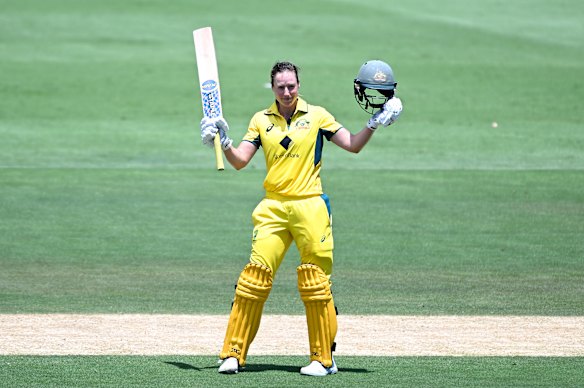

Australian cricket icon Ellyse Perry concedes there will come a time soon when she needs to think about life beyond the pitch, but she has refused to put a definitive timeline on when she will draw the curtain on her decorated career.
“I haven’t thought about it,” the 35-year-old declared in Brisbane.
“I still love waking up every day and having the opportunity to hopefully get better, to work with the teams and look forward to a new challenge. While that’s the case, I don’t really want to change my mindset.
“I’m incredibly grateful I’ve had this amount of time doing it. Nothing will last forever, but as long as that’s the case, I just want to make the absolute most of it.”
Speaking ahead of the three-game one-day series against Bangladesh – beginning on Friday at Allan Border Field – Perry was asked to reflect on a looming milestone that will occur during next year’s Ashes series in England.
The campaign, beginning in late June, will mark the star all-rounder’s 20th year as an international athlete – a tenure that began in July 2007 when she debuted for both the nation’s ODI side and the Matildas within two weeks.
“It’s been an incredible privilege to be part of such an amazing period of growth and development in women’s sport, and to have the opportunity when I was younger to play a few sports and have some amazing experiences around the world,” Perry said.
“To see over the last 20 years how much has changed in the landscape and the opportunities now for young girls and female athletes wanting to play their sport as a profession, and do that around the world, I just can’t believe that’s happened.”
Throughout Perry’s career, she has become one of the country’s most marketable faces – both for her exploits on the field and for the way she has become a role model to the next generation.
Endorsement, sponsorship and ambassador opportunities with adidas and Weet-Bix, among others, have followed, while her franchise cricket in India and England have all culminated in making her one of the world’s most lucrative female cricketers.
“Brands are looking to partner with an athlete who showcases authenticity, and authenticity is what drives brand responses from consumers,” marketing expert Dr Monica Chien said.
“Consumers want to see brands being authentic, and the way they show authenticity is to partner with someone they feel authentically brings certain values.
“She’s approachable, has the community connection, she’s relatable. That relatability and accessibility enhances the marketability in the eyes of stakeholders.”
While Chien stressed that Cathy Freeman’s impact at the 2000 Olympics could not be underestimated, Perry’s dual-sport exploits and how she captured audiences changed industry perceptions of how to source brand ambassadors.
Chien said what had changed was collective female sporting bodies were being given greater exposure opportunities due to the values they showcased while attracting stronger family audiences and positive brand associations. This proved appealing to businesses.
The University of Queensland associate professor anticipated that with more broadcast exposure, marketability would continue to rise as some sports fought to become professional.
“When Perry debuted for both the cricket and football, she was largely seen as an abnormal case or a success story. There was a novelty at that time when a female athlete succeeded in a male-dominated sporting culture, so she became an inspirational role model,” Chien said.
“Now, we’re looking at not just Perry or other athletes, but it’s the collective brand of women’s cricket or the Matildas that actually changed that marketability of women’s sport.
“Sponsors started to realise the value of women’s sport, which allowed them to access audiences that were difficult to reach through traditional media. What they are showcasing is not just sports excellence, but their social values, and it’s the social values that partially drive their marketability.”
The Matildas’ historic 2023 FIFA Women’s World Cup campaign further proved the marketability of women’s sport, when the semi-final clash with England generated the largest television audience in Australia (11.15 million viewers).
Those athletes have become household names, with the shock withdrawal of Mary Fowler – who boasts more than 500,000 Instagram followers and inked a lucrative partnership with adidas this year – from the squad to take on Germany and Haiti triggering extensive engagement.
“The interest being paid to female athletes and the sports they’re playing, the competitions they’re involved in, that’s because it is just genuinely such an entertaining product to watch,” Perry said.
“The way sports are now covered, there’s so much more critical analysis, where we get into the weeds of how female athletes are performing and the teams are going, and various competitions.
“There’s still so much upside in terms of the growth and development of that. Uniquely, I think it’s starting to present its own landscape; it doesn’t follow men’s sport as much as it probably used to.”
Start the day with a summary of the day’s most important and interesting stories, analysis and insights. Sign up for our Morning Edition newsletter.
From our partners
Disclaimer : This story is auto aggregated by a computer programme and has not been created or edited by DOWNTHENEWS. Publisher: www.smh.com.au