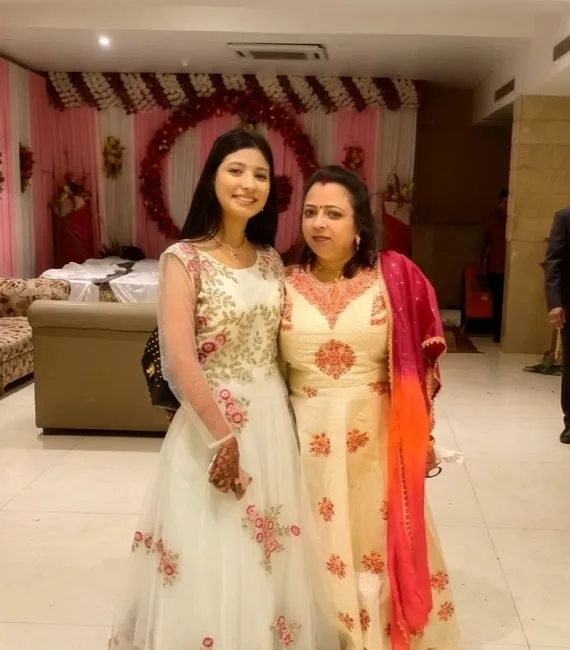
In a modest home in Kanpur, two women sit across from each other, their hands moving with practised ease. One carefully loops yarn into the shape of a rose, each stitch forming a petal that will never wilt. The other threads colour through paper, building a greeting card where every detail feels deliberate, almost like a message waiting to be read.
Without any rush, machines, or assembly lines, they are creating something beautiful and sellable in an era when rush and replication have become the benchmark for good businesses.
When we think of a ‘business,’ this type of handmade work rooted in patience rarely comes to mind. We imagine scale, speed, and systems. But here, in this small, unassuming space, a mother and daughter are gently reshaping that idea, turning it into something slower, more intentional, and deeply human.
Through Kala Ki Dor, Archana Gupta and Ridhima Gupta are not just building a business; they are making it possible for women to step out of their homes, earn an income, apply their skills, and feel a sense of self-worth and financial security. This is priceless for women who have never had the ‘permission’ or opportunity to go beyond their domestic responsibilities.
Where an idea found its roots in empathy
For 29-year-old Ridhima, this journey did not start with a structured plan, but it as a result of growing discomfort with the realities she was witnessing.
In 2020, as the pandemic shut the country down, Ridhima’s work at the bank meant she had no choice but to step out every day, even as everyone else stayed locked indoors. As she travelled to work, she saw how deeply the crisis had affected everyday lives, families struggling for food, people unable to access basic medical care, and entire communities left without support. It was a side of the lockdown she couldn’t unsee, one that most people never had to witness at all.
She couldn’t just keep travelling past it so gradually, she and her colleagues began stepping in where they could—arranging food, mobilising help, and trying to bridge small but critical gaps. It wasn’t much against a crisis this size, but it was a start. And somewhere in that effort, Ridhima noticed something she hadn’t expected to feel.
“I realised that helping people gave me so much happiness; I wanted to do something about it,” she tells The Better India.
That feeling didn’t go away once the lockdowns lifted. Over time, it became clear that the path she wanted to pursue was not limited to banking and it was rooted in people.
/filters:format(webp)/english-betterindia/media/media_files/2026/10/07/kala-ki-dor-2026-10-07-11-45-46.jpg)
Before Kala Ki Dor formally began in 2024, Ridhima had already started engaging with communities around her. She taught children for free and spent time speaking to women who were trying to hold their households together with limited means. One conversation kept coming up again and again.
“Aunties around me would always say that they couldn’t afford school for their kids because of money; it was a simple, honest admission, but one that carried layers of limitation,” she recalls.
Instead of stopping at empathy, she began searching for possibility.
“So I said, okay, if you don’t have money, we can do something creative.”
That “something” began at home, where Ridhima and her mother, Archana Gupta, started thinking through what they could build together.
Archana, 49, brought with her years of creativity, skills she had once practised but had set aside while prioritising family responsibilities.
“I loved making crochet flowers, and when Ridhima discussed this with me, we were happy because this would not just be an enterprise but a skill-based livelihood for women around us,” she says.
What followed was not a formal launch but a series of small, intentional experiments. “I first made handmade cards and prepared them. And at the local level, I promoted it, people started buying it,” Ridhima remembers.
The response was encouraging, but more importantly, it sparked interest and created a ripple effect. Soon, women around them began stepping in, some curious and others hopeful.
“Then some aunties said that we know crochet and embroidery too, and with that, what began as a personal idea slowly grew into a shared effort,” she adds.
Building a model that puts dignity before profit
Today, Kala Ki Dor works with over 30 women, ranging in age from their late twenties to well into their sixties. Many of them are homemakers, widows, or women facing financial constraints, each looking for a way to earn without stepping away from their responsibilities at home.
At its core, the model is simple: create handmade products, sell them at fair prices, and ensure that the women making them are paid directly.
But the philosophy behind it is far more deliberate.
“We have built it as a social impact, purpose-driven initiative. While technically for-profit in structure, no personal profit is retained by us,” says Ridhima.
Every product is priced transparently, factoring in raw material costs, the artisan’s making charges, and minimal logistics.
From crochet flowers and bouquets to handmade cards, embroidered pieces, and keychains, each product carries the unmistakable warmth of something made by hand.
“Our starting prices are from Rs 50, and we make sure earnings directly go to the women artisans,” she adds. Depending on their involvement and output, women earn anywhere between Rs 5,000 and Rs 15,000 a month — sometimes more.
But beyond income, the model is built on flexibility.
/filters:format(webp)/english-betterindia/media/media_files/2026/10/07/kala-ki-dor-2026-10-07-11-59-19.png)
There are no rigid targets, no fixed hours. Women can choose to work from home or step in for a few hours when possible.
“We don’t put pressure on them to make 100 pieces a day, they can make as many as they can,” says Archana.
Materials are delivered to their homes, finished products are picked up, and no deductions are made for logistics.
This flexibility is what makes the model accessible and sustainable.
Alongside livelihoods, sustainability also shapes their work. Products are designed to be reusable, packaging avoids plastic, and traditional crafts like crochet and embroidery, chenille and string art are consciously revived.
“Crochet products are reusable; yarn can be recycled and redesigned if damaged,” Ridhima explains.
For Archana, teaching these skills is central to the process.
“We provide them training as per their comfort, and most women pick it up quite quickly.”
What they are building is not just a production system; it is a support system.
Thirty women may sound like a modest number against the scale of the crisis that first moved Ridhima to act. But for each woman behind that number, the impact is anything but small. For a widow with no other source of income, or a homemaker who hasn’t earned independently in years, even Rs 5,000 a month can mean the difference between asking for help and not having to. It is the kind of money that doesn’t make headlines, but changes what a woman can choose for herself, and for her family.
When work begins to feel like self-worth
For the women involved, the impact of Kala Ki Dor extends far beyond financial support.
Ridhima recalls the story of a widow who joined them during a difficult phase in her life.
“Since she joined us, she has been happily working with us. She gets the basic household expenses and is able to take care of her daughter.”
/filters:format(webp)/english-betterindia/media/media_files/2026/10/07/kala-ki-dor-2026-10-07-11-54-59.jpeg)
Earning, even in small amounts, begins to shift how women see themselves and how they are seen within their families.
“When they start earning money, they get motivated and are respected in ways they weren’t before,” Ridhima says.
At the same time, the initiative has evolved into more than just a workplace.
From small gatherings to helping women sign their names instead of using thumbprints, the effort extends into confidence-building and basic awareness.
A partnership that feels like friendship
At the heart of Kala Ki Dor is the relationship between Ridhima and Archana, a partnership rooted in trust, shared purpose, and an ease that only comes with familiarity.
“There is no business dynamic, just friendship and mutual respect for our craft and the work we are doing,” says Archana.
Their roles are naturally divided — Archana focuses on design and training, while Ridhima manages outreach and operations.
/filters:format(webp)/english-betterindia/media/media_files/2026/10/07/kala-ki-dor-2026-10-07-11-57-39.jpeg)
But the foundation is deeper than roles.
“You can’t find a better bond than a parent, even if I do something wrong, I know mummy is there to guide me,” Ridhima adds.
It is this balance of structure and softness that is reflected in everything they have built.
Women at the heart of it
If Kala Ki Dor is the thread, then the women are what give it meaning.
For 42-year-old Aarti Bajpai, it began with randomly meeting Ridhima outside a nearby temple.
“I met Ridhima outside the temple; she told me about the initiative, and it felt like a wonderful choice for me to join.”
A homemaker for most of her life, Aarti already knew how to crochet, but like many women, her skills had never translated into income.
When she told her family about the initiative and her willingness to join, they supported her decision.
“Everyone in my house supported the idea; they understood that if I am earning from home, I can balance everything and earn something for myself,” Archana adds.
She began with crochet flowers, something she was comfortable with and slowly expanded her work.
“I loved making rose flowers; that was my favourite.”
Today, her earnings contribute to her children’s education and household needs, bringing both financial and emotional satisfaction.
For 21-year-old Anshika, the journey began online. A B.Com student in Kanpur, she came across Kala Ki Dor while scrolling through Instagram — initially looking for a way to manage her personal expenses, she decided to enquire about a work opportunity.
“I joined Kala Ki Dor a year ago, just to secure an extra income for my personal expenses,” she says.
With no prior experience, she went through months of training, learning crochet step by step.
Over time, the work became more than just a source of income.
Being able to support herself, contribute small things at home, and see her work appreciated by her family gave her a sense of pride.
Her mother supported her from the beginning, while her father gradually came around, especially after seeing her creations.
Between Aarti and Anshika, the impact of Kala Ki Dor becomes clear. It meets women where they are, whether they are rediscovering old skills or learning something entirely new.
Rethinking how we value handmade
If there is one thing Ridhima and Archana hope people take away, it is this: a renewed respect for handmade work.
“We struggle a lot when we keep a pricing cost to cost, and people say that they can make it themselves.”
It’s a familiar argument, but one that often overlooks the time, effort, and skill behind each piece.
“Handmade items are made by hand, not by machine, and for us, this is not just about selling products; it is about changing perception,” adds Ridhima.
Because behind every crochet flower or stitched card is not just a craft, but a story, a household, and an assertion of dignity.
All images courtesy of Ridhima Gupta
Disclaimer : This story is auto aggregated by a computer programme and has not been created or edited by DOWNTHENEWS. Publisher: thebetterindia.com