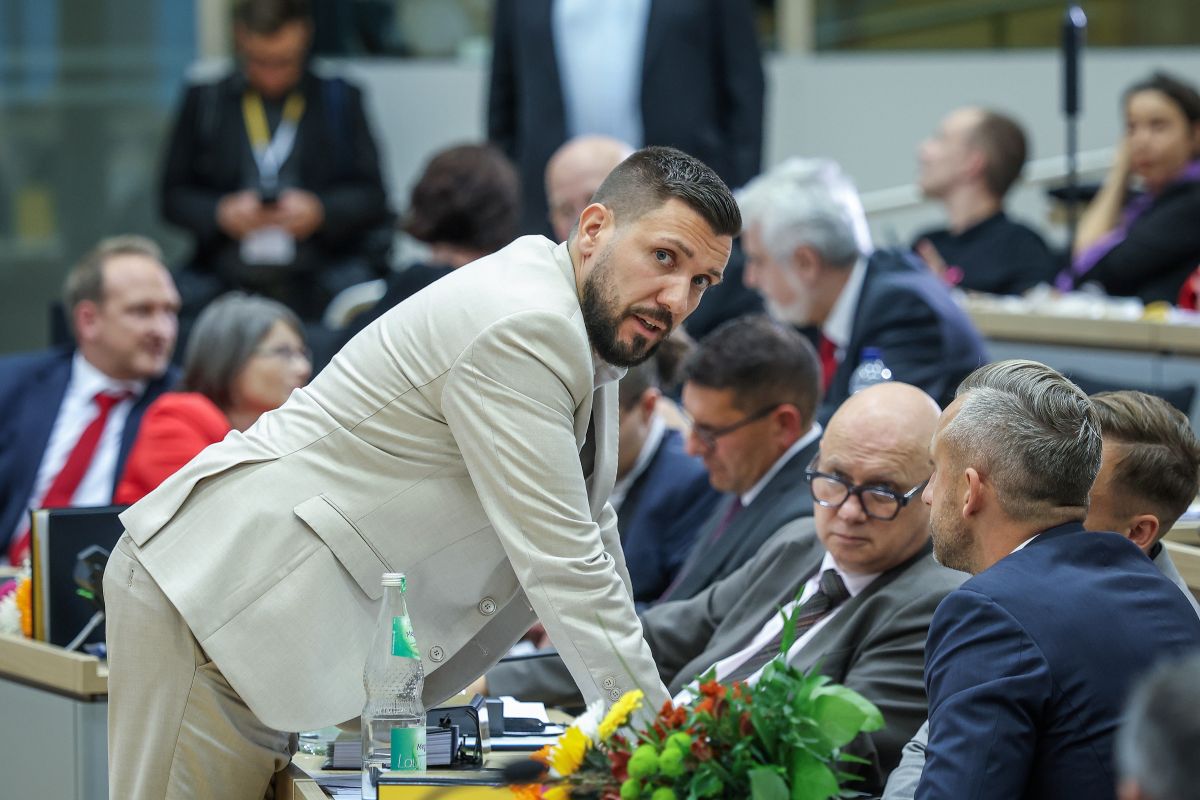
The AfD’s Tobias Rausch was already to be elected parliamentary president in Saxony-Anhalt, but four unexpected votes backing the far-right leader have plunged assumptions about the Germany’s political future into doubt.
When Tobias Rausch of the far-right Alternative für Deutschland (AfD) was elected president of the Saxony-Anhalt state parliament on Tuesday, the result itself wasn’t a surprise.
Germany’s political establishment had already expected that result. But what has rattled politicians far beyond the state’s borders is the question of how the victory was achieved.
Rausch became the first AfD politician to be elected president of a state parliament, and notably the first leader of a far-right party to claim that position in any state in post-war German history.
Yet within hours, attention had shifted away from the AfD’s breakthrough and towards a far more uncomfortable question: who, beyond the AfD and BSW parties, had cast the extra votes that secured it?
For many observers, that question has become a test of whether Germany’s long-standing political “firewall” against the far right is beginning to crack.
Why Rausch’s election mattered
The position of state parliament president sounds ceremonial, but it carries significant influence.
The president chairs parliamentary debates, enforces the rules of procedure, can issue disciplinary measures against lawmakers and oversees the parliament’s administration.
The office also controls access to parliament and has significant influence over staffing, administrative and organisational decisions.
READ ALSO: Is German Chancellor Merz taking a harder line against the far-right after AfD win?
In other words, the role doesn’t allow Rausch to make laws or govern Saxony-Anhalt. But it does give him substantial authority over how parliament functions.
The AfD branch in Saxony-Anhalt is classified by the state’s domestic intelligence service as confirmed far-right extremist, and critics argue the office requires a politically neutral figure.
Rausch, 35, has sought to reassure opponents, describing himself as a pragmatist and promising to treat all parties fairly. His critics point to previous disciplinary warnings he received in parliament and question whether a serving senior AfD figure can truly act as a neutral referee.
The result everyone expected
Before Tuesday’s vote, most political observers already believed Rausch would win.
The AfD holds 39 seats in the new parliament. The Bündnis Sahra Wagenknecht (BSW), which holds five seats, had publicly signalled it would support his candidacy.
That should have produced 44 votes, enough to secure election because abstentions by other parties lowered the threshold required for victory.
In fact, Rausch received 48 votes – and those extra four votes have become the centre of a political storm.
The newly elected president of the state parliament, Tobias Rausch (left, AfD), talks with Ulrich Siegmund (right, AfD) and other party colleagues in Saxony-Anhalt’s state parliament. Photo: picture alliance/dpa/AFP POOL | Ronny Hartmann
Parties on the left – the SPD, Greens and the Left Party, had all publicly ruled out supporting Rausch. Meanwhile, CDU parliamentary leader and state opposition leader Sven Schulze had announced that his party would abstain.
The ballot was secret, but much of the reporting in Germany has concluded that the extra votes most likely came from within CDU ranks. While this can’t be proven, neither public statements nor parliamentary arithmetic currently offer a more convincing explanation.
LISTEN: PODCAST – How Germany is grappling with far-right gains and rising transport costs
The issue became even more explosive later in the day when another AfD candidate, this time the controversial hardliner Hans-Thomas Tillschneider, was elected vice-president of the parliament – again with more votes than the AfD should have been able to command on its own.
Subsequent votes only reinforced suspicions that at least some CDU lawmakers were ignoring the instructions of their party leadership. While the CDU comfortably secured the election of its own candidate, Carsten Borchert, as vice-president, the SPD candidate Armin Willingmann, a former state minister and the party’s lead candidate at the election was not elected.
His defeat, despite the SPD and CDU having governed together until last month’s election, was widely seen as a humiliation for the Social Democrats.
The pattern of voting fuelled speculation that some CDU deputies were willing not only to help AfD candidates but also to deny support to their former coalition partners.
Why Berlin reacted so strongly
The response from the SPD was unusually emotional.
On Tuesday evening, members of the SPD’s parliamentary group in the Bundestag staged a spontaneous march through central Berlin. Lawmakers carried copies of Germany’s Basic Law and gathered at Bebelplatz, the site associated with the Nazi book burnings of 1933.
Defence Minister Boris Pistorius described the result as “a day of anger” and accused those who enabled the election of having “betrayed the democracy of our great country”.
READ ALSO: German state ministers scrap unanimity rule amid AfD concerns
The symbolism was unmistakable: the SPD wanted to present the vote as a national warning sign rather than a regional political dispute.
At the same time, tensions within Germany’s governing CDU-SPD coalition appeared to rise further. As SPD politicians expressed outrage over the apparent support AfD candidates had received from outside their own ranks, the CSU – the CDU’s Bavarian sister party – accused the SPD of hypocrisy because of its ongoing coalition talks with the Greens and the Left Party in Berlin.
The CDU/CSU also extend their firewall against the far-left, here meaning Germany Left party (Die Linke).
Why the firewall debate matters
For years, mainstream German parties have maintained what is known as the Brandmauer, or firewall, against the AfD. The principle is simple: no cooperation and no joint political projects with the party.
Officially, that firewall remains intact. Neither the CDU leadership in Berlin nor the party leadership in Saxony-Anhalt has endorsed cooperation with the AfD.
Yet the Saxony-Anhalt vote has raised questions about whether party leaders can still enforce that position within its own ranks.
As one commentary on public broadcaster Tagesschau put it, “Nothing is certain anymore.”
That may sound dramatic, but it reflects a growing uncertainty about whether traditional political assumptions still hold.
READ ALSO: ‘We don’t accept this’ – Inside the German legal team organising against the far right
A test run for December?
The question now is whether Tuesday’s vote was simply symbolic or a glimpse of what lies ahead. In December, Saxony-Anhalt’s parliament is expected to elect a new minister-president, a position which AfD leader Ulrich Siegmund hopes to take.
Until now, many observers regarded his repeated claims that he could assemble a parliamentary majority as political posturing. After Tuesday, that assumption looks much harder to sustain.
No one knows whether Siegmund can actually win. But the election of Rausch, followed by the unexpected voting patterns later in the day, have thrown all previous calculations up in the air.
Disclaimer : This story is auto aggregated by a computer programme and has not been created or edited by DOWNTHENEWS. Publisher: thelocal.de