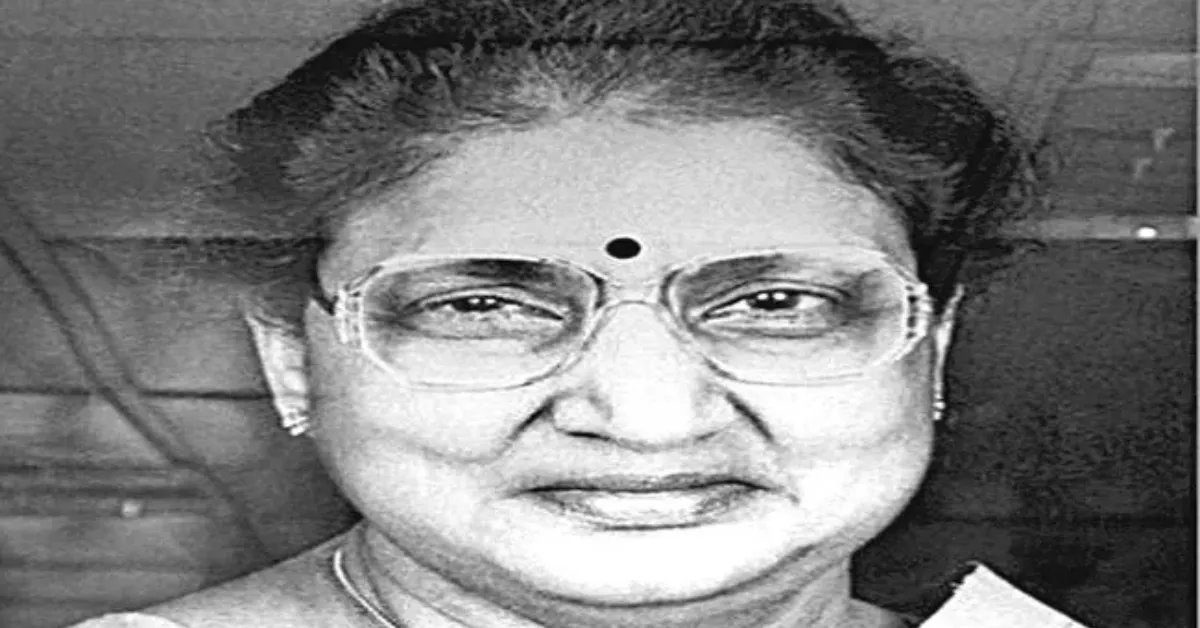
India’s election machinery has had a man at its helm for most of its history.
Gyanesh Kumar became India’s 26th Chief Election Commissioner (CEC) in February 2025. Since then, the office has remained under intense public and legal scrutiny.
But there is another number worth looking at.
Since the Election Commission of India (ECI) was established in 1950, 26 people have served as Chief Election Commissioner. Twenty-five were men. Only one was a woman.
Her name was V S Ramadevi.
She took charge on 26 November 1990. Sixteen days later, her tenure ended.
Who was V S Ramadevi?
Born in 1934 in Andhra Pradesh, Ramadevi was a lawyer by training. She spent decades working within India’s legal and administrative system, eventually becoming Secretary of the Legislative Department in the Ministry of Law and Justice.
Her 16 days at the Election Commission were only one chapter in a career that would see her break several barriers.
She later became the first woman Secretary General of the Rajya Sabha and the first woman Governor of Karnataka.
Her appointment as CEC came during a period of political uncertainty.
On 7 November 1990, Prime Minister V P Singh lost a confidence vote. Three days later, Chandra Shekhar was sworn in as Prime Minister.
Meanwhile, the then CEC, R V S Peri Sastri, died in office on 25 November.
The very next day, Ramadevi took charge as CEC.
Her appointment did not come completely out of the blue. At the time, she was the Secretary of the Legislative Department and was already familiar with the Election Commission and its work.
According to former Election Commission legal adviser S K Mendiratta, Ramadevi knew Peri Sastri and would visit the Commission to discuss legislative drafting. One issue they worked on was the proposed 73rd Constitutional Amendment concerning gram panchayats.
Mendiratta later described her as “extremely intelligent” and “a very good draftsman”.
There was also a political twist to her appointment.
According to Mendiratta, the V P Singh government had intended to appoint Ramadevi as a regular CEC. Her file was cleared by Singh and then sent to the President for approval.
But before the process was completed, the government changed.
By the time Ramadevi formally took charge on 26 November, Chandra Shekhar was Prime Minister.
Her tenure ended on 11 December. The following day, T N Seshan became CEC.
What happened after the Election Commission?
If Ramadevi’s 16 days at the Election Commission had been the end of her public career, her story might have been remembered simply as an unusual chapter in India’s electoral history.
It wasn’t.
After returning to the Law Ministry, Ramadevi went on to become the first woman Secretary General of the Rajya Sabha in July 1993.
The post is the senior-most official position in the Rajya Sabha Secretariat and involves the functioning and administration of the House. Ramadevi held the position until July 1997.
Then came the Raj Bhavans.
Ramadevi became Governor of Himachal Pradesh in 1997. In December 1999, she became the first woman Governor of Karnataka, a position she held until 2002.
Across her career, she repeatedly entered institutions where women had not held the top position before.
CEC.
Rajya Sabha Secretary General.
Governor of Karnataka.
Was Ramadevi really India’s CEC?
There is a constitutional wrinkle to her short tenure.
The ECI officially lists Ramadevi as its ninth Chief Election Commissioner, with her tenure beginning on 26 November 1990 and ending on 11 December 1990.
However, some former election officials have questioned whether her appointment should be viewed in exactly the same way as those of CECs who served longer, given the circumstances surrounding her appointment.
Former CEC S Y Quraishi has noted that her permanent appointment was not ultimately notified, while former ECI legal adviser S K Mendiratta described her period as a temporary arrangement.
Yet institutionally, the ECI records her as a CEC. Its own historical records list her between R V S Peri Sastri and T N Seshan.
So, for 16 days in 1990, the person heading India’s election machinery was a woman.
No woman has held the position since.
Why has there been no second woman CEC?
There is no constitutional provision that prevents a woman from becoming CEC. Article 324 establishes the Election Commission and provides for the appointment of the CEC and other Election Commissioners.
The ECI currently has a CEC and two Election Commissioners.
Historically, appointments to the top of the Commission have come from a relatively narrow pool of senior administrators and election officials.
Under the Chief Election Commissioner and Other Election Commissioners Act, 2023, appointments are made through a three-member selection committee comprising the Prime Minister, a Union Cabinet minister nominated by the Prime Minister and the Leader of the Opposition in the Lok Sabha.
The composition of this committee is currently under legal challenge. In September 2026, a two-judge Supreme Court bench differed on whether petitions challenging the 2023 law should be referred to a Constitution Bench. The matter was subsequently placed before the Chief Justice of India for consideration.
#DidYouKnow? VS Ramadevi was also the first woman to serve as the Secretary General of the Rajya Sabha from 1993 to 1997. #AmritMahotsav #NariShakti #MainBharatHoon https://t.co/agemwb8bm2
— Amrit Mahotsav (@AmritMahotsav) April 15, 2024
The question of who leads the Election Commission is therefore also part of a larger conversation about how India chooses the people who head its constitutional institutions.
Women, meanwhile, have long been central to India’s electoral story. They have participated in elections since the first general election, and in several recent elections, women’s turnout has matched or exceeded men’s in many states.
But at the very top of the institution responsible for conducting those elections, the picture has been different.
The current Commission comprises Gyanesh Kumar as CEC, along with Election Commissioners Sukhbir Singh Sandhu and Vivek Joshi.
What does Ramadevi’s story tell us?
Ramadevi’s career does not, by itself, establish that women were deliberately excluded from subsequent appointments.
But the numbers are striking.
More than seven decades after the ECI was established, only one woman has been recorded as its Chief Election Commissioner.
And that woman held the post for just 16 days.
Ramadevi’s career, however, was much larger than those 16 days.
She was a lawyer, senior administrator, the first woman Secretary General of the Rajya Sabha, the first woman Governor of Karnataka and, for a brief period in 1990, the first woman to head India’s election machinery.
Her shortest tenure became part of the record.
So did her many firsts.
Sources:
‘Before Seshan, there was V S Ramadevi: Only woman CEC who held office for shortest tenure’: By Adrija Roychowdhury, Published on 3 June 2024
‘Supreme Court split verdict on CEC appointment law reference plea, matter goes to CJI’: By Ananthakrishnan G, published on 23 September 2026
Bill Summary: The Chief Election Commissioner and Other Election Commissioners (Appointment, Conditions of Service and Term of Office) Bill, 2023
Disclaimer : This story is auto aggregated by a computer programme and has not been created or edited by DOWNTHENEWS. Publisher: thebetterindia.com