Far in Arunachal Pradesh’s eastern Himalayas, dense forests give way to bamboo and rhododendron at higher elevations, before opening into patches of mountain grassland.
This is Mishmi takin country.
The high-altitude landscape is part of the range of the Mishmi takin, one of the least-studied large mammals of the region.
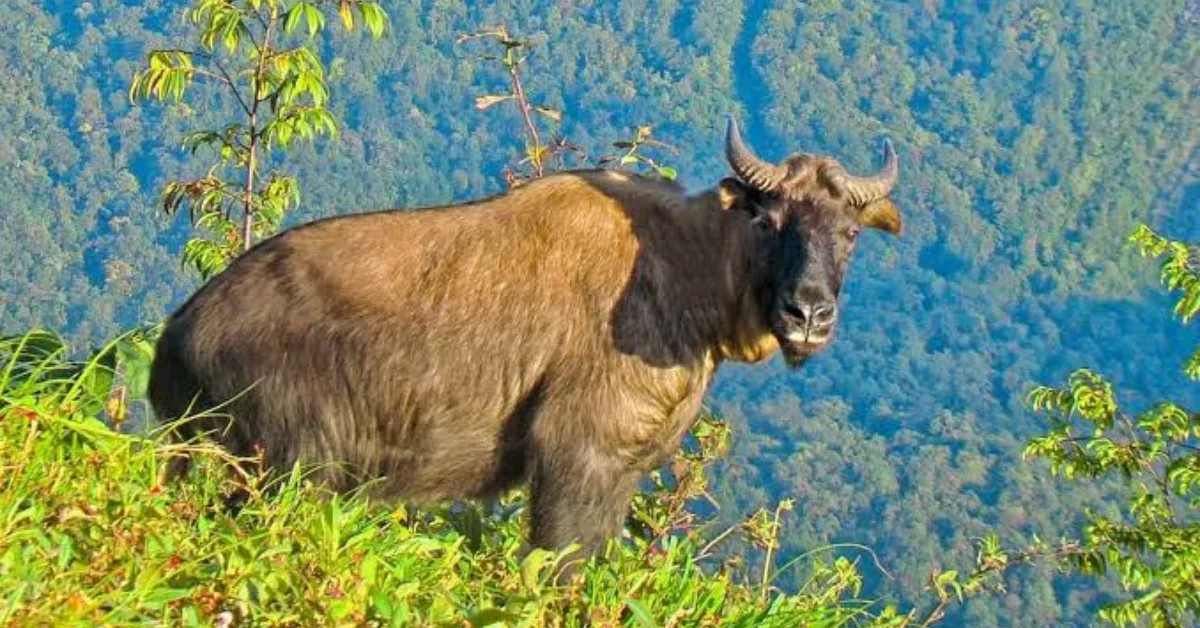
With its heavy body, curved horns, shaggy coat and broad, Roman-shaped nose, the Mishmi takin (Budorcas taxicolor taxicolor) looks like a cross between a goat and a wild ox. It is found across the Mishmi Hills of Arunachal Pradesh and parts of neighbouring China and Myanmar.
For a winter traveller, the search begins in Dibang Valley, where the district headquarters, Anini, sits at about 1,970 metres.
The larger Dibang Wildlife Sanctuary covers 4,149 sq km and stretches from about 1,800 to 5,000 metres in elevation. Its landscape includes temperate forests, alpine habitats and high mountain terrain.
But finding a takin is not as simple as arriving at a viewpoint and waiting.
Follow the landscape, not just the animal
The official Dibang Valley tourism guide describes the Mishmi takin as one of the elusive large mammals of the Mishmi Hills. Its suggested takin trek follows the Dree River from Damben, about 25 km from Anini, towards the upper reaches of the valley.
The route takes 14 days, including nine days of walking through terrain with swamps and bamboo thickets. The district administration says takins are seen in larger numbers during the rainy months of June and July, although smaller herds may be found along the fringes at other times.
Winter, therefore, is less about expecting a sighting and more about understanding where the animal moves.
The Mishmi Takin (Budorcas taxicolor taxicolor) is one of the Eastern Himalayas’ least-known mountain ungulate. This rare goat-antelope inhabiting the high-altitude rugged mountain sharing intricate nature culture relationship. The species remains elusive and poorly understood. This article highlights the Mishmi Takin’s ecological significance, habitat preferences, and significance of integrating traditional ecological knowledge with conservation science highlighting the need for holistic and inclusive conservation efforts to secure its future amid increasing disturbance. Link: https://t.co/fNwxBwRowK @byadavbjp @wii_india @rameshpandeyifs @GobindsagarBha1 @moefcc @gopigv @gaurav_pj
— Wildlife Institute of India (@wii_india) June 23, 2026
A 2015 account of the species in Mammals of South Asia notes that takins use steep mountain forests, with bamboo-rhododendron-conifer forests particularly important at higher elevations. Historical records also place them in open grass patches between 3,000 and 4,000 metres.
The species can move between elevations with the seasons, reaching subalpine and alpine areas in summer.
These grasslands matter because they are part of a larger habitat mosaic. Forests, bamboo thickets, alpine scrub and open mountain slopes together form the landscape through which the takin moves.
A mountain animal we still know little about
For all its distinctive features, the Mishmi takin remains poorly studied in India.
A Wildlife Institute of India research project led by G V Gopi set out to understand the species’ distribution, habitat and threats by combining field surveys with knowledge held by Indigenous communities. Researchers used camera traps, field expeditions, direct observations and signs such as tracks and dung.
That approach has now produced a new set of insights.
A study by Gaurav Pariyal Jagannatha, Sirumai Khusiali Kri and G V Gopi, published in Frontiers in Conservation Science in September 2026, combined traditional ecological knowledge gathered from Indigenous communities between 2021 and 2023 with camera-trap surveys and field observations.
The researchers analysed more than 17,000 independent camera-trap captures. Information from local communities helped them understand seasonal movement, habitat use, group behaviour, congregation sites and perceived threats. The camera-trap data also helped validate several of these observations and identify important sites and seasonal aggregations.
Together, the findings offer a more detailed picture of how the animal uses its mountain habitat.
The takin is not simply an animal that lives “up in the mountains”. Its movements are linked to season, elevation, food and the availability of suitable habitat.
What happens when the grass disappears?
A 2024 study published in the Records of the Zoological Survey of India surveyed Mishmi takins around Mehao Wildlife Sanctuary in Lower Dibang Valley between July 2018 and March 2019.
Using camera traps and foot surveys, researchers identified at least 27 individuals from 198 photographs — 12 adults, seven sub-adults, four juveniles and four calves. They also recorded signs such as dung, hoof marks and browsing marks.
The study identified bushmeat hunting as a major threat and called for more extensive research into the species’ distribution, population and habitat.
That lack of information matters. Without knowing where takins move, where they gather and which habitats they depend on, it becomes harder to protect the species across its range.
So, a winter journey through Dibang Valley is not only a search for an unusual Himalayan herbivore.
It is also a journey through the connected habitats that allow the Mishmi takin to survive — forests where it can shelter, bamboo-rich areas where it can feed, and open mountain grasslands where the forest gives way to the high Himalayas.
Sources:
‘In Search of Mishmi Takin’: By Government of Arunachal Pradesh
Takin-Budorcas taxicolor: By Diwakar Sharma, Tshewang Wangchuk, GS Rawat and AJT Johnsingh,Published in January 2015
‘Linking Tradition and Science: Mishmi Takin’: By Gaurav P J, Wildlife Institute of India. Published in 2025
‘Integrating Traditional Ecological Knowledge with Ecological Surveys for Conservation of the Mishmi Takin in Eastern Himalaya, India’: By Gaurav Pariyal Jagannatha, Sirumai Khusiali Kri, Govindan Veeraswami Gopi, Published on 15 September 2026
Disclaimer : This story is auto aggregated by a computer programme and has not been created or edited by DOWNTHENEWS. Publisher: thebetterindia.com