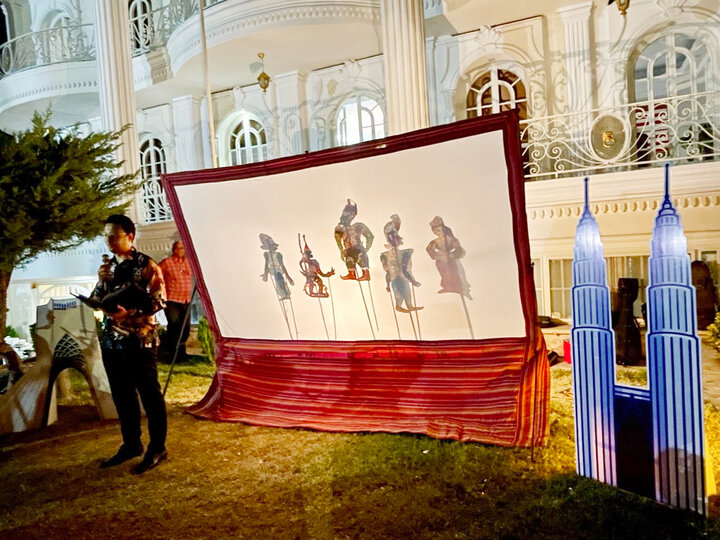
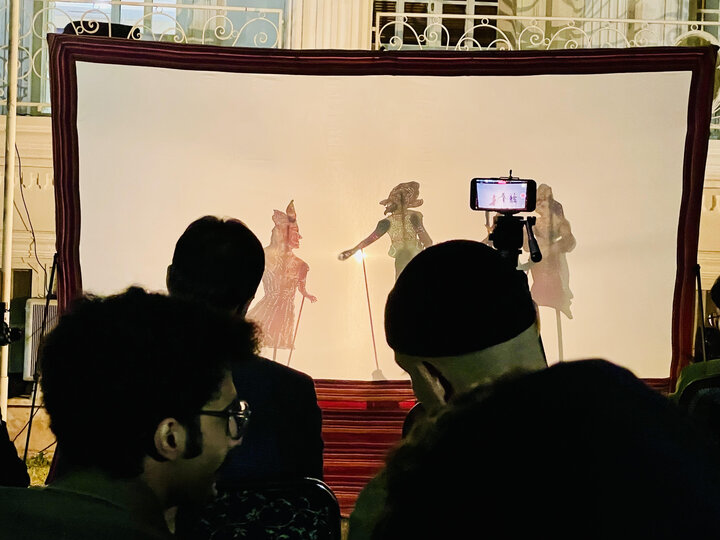
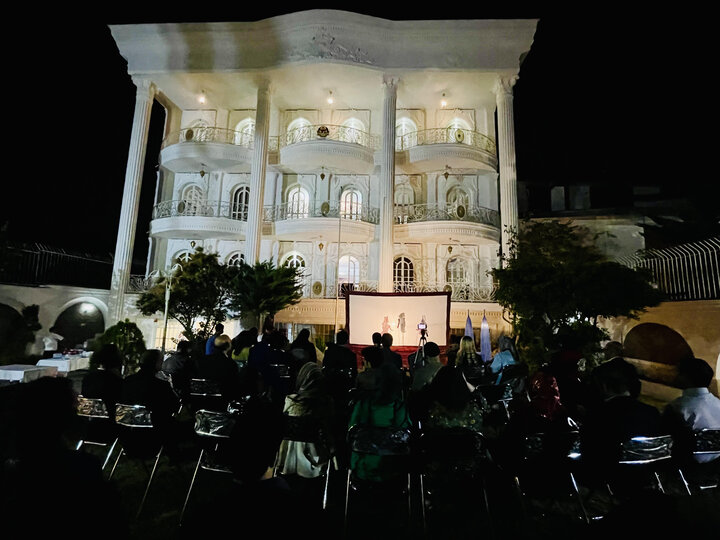
TEHRAN- On the evening of October 6, the Embassy of Malaysia in Tehran hosted a truly captivating cultural event: a Wayang Kulit (puppet show). It was one of those rare programs that entertains, educates, and quietly strengthens the invisible threads between nations. The evening was not merely a performance; it was a living conversation between two ancient cultures—Malaysia and Iran—conducted through light, shadow, music, and story.
One of the staff explained the story behind the performance
The story of how this performance came to be is as fascinating as the show itself. Invited to Iran by Mobarak, Sri Rama’s visit is initially complicated by his host’s poor planning. After sightseeing, Sri Rama requests a local play, leading Mobarak to arrange a unique artistic collaboration: an Iranian dalang stages the epic of Sohrab and Gardafrid, while Sri Rama performs a section of his quest for Sita Devi. Deciding to return to Malaysia, Sri Rama receives a final cross-cultural souvenir from Mobarak: a newly created dance called Ramasia.
That story—with Mobarak, Sri Rama, Sohrab and Gardafrid, Sita Devi, and the new dance Ramasia—was itself a symbol of cross-cultural creativity. It showed how two traditions can meet, not as strangers, but as collaborators.
Then, Dato’ Wan Aznainizam Yusri bin Wan Abdul Rashid, Chargé d’Affaires and Head of Mission at the Embassy of Malaysia, delivered this speech:
Respected officials from the Ministry of Foreign Affairs of the Islamic Republic of Iran, Our friends from Tehran Times, MTCP Alumni, and friends of Malaysia in Tehran,
Distinguished guests, ladies and gentlemen,
A very good evening, and Salam Khosh Amadidto you all.
It is an absolute honor to welcome such a distinguished gathering to the Embassy of Malaysia tonight. We are particularly grateful for the presence of our friends from the Iranian Ministry of Foreign Affairs, whose support continues to strengthen the diplomatic and cultural bonds between our two nations.
Tonight, we are gathered to share a piece of Malaysia’s soul. Wayang Kulit, or the traditional shadow puppet theater—specifically from the state of Kelantan—is one of Malaysia’s most treasured cultural art forms. For centuries, it has served as a bridge across time, blending folklore, philosophy, and community values into a single screen of light and shadow.
To celebrate this beautiful art, allow me to share a traditional Pantun Melayu (Malay poetic verse) that perfectly captures the magic behind the screen tonight:
Tengah malam dipasang pelita, Kelir dibentangmencerna bayang; Bukan sekadar penyeri cerita, Warisan bangsa pusaka moyang.
(In the midnight hour, the lamp is lit, / The screen is unfurled to cast its shadow; / This is not just a visual tale, / But the sacred heritage bequeathed by our ancestors.)
As I look out into the audience this evening, I am reminded of how deeply our cultures mirror one another in this land of profound literature, the legendary mystic and poet Jalaluddin Rumi elegantly captured the essence of creation and art when he said:
“You dance inside my chest where no one sees you, but sometimes I do, and that sight becomes this art. “
Like Rumi’s vision of unseen depths coming alive as physical art, Wayang Kulit animates hidden human emotions, moral truths, and spiritual wisdom using nothing but light, movement, and leather shadows.
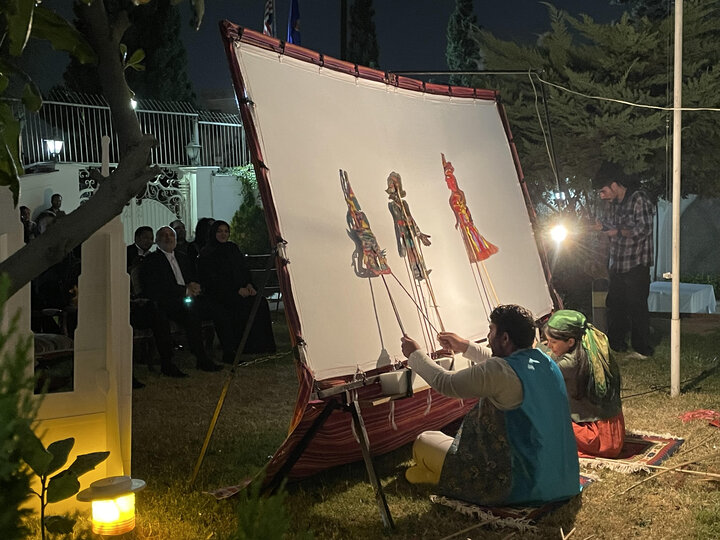
While tonight we showcase Malaysia’s WayangKulit, Iran is home to its own ancient puppetry traditions, such as Kheimeh Shab-bazi. Though separated by thousands of miles, our theatrical heritages share a striking, kindred spirit:
• The Dialogue of the Masters: Just as our Tok Dalang commands the stage, speaking for the puppets and guiding the narrative, the Iranian Morshed stands before the booth, engaging in a live, witty dialogue with the marionettes to reveal deeper truths.
• The Voice of the People: In Kelantan’s Wayang Kulit, beloved comic figures like Pak Dogol and Wak Long use humor and satire to speak wisdom. In exactly the same way, Iran’s iconic red-clad clown hero, Mobarak, uses sharp wit to represent the voice of the common citizen.
• Live Rhythmic Storytelling: Both traditions refuse to separate story from sound. Our shadow play relies entirely on the live energy of a traditional orchestra, matching the spirited live musical performances that have accompanied Iranian puppet booths for generations.
Culture has a unique power to transcend borders and languages. Like Iran’s magnificent traditions of epic poetry, storytelling, and Naqqali, Malaysia’s Wayang Kulit reflects our shared human appreciation for narrative, wisdom, and moral heritage. By opening this window into Malaysian tradition tonight, we hope to foster deeper mutual understanding and a closer cultural kinship between the peoples of Malaysia and Iran.
I would like to extend my heartfelt thanks to the talented performers from Harathi Wayangwho are here with us this evening, and to all of you for gracing this showcase with your presence.
Without further ado, please sit back, relax, and enjoy the magical world of Wayang KulitKelantan.
Thank you, Tashakkor, and Terima Kasih.
Why this program mattered
The Wayang Kulit evening was a beautiful example of cultural diplomacy at its best. It did not simply present Malaysia’s heritage; it placed that heritage in conversation with Iran’s own Kheimeh Shab-bazi, Rumi’s poetry, Naqqali, and the beloved figure of Mobarak. By highlighting parallels—Tok Dalang and Morshed, Pak Dogol and Wak Long beside Mobarak, live orchestral rhythm in both traditions—the embassy created a space where Iranians and Malaysians could see themselves in each other.
Such programs have a profound impact. They build people-to-people ties, soften formal diplomacy, and replace distance with curiosity. They remind us that culture can transcend borders and languages. For the Iranian audience, it was a window into Malaysia’s soul. For Malaysia, it was a chance to honor a host country’s rich storytelling traditions. And for both, it was a reminder that shared human values—wisdom, humor, moral heritage, and the love of narrative—are stronger than geography.
In a world often divided by politics, an evening of puppets, poetry, and music did something quietly powerful: it made friendship visible. The shadows on the screen may have faded when the lights came up, but the bonds they illuminated will linger far longer.
Disclaimer : This story is auto aggregated by a computer programme and has not been created or edited by DOWNTHENEWS. Publisher: tehrantimes.com