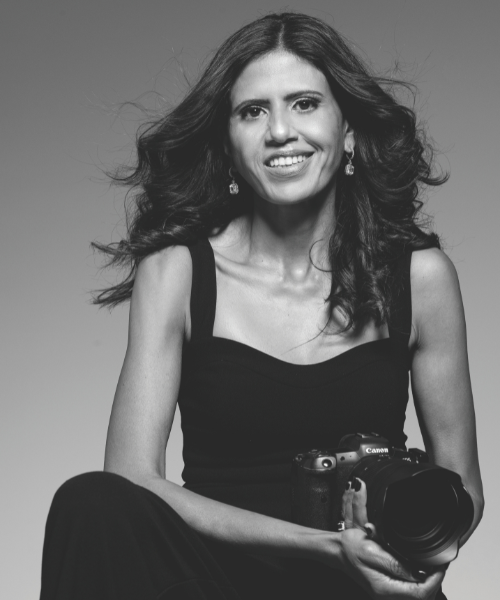
Over a relaxing breakfast one morning in Dubai, the wildlife photographer Kriti Walia casually mentions that she is behind with her packing. In a few days she is off to Alaska, where she will hike in to photograph brown bears as they come down after hibernation to fish for sockeye salmon. She will be on foot, just metres away from the animals. “It’s gonna be amazing,” she says. “A once-in-a-lifetime experience.” Then Walia flies on to Brazil to sit in a boat and wait for a jaguar. If she gets it, she will have completed the set: every big cat on earth, photographed in the wild, on her own terms, by a woman who did not pick up a serious camera until she was 48 years old. What is remarkable is that, at first, Walia didn’t even clock that she was about to hit that milestone. She recalls that she just happened to be photographing tigers with a friend in India in January when he ran down the list and asked whether she realised she was about to become one of the first female Indian photographers to have seen and photographed all the big cats in the world. “It didn’t even register,” she says. “I was just going along.” Going along, in Walia’s case, is a specialist skill. Almost nobody has started over in life as many times as she has, and nobody I’ve met has done it with as much grace.
Walia grew up as an army kid, which meant she was never anywhere long. “In 12 years of my education, I changed schools 10 times,” she shares. The postings were not cities but small towns in forests and mountains. And it’s the kind of childhood that has largely stopped existing in today’s interconnected world. “I’m a kid of the ’70s, and in that time we didn’t have any social media, we didn’t have any of these distractions. So playing outside, being in nature, it was just a part of living your daily life,” she explains. Her father, who played at national-level cricket tournaments in India, also happened to have a Yashica film camera, a darkroom, and a passion for photography. Walia remembers how he would arrange the camera on a tripod and wrangle his family together for group photos, or shoot landscapes. Eventually, Walia left home for school and forgot all about photography for the next 25 years.
What she did instead was hotels. She had a history honours degree but no hospitality background whatsoever when she passed a fiercely competitive campus interview for the Oberoi Centre of Learning and Development, and found herself, as she puts it, gravitating towards the world of luxury hotels. It was there that she met her future husband, Sandeep. She was 21. They have now been together 32 years.

Eight or nine years into her career, on a clear leadership track, Walia got pregnant. The company chairman, the late Prithvi Raj Singh Oberoi, called her in. “He said, look, I’m not going to let you go. You take a sabbatical for two years,” Walia recalls. Around the same time, her husband was given a promotion and transfer to an Oberoi property in Egypt. She took the chairman up on his offer, picked up her two-and-a-half-month-old daughter and moved with her husband to Hurghada, on the Red Sea coast.
Walia is unusually honest about what happened next. “I was literally thrown at the deep end of the ocean,” she says. The bond with her daughter was extraordinary, precisely because it was just the two of them discovering a new country together while her husband cracked on with his new job. Walia is grateful for that precious time with her daughter, but she doesn’t deny that being a new mother in a new country, without the familiar structure of a job to go to, was a shock to the system. “I was like, what happened to my desk, my work, my travels, and the phone calls, and the emails, and the strategy, and the meetings?” She pauses. “I didn’t realise that this was it. This is permanent. And I was so shattered,” she admits.
What helped her get through this profound, life-changing moment was the can-do attitude that her father instilled in her when she was a girl. “My dad always told us to move on in life, keep moving on,” she says. “So I was like, okay. What now? What can I do? What’s the plan B? I am always trying to move forward, never backwards.”

Plan B ended up starting with a plate of cookies. Her daughter’s crèche asked parents to bring something to a Christmas party. Walia, who had never baked, went into her kitchen and rolled up her sleeves. “I must have thrown out three or four batches before I could get six cookies right,” she says with a laugh. She carried them in. People wanted to know where she’d bought them. “I started feeling useful and validated,” she remembers, and is careful to clarify what she means. “I mean me, not just as a mom or wife, but a full being.”
One of the mothers introduced her to a woman running a small bakery in the village, who took the cookies, then asked what else she could do. “One bakery became two. Two bakeries became three,” recalls Walia. Then her husband got a new role at the Ritz-Carlton in Sharm el-Sheikh, and she did the whole thing all over again, walking her samples into bakeries. Then Russia, in 2007, where she arrived and panicked. “It was a saturated market with amazing bakeries, world class. I was like, who the hell is going to buy my things?” So she pivoted sideways: noticed that almost nobody spoke English, got herself CELTA-certified, and built a corporate English training business, with a side hustle doing mystery shopping for hotels across the CIS, Mauritius, and the Seychelles.
Later, on a trip to Washington DC, she spotted a queue running the better part of a kilometre outside a cupcake shop on Valentine’s Day. “It just hit me like tons of bricks that cupcakes were conspicuously missing in Russia,” she says. So she bought books on the art of cupcake-making and began selling cupcakes in Moscow – out of her own kitchen, under the name Cupolicious. The business was an instant hit. She was, by her own account, making insane money when Sandeep announced he had an amazing new job opportunity in Germany. It is the only moment in our entire conversation where she admits to flinching. “This is the first time that I felt like, oh no,” she says. “By then, I was almost 40, and I was like, ah, not again.”
In Germany, the ever-resilient, always forward-moving Walia got a commercial baking licence in six months, without speaking a word of German and without a single contact. “I bulldozed my way into it,” she admits. She then spent seven years as a wedding cake maker in the Rhine-Main region, with a Cordon Bleu-trained assistant and a corporate client list that included Cartier, Chanel, Tiffany & Co, and Sephora. She even ended up gaining German citizenship.
Dubai came in 2019 and felt, initially, like a reward. “It was literally like going from black tarmac to red carpet,” she says. Walia signed a cloud-kitchen deal with a well-connected investor. Then Covid hit, and nobody on earth wanted to eat food made in a stranger’s kitchen. She retrained as a yoga teacher–200 hours in three months–and discovered that nobody wanted in-person classes either. “One day, I woke up. I told my husband I’m leaving,” she says. She was 47, and she was, she now knows, seriously depressed. “I used to feel so low and so down and so sad about everything, and that was very unlike me.”
She went to Rishikesh, in India, where the Ganges comes out of the Himalayas, because yoga was the only thing still making her feel anything. Sandeep, who she says believes in her more than she believes in herself, booked her into a beautiful hotel on the river. She arrived elated. The next morning she woke in what she calls a dark hole. “I was like, oh my God, how can this be back? I’m in this beautiful place. What is happening?”
So Walia went down to the water and sat there for hours. “I just sat there and I surrendered,” she says, and even now, recounting it, she has to stop. She asked the universe for guidance. “Show me the path. I will do anything.” Then she wept, went back to her room, and slept.
When Walia woke, she made coffee and took it out to the patio. There, a crimson sunbird landed in front of her and stayed. “I was so consumed, in that moment, that I thought of nothing,” she recalls. “It was just me and the bird.” She went inside for her phone so she could take a photo of the bird, but when she came back out, it was gone.
This inspired her to hire a naturalist to walk her round and point out different birds. Green bird, blue bird, yellow bird. “I was like, child in a toy shop,” she says. “And for 10 days, I was just running behind birds, and off went the depression. Until this day, I’m running behind them.” The camera she used was a point-and-shoot she’d bought for photographing cakes, which had inexplicably found its way into her bag. “I was hopeless,” she says happily of those early days as a budding wildlife photographer.
The idea of photographing all seven big cats – tiger, lion, jaguar, leopard, puma, snow leopard, and cheetah – came from birders she met along the way, who kept asking whether she’d photographed any of them. Walia admits that trying to capture these cats in the wild takes almost saint-like patience. The two cats that nearly broke her were the puma in Chile and the snow leopard in India’s northernmost territory, both of which she trekked in to photograph on foot. “You are looking at an elevation of between 4,000 and 4,500 metres,” she says. “The air is thin. You can’t breathe. You are out for eight to 16 hours a day.” Shooting in temperatures of between minus 10°C and minus 15°C, with no vehicle and no shelter, for a fortnight, all the while waiting, in the case of the snow leopard, on an animal so elusive it is colloquially called the “grey ghost”.
Walia’s favourite frame came out of that trip, and it isn’t the portrait you’d expect. A snow leopard mother sat at the bottom of a gorge, almost a kilometre from her cubs, who were playing higher up the mountain; neither could see the other. “She just started purring,” Walia says of the magical moment she captured on camera. “They don’t roar, they make this sound called sawing.” Somehow the cubs heard her from the other end of the gorge and started moving in her direction. The mother started walking too. Walia watched them close the distance. “It was spectacular.”
Walia hopes that her story will inspire other women not to give up on their dreams later in life. “I come from a culture where I’ve seen my mother, my aunts, my grandmother all say, oh, life’s over now, we are 50,” she says. Her counter-argument comes, naturally, from the animal kingdom: orca pods, where it is the grandmothers, not the mothers, who teach the young to hunt. All that knowledge, finally applicable, with the responsibilities lifted.
“Life is a privilege,” she says. “Everything is a privilege. I just have deep gratitude in my heart for everything.” Whenever she wavers, she says, she does one simple thing. “I remind myself of how far I have come.”
P.S. Walia did capture her last big cat – a jaguar named Bororo, which she photographed as he bounded through the water after his prey. It’s a breathtaking shot, and the perfect image to mark another milestone in a life lived to its fullest.
– For more on luxury lifestyle, news, fashion, and beauty, follow Emirates Woman on Facebook and Instagram.
Images: Supplied
Disclaimer : This story is auto aggregated by a computer programme and has not been created or edited by DOWNTHENEWS. Publisher: emirateswoman.com