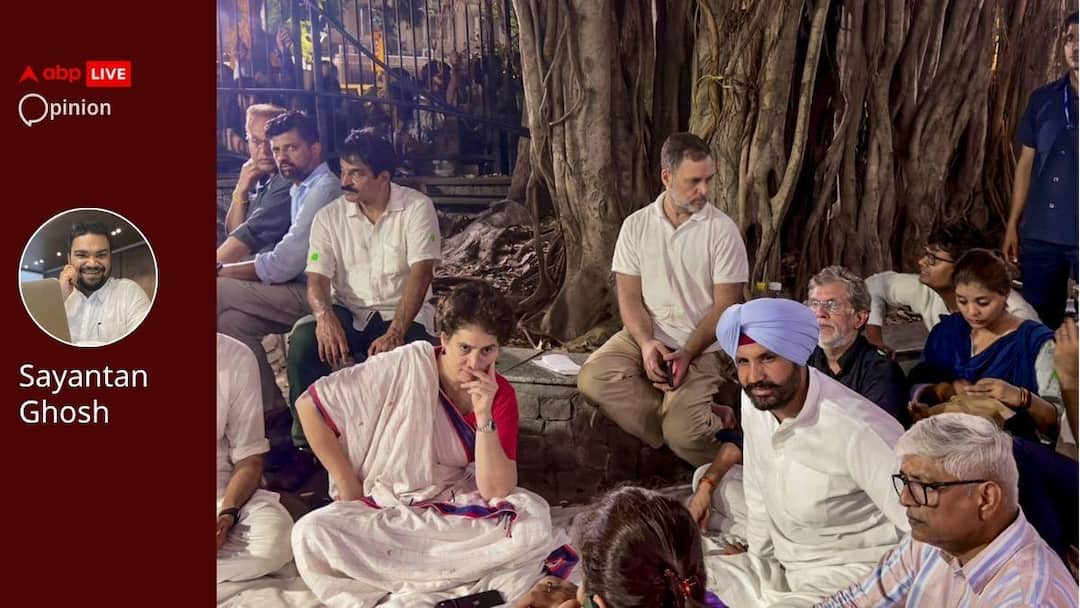
- Opposition parties protested against CEC, alleging electoral irregularities.
- Protests united diverse parties demanding Kumar’s resignation.
- Internal rivalries and leadership questions persist within the bloc.
- Upcoming state elections will test the alliance’s fragile unity.
It is seldom that the visuals of an opposition protest take over the day’s headlines. For the past two days, they have. Marches against Chief Election Commissioner Gyanesh Kumar, and against the Bharatiya Janata Party government, which the opposition holds responsible for him, have crowded out the rest. The pictures are of Leader of the Opposition Rahul Gandhi and Congress leader Priyanka Gandhi Vadra in the grip of the Delhi Police, and of the resistance that followed: the raised flag, the sit-in, the refusal to disperse. Those frames are everywhere, on social media and across the media. Behind them stood a wider gathering. Congress, the Trinamool Congress, the Left parties, the NCP (Sharadchandra Pawar), the Shiv Sena (Uddhav Balasaheb Thackeray), the Samajwadi Party, the Biju Janata Dal and Vijay’s Tamilaga Vettri Kazhagam shared a platform built on one demand: that Kumar must go.
On Tuesday, close to 300 opposition MPs marched from Parliament towards the Election Commission and were stopped. On Wednesday, another attempt to reach Jantar Mantar ended in more detentions. Mallikarjun Kharge had called the gathering. Mamata Banerjee had set the tone on September 30, calling Kumar a thief. The trigger was the disclosure that Election Commissioners Sukhbir Singh Sandhu and Vivek Joshi had objected at least 14 times in ten months to decisions taken without their knowledge, including changes linked to the Special Intensive Revision. The opposition has folded that rupture into its charge of “vote chori”. It wants Kumar out, the revision paused, and a meeting with President Droupadi Murmu. A camera can hold rivals for an afternoon. It cannot settle who yields a seat in Malappuram, who accepts a junior role in Bengal, or whose face goes on a 2029 poster. The INDIA bloc has found a common enemy, and a set of images. It has not found a common future.
A March Is Not a Merger
What the protest proved is narrower than its organisers will claim. Parties that had drifted or formally left stood together because the target sat outside electoral arithmetic. Kumar is not a candidate in Kerala or Punjab. Demanding his resignation costs no assembly seat. That is why the platform could stretch from Abhishek Banerjee and Derek O’Brien to Akhilesh Yadav, Supriya Sule, the Shiv Sena (UBT), Left MPs such as John Brittas, a Biju Janata Dal MP outside the bloc, and Vijay’s TVK, born from the wreckage of the old Tamil Nadu arrangement.
Twenty-three parties were reported at the Tuesday march. The September 30 meeting, with Kharge, Rahul Gandhi, Sonia Gandhi, Mamata Banerjee, Tejashwi Yadav, Omar Abdullah and Mehbooba Mufti, had fixed the script: district marches from October 2, a march on the Commission, a later rally in the capital. The unity is real. The Samajwadi Party skipped Kharge’s lunch on the second day after allies grumbled that Tuesday had become a Rahul Gandhi show. A sincere protest can still shelter the questions that begin when the barricades come down.
Congress Rising, Partners Receding
The 2024 Lok Sabha result gave Congress 99 seats and a claim it had not held since 2014. The 2026 verdicts strengthened that claim uncomfortably. The Trinamool, which won 215 seats in 2021, was cut to around 80. Mamata Banerjee lost Bhabanipur to Suvendu Adhikari, and the BJP formed a government in West Bengal for the first time. In Tamil Nadu, a fractured mandate and Vijay’s TVK broke the old Dravidian settlement. DMK leaders now say the party is no longer in the INDIA bloc, arguing that Congress dumped it and moved towards TVK. It is crucial to recognise that more the regional political parties recide its advantage Congress. Earlier, there are many times when the TMC has objected to Congress’ big brother attitude but a few days Mamata sat beside Sonia Gandhi during the INDIA bloc press conference and its Sonia who thumped the table and patted her in support. Political equations change so fast.
The Aam Aadmi Party walked out on July 18, 2025. It backed action against Kumar, then refused the September 30 table. Sanjay Singh said AAP was no longer in the alliance. Its absence from the Delhi street was arithmetic in Punjab, where Congress is the rival it must fight. Congress looks more like the national pole than it did three years ago, and the pole comes with absences. Tamil Nadu and Punjab are now sites of separation. A bloc that cannot count the DMK or AAP is a smaller room with a louder host.
Even during the Delhi protests, sections of the opposition raised a concern: despite the presence of senior leaders from different parties, including Akhilesh Yadav of the Samajwadi Party and Abhishek Banerjee of the Mamata faction of the TMC, the political spotlight eventually centred on Rahul Gandhi and Priyanka Gandhi Vadra. That discomfort surfaced again on Tuesday, when the Samajwadi Party stayed away from the launch convened by Congress president Mallikarjun Kharge. Alliance politics is not easy. It requires not only a common political cause but also a sense that every partner, and every leader, has an equal place in the arrangement.
The Wars the Barricades Cannot Pause
State politics does not adjourn for a Delhi dharna. In Kerala, Congress and the Left will face each other as they have for decades. Left MPs standing beside Congress leaders on Parliament Street cannot erase the contest between the CPI(M)-led government and the Congress-led opposition. A shared fight against the CEC will not produce a shared candidate list in Kannur.
Bengal presents a newer contradiction. Mamata Banerjee spent years treating Congress as a depleted rival and Rahul Gandhi as an inadequate national face. Defeat has changed the language, but softer language does not automatically produce seat-sharing.
After the 2026 Assembly defeat, Mamata presides over a fractured political house. A majority of Trinamool MLAs have rallied behind the Ritabrata Banerjee faction, while several MPs have moved to the NCPI. Mamata has also lost control of the party’s old name and symbol, leaving her with a much smaller organisation than the one that governed Bengal for fifteen years.
This makes national political relevance more important to Mamata than before. More surprisingly, her equation with the Left is changing. CPI(M) general secretary M.A. Baby recently reached out to her for a united fight against the BJP and the CEC. Mamata called him back and the two spoke at length, an extraordinary development in Bengal politics considering that her political rise was built on defeating the Left.
Yet national cooperation has obvious limits. Congress and the Left have just returned to the Bengal Assembly and will hardly surrender recovered ground to Mamata. She, equally, cannot afford to surrender what remains of her organisation.
The same contradiction runs through Uttar Pradesh and Maharashtra. Opposition parties may march together in Delhi, but elections are negotiated constituency by constituency. Delhi can provide the photograph of unity. State politics decides whether that photograph survives the fight over seats.
Whose Face, Whose Government
Every opposition front reaches the question it postpones. Who will be the face? Rahul Gandhi is the obvious answer inside Congress and the awkward one outside it. He is Leader of the Opposition, he has driven the vote chori campaign, and he gave the protest its sharpest line. None of that is a nomination.
Asked in Delhi whether he would be the prime ministerial candidate in 2029, Mamata Banerjee chose silence and a later press conference. That silence is the bloc’s real minutes. Akhilesh Yadav has a state to win back and no reason to shrink into a supporting act. Uddhav Thackeray and Sharad Pawar’s party have survival problems of their own. The Left does not vote for dynastic projection even when it shares a slogan. Vijay is unlikely to underwrite a Delhi face he did not choose. Ranking ambitions is harder than ranking the Election Commission below the BJP. Regional leaders will want 2029 negotiated, not announced.
The Tests Already on the Calendar
The next state elections will do what this week cannot. They will force numbers onto the table. Seat-sharing is where friendship ends, because every seat given away demoralises a worker and empowers a local rival. Punjab will ask whether Congress and AAP can share a sentence. Tamil Nadu will ask whether Congress, TVK and an estranged DMK can fit any anti-BJP design, or whether the state enters 2029 as three separate arguments. Kerala will ask Congress and the Left to forget the photograph.
Bengal will ask Mamata whether unity is a Delhi tactic or a willingness to lose seats at home. Uttar Pradesh will ask whether the Tuesday march survives ticket distribution. Parallel campaigns against the Commission would show that the unity was as wide as the complaint. Common opposition to the Election Commission is a position, not a coalition. Coalitions are made of sacrificed seats, accepted leaders and losses swallowed in public. Until INDIA can show those, the road outside the Commission is a meeting place, not a destination.
Sayantan Ghosh, a columnist and Doctoral Research Scholar in Media & Politics, is a contributing author for ABP Live English.
[Disclaimer: The opinions, beliefs, and views expressed by the various authors and forum participants on this website are personal and do not reflect the opinions, beliefs, and views of ABP News Network Pvt Ltd.]
Disclaimer : This story is auto aggregated by a computer programme and has not been created or edited by DOWNTHENEWS. Publisher: abplive.com