
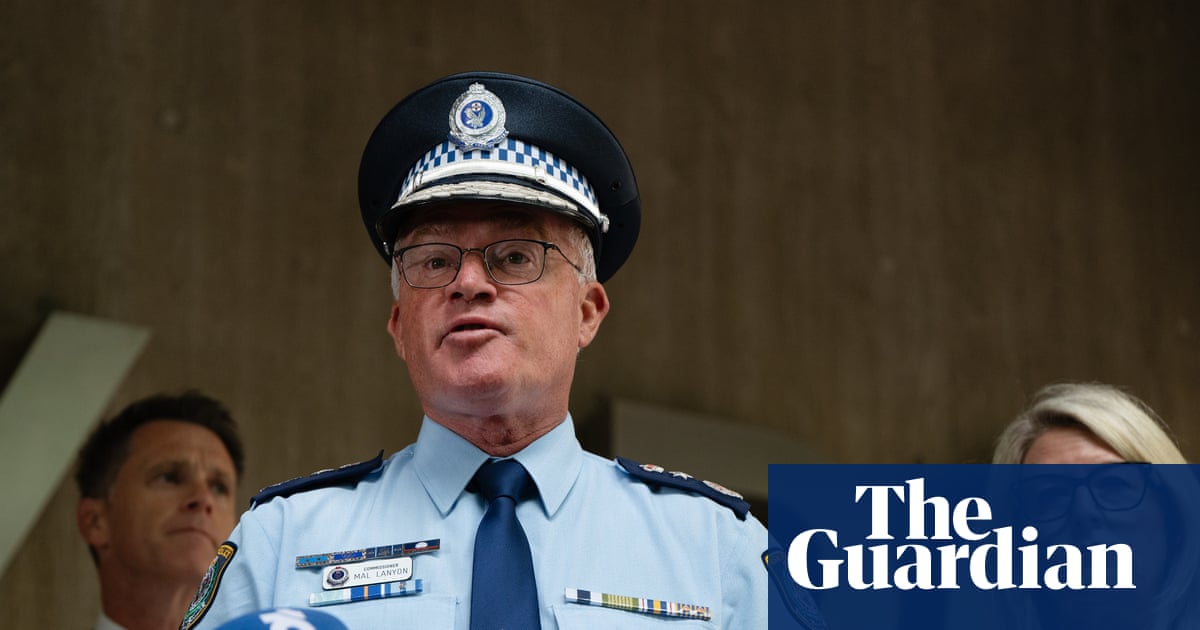
The New South Wales police commissioner made a last-minute bid to hold hearings into Sydney’s anti-Herzog protest behind closed doors, delaying the inquiry, the police watchdog has revealed.
The Law Enforcement Conduct Commission (Lecc) has said that its inquiry into the February protest at Sydney’s town hall, launched after widespread allegations of police brutality, would go ahead this month with a mix of public and private examinations, saying the timing of issues raised by police commissioner, Mal Lanyon, was “regrettable”.
Lecc launched an investigation after the protest on 9 February, during which numerous protesters – and 10 officers – were injured, including demonstrators in their 70s and 80s. Viral video footage showed police punching multiple protesters, and grabbing Muslim worshippers while they undertook their sunset prayers.
Thirty people were charged in the months after the protest, but four have since had their charges dropped. More than 20 of those charged are due to face a joint hearing next July.
In a decision made public on Thursday, the Lecc chief commissioner, Peter Johnson SC, revealed that legal representatives for Lanyon had indicated for the “first time” on 9 September that he wished to be heard on the issue of public and private examinations. The bid was made less than two weeks before the public hearings between September and November were due to start. Some hearings were also expected to be heard in private.
“The timing of these issues being raised by the Commissioner of Police is more than regrettable given its impact on the orderly progress of the investigation, the preparation for examinations and the efficient and effective use of public resources by both the Commission and the NSWPF and the associated cost and disruption flowing from the delay,” Johnson said.
Johnson said the start date of public hearings, 21 September, was subsequently delayed to “a date to be fixed” to allow a private hearing for submissions on the issue.
Lawyers acting on behalf of Lanyon submitted that Lecc’s opening address and the examination of witnesses should occur in private and not be livestreamed. They argued that the Lecc Act does not have the power to hear “broad ranging open submissions” and said Lecc should not take the “unconventional approach of hearing opening submissions in public part way through an investigation that is already underway”.
But Lecc argued that it does have the power to decide when public examinations are appropriate. The counsel assisting submitted that public examinations were necessary because “there was already significant information concerning the events of 9 February 2026 in the public domain, including footage of use of force by police” and that senior police officers had advanced in public an “official narrative of what took place”.
“Public comments made by senior police increase the need for independent scrutiny,” the commissioner wrote.
The counsel assisting had pointed to specific features of the investigation as reason for why only private examinations were not appropriate. This included the “significant public concern” after the protest, including in parts of the Islamic community in Western Sydney.
On Thursday, the watchdog said its inquiry into the protest would begin with a public address by counsel assisting on 19 October, followed by five weeks of private hearings. Lecc expects senior officers will then appear at public examinations.
It said its Operation Makalu inquiry would analyse the use of OC spray, as well as the “improper use of arrest powers and the police use of force” at the protest. It will consider police planning ahead of the protest and “any opportunities for improvement in the policing of protests”.
In his decision, the commissioner determined that private examinations would be held on “issues of fact” while public examinations would be held to deal with systemic issues, but only after the private examinations have been held.
In September, Palestinian Australian Eyad Shadid launched a civil case in the NSW district court, alleging he was assaulted, battered and falsely imprisoned by police near Sydney’s town hall. He alleged in his statement of claim that NSW police committed misfeasance in public office and subjected him to a malicious prosecution.
In a statement, NSW Greens justice spokesperson, Sue Higginson, described the push to hold hearings in private as “an extraordinary attempt by the police to suppress the public examination of allegations of serious misconduct by uniformed police officers, and to prevent public scrutiny of the political decisions and command structures that led to police violence against protesters”.
At a NSW parliamentary inquiry in May, Johnson said police had become “overly defensive” in response to requests for information in its investigations, describing the relationship between the agencies as “difficult”. He said the Lecc had received a record number of complaints, more than 800, as part of its investigation into the Herzog protest.
In a statement following Johnson’s comments, NSW police said it “complied with the requirements of the LECC Act in a cooperative manner”.
NSW police said in a statement it acknowledged the decision to hold private hearings and awaited the findings.
Disclaimer : This story is auto aggregated by a computer programme and has not been created or edited by DOWNTHENEWS. Publisher: theguardian.com




