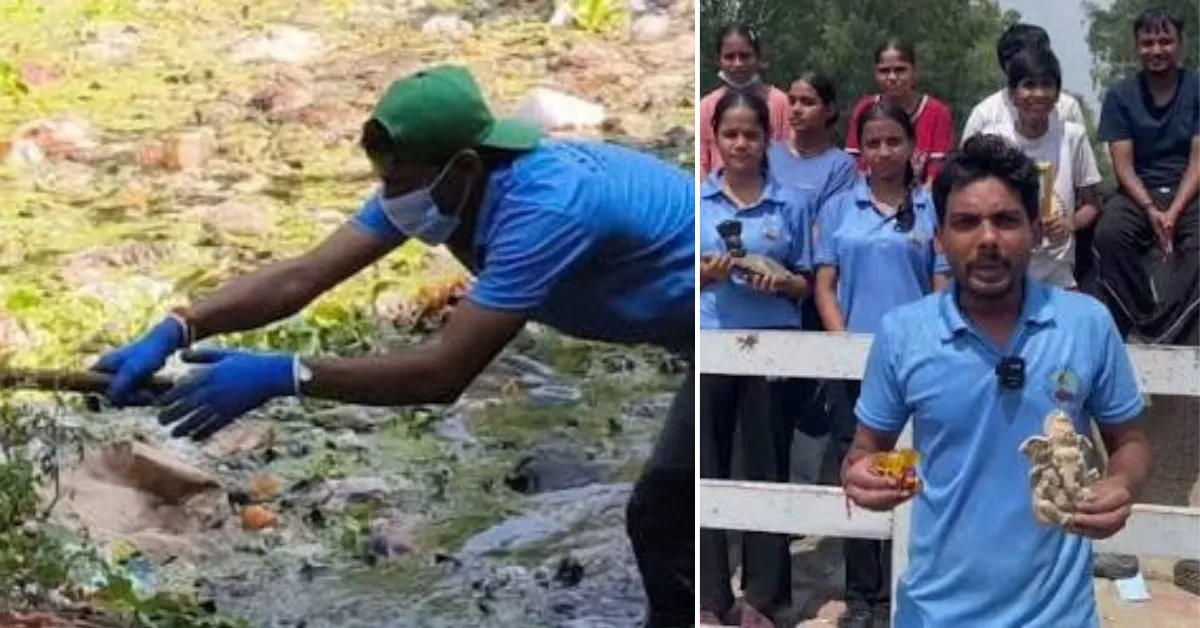
Every Sunday, groups of 40 to 50 children in north-west Delhi pull on gloves and masks, pick up brooms, shovels and sacks, and head for a park or street corner buried in rubbish.
Most of them come from migrant working-class families whose parents moved to the capital for work and now rent homes nearby. Behind them walks Vinay Das, a tutor who lives with his wife, two children and mother in a rented room in Wazirpur that measures eight feet by eight feet.
Since 2018, his young volunteers have cleared around 250 parks, streets and public spaces, and 1,600 children have now joined his mission.
A tutor who skipped a lecturer’s post
Das began offering free tuition to poor children in his neighbourhood in 2013.
Soon after finishing his own education, he received an offer to join a semi-private university as a lecturer, a job that would have made him financially secure, but he chose to work among children from slums and rented rooms instead.
His own childhood shaped that choice, because his mother recalls that even three meals a day were hard to manage. His father worked as a peon at a Delhi police station, and Das grew up in a small room shared with two brothers and three sisters. He started working at the age of 7 to pay for his studies.
Today, he teaches around 300 children, and some of his former pupils are pursuing master’s degrees.
From one park to 250 public spaces
Das says Wazirpur’s parks once held garbage piles 12 to 15 feet high, so he concluded that educating children and raising their awareness had to go together.
On 1 September, 2018, he led a team of 150 children into one such park and cleared all of it. Children now play there. The drive then spread beyond Wazirpur as the team began posting its work on social media.
Shruti, who has volunteered since 2019 and now holds a master’s degree, says residents began telling the team about neglected spots. Her parents first pointed out that she did no housework at home yet went out to clean, but they now support her and sometimes join in.
Although 1,600 children belong to his projects, about 350 take part in the cleaning drives at any time. Teams also plant saplings where garbage once stood and tend them for at least three months. Rahul Mishra, who is now studying for a master’s in law and has known Das since his school days in 2017, says his parents disliked the idea at first but now feel proud when people praise him.
Idols, canals and hazards
The volunteers clear green waste, debris and household waste, and they also collect idols that people leave beside roads or under peepul trees. They immerse these idols in artificial ponds or large tanks.
/filters:format(webp)/english-betterindia/media/media_files/2026/10/08/3-2026-10-08-16-28-27.jpeg)
Das, who is Hindu, says the sight of discarded idols pains him, so his team paints messages on peepul trees reminding passers-by that the tree is not a retirement home for gods.
At the Munak canal, where he saw large numbers of idols being immersed, the team has cleaned about three kilometres and, according to Aaj Tak, removed more than 2,500 idols.
One recent drive pulled a Shivling weighing 30 to 35 kilograms out of the waste, and government work to clean the canal is now under way as well. The work carries risk, since volunteers have found glass and needles in the waste, and chemicals leaking from one sack once blistered Das’s hands.
How the work is funded and why it matters
Das charges parents a fee of up to ₹600 for students from Class 1 to 12, which covers cleaning supplies, stipends for older students who tutor younger ones, and the rent for a free library where children study and play educational games. In 2024, he registered an NGO, Swasti Das Seva Samiti.
The need is considerable.
Delhi generates 11,852 tonnes of municipal solid waste daily but processes only 7,611 tonnes, the Central Pollution Control Board told the National Green Tribunal, which leaves 4,241 tonnes for the Bhalswa and Ghazipur dumpsites.
/filters:format(webp)/english-betterindia/media/media_files/2026/10/08/4-2026-10-08-16-29-52.jpg)
ThePrint reports that fresh waste still arrives at 11,000 to 12,000 tonnes a day. Recognition has followed. Delhi Chief Minister Rekha Gupta has shared Das’s Instagram page, and Mishra says 95% of residents in cleaned areas become more aware and litter less.
Das says his larger aim is that these children carry such campaigns wherever life takes them, and he adds that he does not work for praise.
About the campaign
This story is part of The Better India’s #CivicSenseRevolution, a year-long nationwide campaign celebrating citizens who take responsibility for the places and communities we all share. From cleaner streets and safer roads to restored lakes and public spaces, we’re looking for everyday Indians turning civic sense into action. Know someone doing work like this? Nominate your Civic Sense Hero here.
Sources:
‘From Free Tuitions To A Social Campaign: How One Man Inspired A Team Of Underprivileged Kids To Clean Up Delhi’s Garbage‘: by ETV Bharat English Team for ETV Bharat, Published on 28 January, 2026
‘गली-मोहल्ले साफ करते-करते बना डाली 1600 लोगों की टीम; खुद बच्चों को दी मुफ्त शिक्षा और लाइब्रेरी, जानें दिलचस्प बातें‘: by ETV Bharat Delhi Team (report by Shashikala Singh) for ETV Bharat, Published on 30 January, 2026
‘हाथों में दस्ताने, कंधों पर कचरे के बोरे… दिल्ली की मुनक नहर चमकाने निकले युवा‘: by Manish Chaurasia for Aaj Tak, Published on 28 September, 2026
‘Delhi processes only 64 pc of daily waste, rest dumped at Bhalswa, Ghazipur landfills: CPCB tells NGT‘: by IANS for The Hans India, Published on 1 January, 2026
‘Delhi’s garbage mountains are finally coming down. New ones are rising‘: by Manisha Mondal for ThePrint, Published on 2 October, 2026
Disclaimer : This story is auto aggregated by a computer programme and has not been created or edited by DOWNTHENEWS. Publisher: thebetterindia.com