Staff writers
Updated ,first published
The Australian sharemarket has risen at the open with banks driving gains despite falls on Wall Street, with technology stocks slumping after a report said OpenAI’s revenue may be lower than forecast.
The S&P/ASX 200 was up 38.7 points, or 0.5 per cent, to 8699.6 in early trade, with six of 11 industry sectors in positive territory.
Financial stocks advanced across the board with Westpac rising 1 per cent while Commonwealth Bank, National Australia Bank and ANZ Bankadded 0.9 per cent.
Technology stocks are higher despite sharp falls for technology stocks on Wall Street. Codan added 0.9 per cent, WiseTech gained 1.6 per cent, Xero advanced 2.2 per cent, Technology One climbed 1.2 per cent and NEXTDC gained 0.8 per cent.
Meanwhile, data centre start-up Firmus has withdrawn its plans for a blockbuster listing on the ASX after investors balked at the price and terms, scrapping an initial public offering that would have valued the Australian company at about $43.7 billion.
Mining stocks are mixed. BHP lost 0.3 per cent, Fortescue shed 0.6 per cent while Rio Tinto was 0.3 per cent higher. Gold miners are higher after the price of the precious metal rose from a two-month low, with traders assessing the outlook for energy prices after President Donald Trump said the US would not attack Iran before the midterm elections. Bullion climbed as much as 0.9 per cent to trade near $US4146 an ounce. Northern Star added 0.5 per cent and Evolution Mining was 0.7 per cent higher.
Energy stocks are mixed as oil prices eased in early Asian trade after Trump’s Iran announcement. West Texas Intermediate dropped toward $US91 barrel while Brent closed above $US104. Woodside Energy dipped 0.3 per cent and Santos added 0.2 per cent in early trade while Ampol was flat and Viva Energy shed 0.9 per cent.
The Australian dollar was trading at US69.59¢.
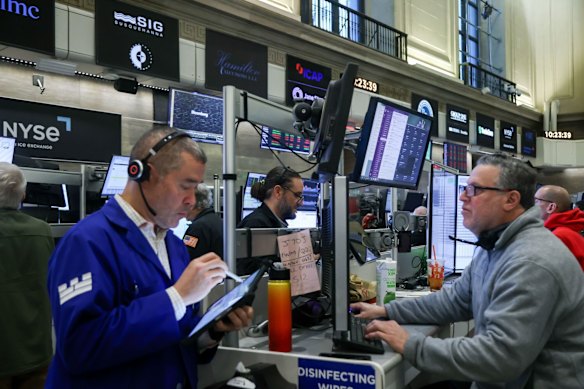
Overnight, the S&P 500 dipped 0.5 per cent for its second-straight loss after setting its all-time high. The Dow Jones closed flat and the Nasdaq finished 1.3 per cent lower.
Nvidia, the chip company that’s ridden the tidal wave of demand created by the artificial-intelligence technology frenzy, fell 2.9 per cent and was one of Thursday’s heaviest weights on the S&P 500. Tech and AI-linked stocks fell around midday amid multiple bearish headlines. The Financial Times reported OpenAI’s annualised revenue is $US20 billion ($28.7 billion) less than previously signalled. Oracle slid following a report it was trucking natural gas to server farms as a workaround to power bottlenecks.
That was even though a bellwether for the chip industry, Taiwan Semiconductor Manufacturing Co., reported growth for September that suggested its revenue for the latest quarter was strong enough to top analysts’ expectations. TSMC’s stock that trades in the United States fell 1.4 per cent.
Wall Street also felt pressure from more sharp swings within the bond market.
The yield on the 10-year Treasury veered from 5.28 per cent late on Wednesday to 5.35 per cent early on Thursday morning. It then fell back to 5.26 per cent.
Despite all the back and forth, it remains near its highest level since 2002 and well above its 3.97 per cent level from before the war with Iran began because of worries about high inflation, big government debt loads and other factors.
Also helping to support yields was the latest report to suggest the US economy is continuing to chug along. Fewer US workers applied for unemployment benefits last week, which may mean companies are laying off fewer workers.
Higher yields can slow the economy by making it more expensive for everyone to borrow money. High yields also put downward pressure on prices for stocks and other investments, and those seen as the most expensive often feel the brunt.
That raises the pressure on companies to deliver big growth in profits, which can offset the downward push on their stock prices from higher bond yields. A big reason for the S&P 500’s rally to a record is that analysts expect companies in the index to deliver nearly 30 per cent growth in earnings per share this upcoming reporting season.
That’s a high bar.
Levi Strauss reported a bigger profit for its latest quarter than analysts expected, while raising its forecast for profit over its full fiscal year. But its stock nevertheless fell 2.4 per cent after its growth in revenue fell short of analysts’ expectations.
PepsiCo, in contrast, added 3.7 per cent after reporting stronger profit and revenue for the latest quarter than analysts expected and highlighting strength outside of North America. It, though, cut its forecast for an underlying measure of profit this fiscal year.
Expectations are likely not as high for PepsiCo as for other companies because its stock came into the day with a drop of nearly 14 per cent for the year so far. That compares with gains of nearly 15 per cent for the S&P 500 and 27.3 per cent for Nvidia over the same time, which are both near their records.
In stock markets abroad, South Korea’s Kospi fell 2.6 per cent for one of the world’s larger losses. It was hurt by a 2.4 per cent drop for Samsung Electronics, one of its two dominant stocks.
The tech giant said its operating profit for the latest quarter likely soared to $US107.4 trillion Korean won ($110 billion) from $US12.17 trillion won a year earlier, but that wasn’t enough to satisfy investors.
Indexes fell across much of the rest of Asia and Europe.
With AP, Bloomberg
The Business Briefing newsletter delivers major stories, exclusive coverage and expert opinion. Sign up to get it every weekday morning.
From our partners
Disclaimer : This story is auto aggregated by a computer programme and has not been created or edited by DOWNTHENEWS. Publisher: www.smh.com.au