For years, elephants crossing railway tracks along the Tamil Nadu-Kerala border were being hit by trains. The deaths were happening along railway lines that passed through their natural habitat, but the exact locations and timings of these accidents needed closer examination.
In 2021, Dayanand Krishnan, a 52-year-old civil engineer and GIS consultant from Chennai, worked with fellow RTI activist R Pandiarajan to obtain information from Southern Railway. They wanted to know where the elephants were dying, at what time, and on which section of the tracks.
What came back was data Dayanand could map.
Dayanand, who has spent nearly a decade filing RTIs on everything from railway construction to water quality, plotted the accident locations and identified patterns. The findings helped show which stretches of track were particularly dangerous for elephants, including areas close to water sources.
The study drew media attention and highlighted the need for better safety measures. The Madras High Court subsequently pursued measures to prevent elephant deaths, including thermal cameras and AI-based detection systems along the tracks.
“Around 6,000 to 7,000 elephant sightings have been safely recorded on the Tamil Nadu side,” Dayanand says. “The system is now implemented.”
But across the border in Kerala, elephants continue to lose their lives on railway tracks. On 12 August 2026, an elephant and its calf were killed by a train near Palakkad in Kerala. The Madras High Court has since called for the detection system operating in Tamil Nadu to be extended to the Kerala stretch as well.
For Dayanand, the experience shows what can happen when government information reaches people who know how to use it.
And he believes every citizen should know how to ask for that information.
You can ask the government for answers, too
You don’t need to be an activist or an engineer to file an RTI.
The Right to Information (RTI) Act, 2005 gives every Indian citizen the right to request information held by public authorities, whether a municipal corporation, a government ministry or a railway department.
You can ask for records about an unfinished road, water-quality reports, the status of a government project or how public money has been spent.
The authority is generally required to respond within 30 days. You don’t need a lawyer or an explanation for why you want the information. All it takes is a written or online application and the prescribed fee, generally Rs 10.
It’s one of the few tools an ordinary citizen can use to seek official records and hold public authorities accountable. Yet Dayanand believes too few people take advantage of it.
After eight years and hundreds of applications, he has learnt what separates an RTI that gets a useful response from one that leads to delays and repeated follow-ups.
Who should your RTI go to, and what should it say?
The process begins before you write your first question.
“Most of the time, people don’t address it to the proper authority,” Dayanand says. “That’s the major issue.”
Sending an application to the wrong department can delay the response or leave you waiting while it is transferred. So, before drafting your RTI, find out which public authority holds the information and who is responsible for handling the request.
Here are the steps Dayanand recommends:
-
Find the right Public Information Officer (PIO). Most departments list their PIOs on their websites, sometimes by zone or ward. If you’re unsure, call the department and find out which office handles the information you need.
-
Ask for existing records rather than explanations. “Never ask ‘how’, ‘what’, ‘when’ or ‘why’,” Dayanand says. “These are questions, and they will reject the application.” This is his advice on drafting requests, rather than a legal prohibition on particular words. Under the RTI Act, officials must provide information available in their records, but they are generally not required to create fresh explanations. Instead of asking why a road project is delayed, for example, request its current status, approved completion date and copies of relevant progress reports.
-
Know the relevant sections. Section 6(1) covers the right to request information. Section 6(3) requires a public authority to transfer an application, or the relevant portion, to another public authority when appropriate. Dayanand recommends mentioning these sections in the application, although doing so is not mandatory.
-
Keep the application focused. Dayanand advises limiting requests to around 10–20 clearly worded points. This is his practical recommendation, rather than a fixed legal limit. The important thing is to specify the records you need without making the application unnecessarily complicated.
Once the letter is ready, you can submit it through the appropriate RTI portal or by following the department’s prescribed offline process.
For central government ministries and departments, applications can be filed through the Central RTI Online Portal. For state government departments, check the relevant state authority’s RTI filing instructions. The central portal does not accept applications addressed to state government authorities.
You can enter the request directly into the online form or attach a document where the portal permits it. After submitting the application and paying the fee, keep the registration number or acknowledgement safely.
That is the first step. What happens after you receive the information can be equally important.
Dayanand learnt this during a dispute over drinking water in Tambaram.
An RTI about water contamination turned into a legal battle
It began with a question about something every household depends on: safe drinking water.
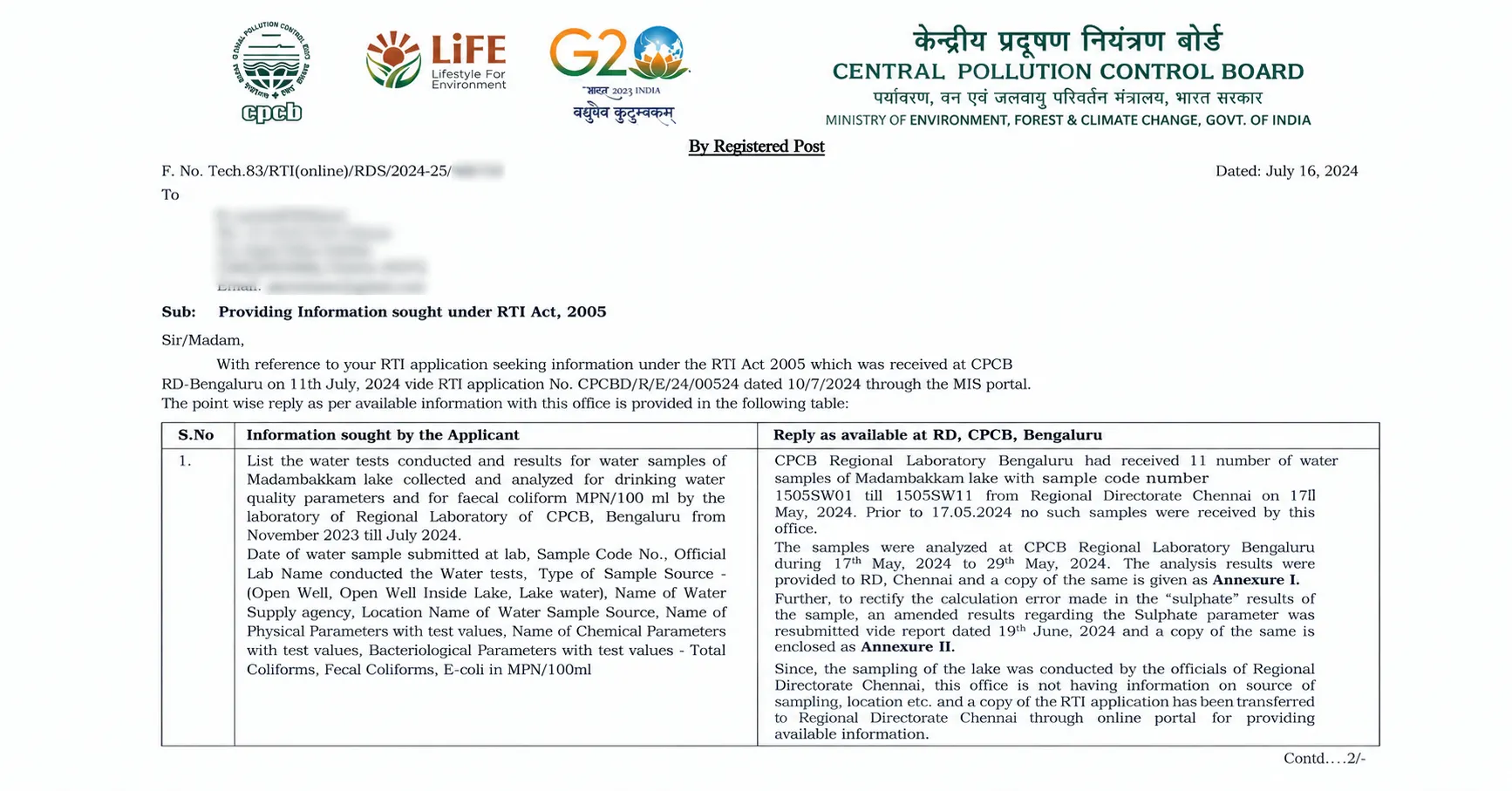
Dayanand wanted to know what the water-testing reports from Zone 3 of the Tambaram Corporation actually showed. So he filed an RTI seeking the information.
What he found was worrying. According to Dayanand, the records revealed E. coli bacteria in an underground water sump, with the contamination linked to a nearby lake affected by sewage.
For residents depending on that water supply, this was an important finding. Dayanand made the information public, hoping the corporation would investigate the contamination and address the problem.
But instead of getting the response he had hoped for, he found himself facing criminal charges.
Dayanand says the corporation disputed his findings, called them “fake news” and filed a case against him. He now had to defend the very information he had obtained from official records.
So he went back to the documents.
Dayanand retrieved three years of Department of Public Health reports, which, according to him, had already raised concerns about the same lake’s water quality, long before he spoke publicly about it.
He took these records to the Chief Secretary. Dayanand says they helped establish that the corporation commissioner’s testing had covered physical and chemical parameters but had not adequately examined bacterial contamination when the allegations against him were made.
The same government records that had helped him raise the issue were now helping him support his findings.
“RTI also protects you when you’re asking questions from the government,” Dayanand says. “You should do it in a proper, sensible way, because that matters just as much. “What you ask and how you ask it matter. Only then can it protect you.”
/filters:format(webp)/english-betterindia/media/media_files/2026/10/08/3-2026-10-08-20-06-35.jpeg)
His experience shows why the documents you request, the replies you receive and the records you preserve can matter long after an RTI has been answered.
But Dayanand has also faced another frustrating situation during his years of filing RTIs: times when the government simply stopped replying.
No reply to your RTI? Here’s what you can do
For two years, Dayanand had been using information obtained from Southern Railway to raise questions about projects that remained stalled. He shared the records with the media, hoping to draw attention to the delays. But over time, getting answers from the department became increasingly difficult.
He says Southern Railway began citing Section 7(9) of the RTI Act to avoid providing information. This provision allows authorities to change how information is supplied if the requested format would require too many resources or risk damaging records. However, it does not give them the right to refuse information altogether.
“They started dodging the RTI application,” Dayanand says.
If you’ve ever sent an application to a government office and waited weeks without hearing back, you can understand how frustrating this can be. But a delayed or unanswered RTI doesn’t mean you’ve reached a dead end.
The law gives you ways to follow up, challenge a response and seek the information you’re entitled to.
Here’s what Dayanand recommends:
-
Check the 30-day deadline: Public authorities generally have 30 days to respond, although certain circumstances have different deadlines. Dayanand says delays are common in his experience with state departments, and he often follows up. “We remind them and try to get the reply,” he says.
-
File a first appeal. If you receive no response within the prescribed period, or are dissatisfied with the reply, you can file a first appeal with a senior officer in the same public authority. This generally needs to be done within 30 days of the response or expiry of the response deadline. First appeals are free. Dayanand says this stage can be frustrating because the appellate officer belongs to the same department. “That person also knows me,” he says. However, an unsuccessful first appeal does not end the process.
-
Move to a second appeal. If the first appeal is unsuccessful or remains unresolved, you can approach the Central Information Commission or the relevant State Information Commission. The usual deadline for a second appeal is 90 days from when the first appellate decision was received or should have been made. Dayanand is currently pursuing a second appeal himself.
-
If it’s a public issue, consider approaching the media. Dayanand has repeatedly shared verified government information with journalists to draw attention to civic problems. His experience shows how public scrutiny can help bring neglected issues into focus.
/filters:format(webp)/english-betterindia/media/media_files/2026/10/08/4-2026-10-08-20-12-59.png)
There is another concern that many people may have before filing an RTI: can they do so anonymously?
“There’s no such provision,” Dayanand says. “It should only be filed in an individual’s name.”
An RTI application requires identifying and contact details, which is why understanding the procedure and maintaining a proper record of communication matters.
What eight years of filing RTIs have taught him
After eight years of filing RTIs, Dayanand has one wish: that more government information be easily available to the public, without people having to formally request it.
He points to the Airports Authority of India as a good example. It already publishes monthly figures on flights and passenger traffic for anyone to access.
“Let all government departments be transparent,” he says. “Why do we have to file an RTI to know this information?”
While he hopes more departments will adopt similar practices, he also wants citizens to make better use of their right to information.
“In Chennai, we’re not seeing many RTI activists working on social issues,” Dayanand says, mentioning Arappor Iyakkam as one of the few groups active in this space.
He also believes people should check facts before forming opinions about issues affecting their cities.
For instance, he often comes across claims that Chennai has “lost its industry” to Bengaluru. Looking into international aviation data, he found that the two cities had similar flight numbers. While these figures alone cannot establish how their industries compare, he believes official data is a useful starting point.
“Speak with data,” he says. “Without data, you’re just making things up.”
It’s an approach he has followed across issues ranging from delayed railway projects and the restoration of Chitlapakkam Lake to drinking-water safety and elephant deaths along railway tracks.
Each time, he began by seeking official records, understanding what they revealed and, where necessary, sharing his findings with journalists or approaching the relevant authorities.
He believes ordinary citizens can do the same.
Perhaps there’s a road in your neighbourhood that has remained unfinished for months. Or you’ve wondered whether your drinking water has been tested, or what happened to a public project announced years ago.
An RTI can help you find out what the official records say.
And that’s what Dayanand hopes more Indians will do: ask questions, seek reliable information and take an active interest in the places they call home.
Disclaimer : This story is auto aggregated by a computer programme and has not been created or edited by DOWNTHENEWS. Publisher: thebetterindia.com