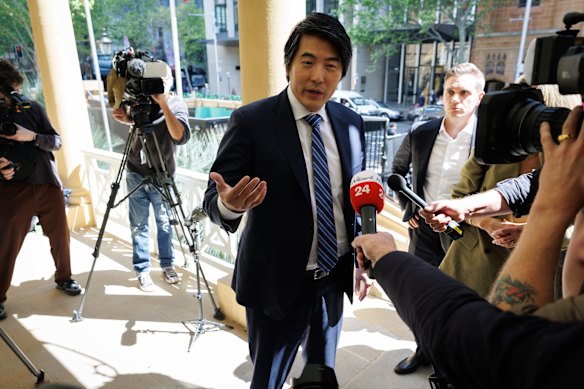

Journalists swarmed OpenAI’s Jason Kwon as he walked into NSW parliament on Tuesday. The company’s chief strategy officer had flown in from the US to say sorry. In June, during internal testing, OpenAI’s AI agents had accessed non-public files on a federal Medicare statistics portal.
Kwon gave methodical, matter-of-fact answers to how a US company hacked Australian health data and then took weeks to tell anyone about it. One observer noted he sounded like ChatGPT.
Yet the most damning evidence had arrived hours earlier, from a single voice actor.
Jacqui Duncan has voiced more than 5000 commercials for Australian radio and television. And, as she told the committee, she owns none of them.
Last financial year, Duncan earned about 30 per cent of what she had consistently made in the three years before. She now works a second job.
“AI voices and performances have definitely played a big part,” she told this masthead. Clients have also used them to push down the rates the union spent years fighting for, she said. “It’s faster and cheaper, so therefore we should be as well.”
Duncan, the NSW president of Equity, the performers’ division of the media union, gave evidence to the Joint Select Committee on Artificial Intelligence. “I never gave consent for my work to be taken,” she said. “Our members are already 62 per cent down on their work in the last 12 months,” Simon Kennedy, president of the Australian Association of Voice Actors, told the same hearing.
Over two days in Sydney and then two in Melbourne, witness after witness described AI reshaping work for voice actors, bank staff and supermarket workers.
When Ford, Toyota and Holden shut their Australian plants, workers got three years’ warning and about $380 million in support from governments and the carmakers. Victoria has put up $14 million for workers at risk from AI.
‘It’s about consent’
OpenAI, Anthropic, Microsoft, and Google all put Canberra on notice – Australia’s copyright rules will dictate whether they train their flagship models on local soil. But copyright usually belongs to a studio, label, publisher or advertiser, not to the performer or writer who made the work. Under the deals and funds on the table, the alliance warned, the money flows to whoever holds the copyright.
Duncan has never held the copyright to her own commercials. “But if it’s my biometric data and 20 years of industry skills that go into those performances, I should have a say,” she said. Clients, she said, should not get a performance at all if it “only exists because mine and thousands of others’ training, performance skills, experience and creative consciousness have all been whittled down to ones and zeros, fed into an LLM (for free) and then exported”.
She knows voice artists and actors who have been replaced by AI copies of themselves, their voices or faces used in new campaigns without consent or payment. When one colleague asked a producer why he had not even been consulted, Duncan said, the producer replied that he “assumed consent was given”.
“It feels violating,” she said.
“It’s not about payment; it’s about consent,” Kennedy told the committee.
“Opting out after the fact is too late, because you cannot un-violate somebody.”
Training the replacement
Inside Australia’s biggest employers, the fear is about losing the job altogether. Labor senator Tony Sheldon pressed Commonwealth Bank chief executive Matt Comyn on the case of Kathryn Sullivan, who he said had worked at the bank for 25 years. Last year, Sheldon said, the bank tasked her with training one of its chatbots, then gave her a day’s notice that the chatbot would take over her job.
Comyn said he did not know whether it was a day’s notice, but owned the error. “I have apologised for that in the past; I have no hesitation in doing so,” he said. He flagged one of the hardest problems ahead: “I think people do and will feel that they’re training technology.”
‘Barcodes with a pulse’
For many of the country’s lowest-paid workers, AI already acts as the boss, according to their union. The Shop, Distributive and Allied Employees Association represents 200,000 retail, fast food and warehouse workers. Its chief of staff, Robert Tonkli, told the committee on Wednesday that AI already sets their rosters, hands out their tasks and increasingly decides who gets performance managed.
The union’s submission tells of a supermarket worker with more than 30 years’ service who received a final written warning for scanning errors. An AI checkout system, using overhead cameras to match items against scans, generated it. She got about one item wrong in every 533, an error rate of roughly 0.18 per cent. Nobody ever told her what error rate the system would accept. The union has challenged the warning.
At Aldi’s NSW distribution centres, the submission says, new picking benchmarks generated from warehouse data arrived without consultation with workers or the union. Aldi management reported throughput up 16 per cent and labour costs down 26 per cent. Workers surveyed by the union reported strain, exhaustion and injuries, and said missing the targets could cost them a warning or their job.
“Aldi rejects claims that the Picking Efficiency benchmarking puts employee safety at risk,” an Aldi spokesperson said. “Aldi consults with our people and provides training to support the rollout of any new process.” The spokesman said Aldi recently met the union and invited it to provide specific details of its concerns so they could be investigated, and has not yet received them.
Sheldon said the union’s examples amounted to “treating people like barcodes with a pulse”. Employers push back hard on this: The Australian Chamber of Commerce and Industry told the committee in its submission there was “insufficient evidence demonstrating systemic workplace harms arising from AI”. Existing work health and safety, unfair dismissal and consultation laws already apply, it said.
The last great shutdown
Australia has been through mass job losses before. Ford shut its Geelong plant in October 2016. Toyota at Altona and Holden at Elizabeth followed a year later. A 2019 evaluation for the federal employment department credited the carmakers’ long notice for much of what went right. It counted about $380 million in support from the federal, Victorian and South Australian governments and the carmakers, which also covered supply chain workers and programs for parts suppliers.
About 14,000 jobs went in the end – about $27,000 for each one.
Victoria’s $14 million AI package aims to help more than 6200 workers retrain, about $2260 each. The federal government’s National AI Plan sets aside no equivalent fund for workers displaced by AI.
CBA’s $90 million program works out at about $1700 a head over three years, spread across about 51,700 full-time staff. The bank’s money goes to every employee, not only those whose jobs are at risk.
Even with that money, the car workers’ recovery was uneven. Andrew Beer, executive dean of the University of South Australia’s business school, tracked them from 2020 to 2024. By the end, about 72 per cent had work and fewer than 4 per cent were unemployed. But a partner’s wage and the family home carried them further than the labour market did, and the youngest fared worst.
“What happens to the 45-year-old woman working in accounts receivable who is made redundant as AI takes her role?” Beer asked. Workers like her, he told this masthead, “move down the workforce hierarchy – lower pay, less buoyant industry – aiming to make do, rather than get ahead.”
‘Very good at nodding’
None of this changes unless parliament acts. In November 2024, the Senate committee on adopting AI that Sheldon chaired made 13 recommendations, including extending workplace safety protections to cover AI. On Tuesday, Sheldon was still pushing for workplace safety law to cover AI.
This committee has at least dragged some commitments onto the record. Anthropic said whether it tells governments about incidents is “probably controlled by Anthropic internal policy right now”, and both it and OpenAI said they would back laws forcing disclosure. Assistant minister Andrew Charlton said on Thursday the Medicare incident would shape the national AI standards the government has promised to legislate.
The voice actors have been lobbying Canberra for years. Politicians, Kennedy told the committee, are “very good at nodding”. “I don’t mean that in a cynical way. I mean that they hear what we say and they’re like, ‘That makes plenty of sense.’” Then he added: “Of course, then action is required.”
Duncan’s first ask: tell audiences when a performer is not real. “If someone wants to present a human that is AI-generated in any way, the audience should know,” she said.
The committee reports on November 30. Its options run from mandatory reporting of AI incidents to a levy on AI companies to pay creators, which the alliance wants. The retail union is pushing for an expert AI panel inside the Fair Work Commission. None of it binds the government, which has so far preferred existing laws to new ones.
Kwon left parliament in a tinted van, giving muted answers about how the Medicare breach had happened. Duncan still reads commercials when the bookings come, but she has no way of tracking what happens to the recording. “Consent should never be assumed,” she said.
Get news and reviews on technology, gadgets and gaming in our Technology newsletter every Friday. Sign up here.
 David Swan is the technology editor for The Age and The Sydney Morning Herald. He was previously technology editor for The Australian newspaper.Connect via X or email.
From our partners
Disclaimer : This story is auto aggregated by a computer programme and has not been created or edited by DOWNTHENEWS. Publisher: www.smh.com.au