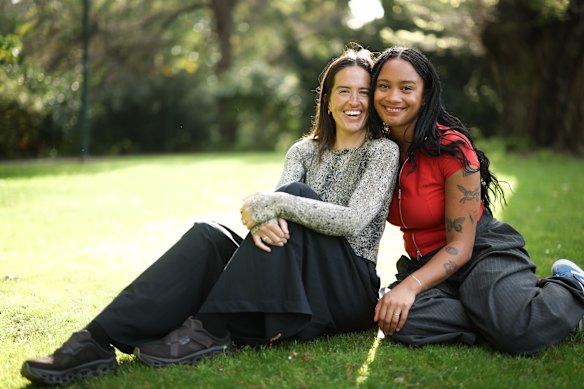

Every morning, Aurelia St Clair and her wife, Tamara Natt, say goodbye with a kiss.
“Aurelia will always drop me off at the train in the morning, and we’ll have a kiss goodbye, and then she’ll pick me up with our dog, and we have a kiss hello,” Natt, 35, says.
“It’s like punctuation,” adds St Clair, 31.
For the couple, who split their time between Tweed in northern NSW and Melbourne, kissing has been a formative part of their relationship since the beginning.
“Our first kiss was at the airport where we met for the first time,” Natt recalls.
“Aurelia was visiting me on the Gold Coast for our first date because she lived in Melbourne, and I was on the Gold Coast at the time. I pulled into the airport pick-up zone, left the car in the middle of the road, engine still running, opened the door and I saw her, and we just kissed on the spot.
“It’s the first thing we did without even saying a word to each other.”
What’s in a kiss?
Whether it’s Juliet telling Romeo “you kiss by th’book”, Peter Parker and Mary Jane kissing upside down in the rain, or Kenzie’s assertion that “a kiss is like a handshake” on Love Island USA, kissing has been a perennial point of fascination in the modern cultural imagination.
While it’s now often viewed through the lens of love and sex, if you look back through human history, kissing has evolved in both significance and meaning. In medieval and early modern Europe, we kissed to sign a contract, to demonstrate fealty to a superior, to express affection and more, explains historian and Macquarie University professor Katie Barclay.
“Over time, the reasons for kissing declined, becoming an intimate gesture of romantic love and family life,” says Barclay, who also wrote the forthcoming book, The Kiss: A History of Passion and Power.
Today, kissing is closely associated with evolutionary and sexual drives, as well as part of theories of child development and attachment.
“Kissing as part of adult sexual life is usually viewed as growing out of our early development, and viewed as a manifestation of connection and love.”
What are the health benefits of kissing?
There’s good reason why kissing is particularly significant among humans compared to other animals. Our lips, for one, pout outward and are made of thousands of nerve endings that can send messages to the brain from a simple brush.
Our sense of smell, however, isn’t as strong. So, to smell a potential mate (scent has been found to be a strong natural indicator of romantic attraction), we need to get up close and personal. Evolutionary psychologists from the University at Albany found that more than half of men and women have ended a relationship because of a bad kiss.
Separate to the search for a partner, kissing is good for us because it makes us feel good.
When we kiss, the pleasure and reward centres of our brain are activated, releasing a chemical cocktail of dopamine, oxytocin and serotonin (known as the desire, love and feel-good hormones, respectively).
In a small German study, researchers found that daily instances of intimacy like kissing lowered stress hormones like cortisol.
Kissing as a relationship measure
A recent study published in PLOS One examined how public displays of affection (PDA) can influence relationship satisfaction across diverse cultures.
After collecting data from 461 participants in Poland, Indonesia and Nepal, they compared their public and private displays of affection, as well as how they felt about other people engaging in PDA. They also examined relationship satisfaction and its associations with the expression of affection.
Across all three countries, despite their differing cultures, positive correlations were observed between displays of affection and relationship satisfaction, underscoring the importance of affectionate behaviours in romantic relationships.
Clinical psychologist Narelle Dickinson echoes similar sentiments, explaining that when talking to couples, kissing can function as a barometer for establishing the overall health of a relationship.
“Sometimes we can ask people a question of ‘when did you last kiss your partner, not because you were looking to have sex but because you just wanted to kiss them?’ And if you think, ‘oh my God, I can’t remember, or it’s been weeks’, that’s probably a real shame,” Dickinson says.
“It doesn’t mean that your relationship is on the line, but it means that intimacy has fallen by the wayside a little bit.”
Couples therapists and clinical psychologists Julie and John Gottman famously asserted that a six-second kiss was all it took to transform a relationship. Across 30 years of research, they’ve assessed over 3000 couples to determine that six seconds was long enough to trigger the release of oxytocin in the brain, encouraging feelings of closeness and bonding among partners.
“One of the nice things about a kiss is that it doesn’t require a big gesture,” Dickinson says, adding that for couples navigating medical treatments or fertility issues that can render sex a chore, finding non-sexual forms of intimacy is crucial.
“You don’t have to save it for date night; you can kiss your partner when they get home, or when you’re passing them in the kitchen.
“It’s closeness and connection that are important, so having some of those other forms of intimacy like kissing or even just holding hands and hugging make a difference.”
Aurelia and Tamara have adopted a similar approach over their four-year marriage.
“It’s part of our relationship health,” Tamara says. “Building that into our routines like we do like exercise or anything else because it maintains that sense of closeness without effort.”
Make the most of your health, relationships, fitness and nutrition with our Live Well newsletter. Get it in your inbox every Monday.
From our partners
Disclaimer : This story is auto aggregated by a computer programme and has not been created or edited by DOWNTHENEWS. Publisher: www.smh.com.au