This article has been published in partnership with India Mental Health Alliance (IMHA).
This article discusses suicide, mental health conditions, and bereavement by suicide. Reader discretion is advised.
A 16-year-old stands in front of a mirror with her mother, holding up one photograph after another and repeating the same words: “this is you”. Her mother, in the middle of an episode of psychosis associated with schizophrenia, looks at the picture, then at her own reflection, and insists that the woman standing beside her husband is a stranger and not her.
In Madurai, a woman grieving her husband sits through a crying spell while the family’s golden retriever climbs onto her lap, wraps both paws around her neck and licks away her tears.
In Mumbai, a 46-year-old woman lives on her own. OCD and anxiety have shaped her life for as long as she can remember, and she still needs a great deal of support and care to live her life. Hanging over it all is one question: what happens to her when her parents are gone? Her mother’s answer, repeated over the years, is the same: “you will be cared for.”
These three moments belong to Dr Kavita Arora, a child psychiatrist, Founding Cohort IMHAand co-founder Children First, Dr Nandini Murali, founder of SPEAK and Project SPEAK, and Dr Pheroza J. Godrej, a philanthropist, and art historian who founded the Cymroza Art Gallery.
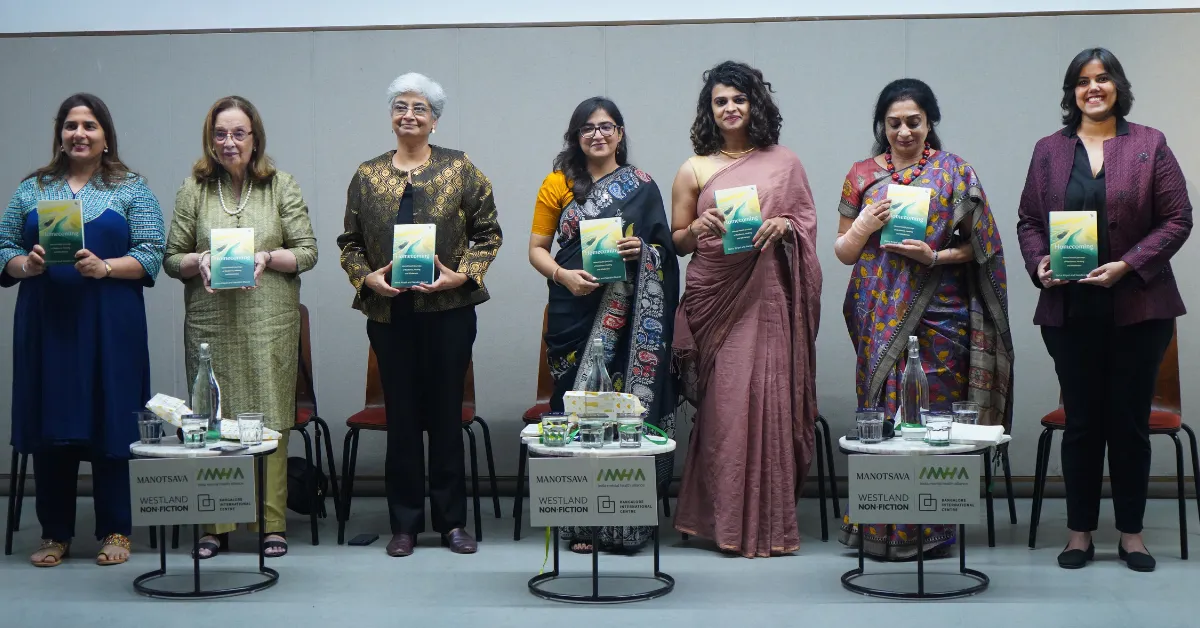
Each stood in a different place around a family’s mental health journey, as a daughter, a wife and a mother, and each has now told her story in Homecoming: Mental health journeys of resilience, healing and wholeness; India’s first anthology of 11 women leaders navigating mental health challenges.
Their stories mostly play out away from the doctor’s cabin. As Kavita puts it, “a lot of the living actually happens between doctors’ appointments.” In these three homes, it was the women who held that daily living together, and very few people asked how they were doing. This story keeps returning to that question, and to another: who was looking out for them?
What a child learns to recognise
When a patient walks into Kavita’s consulting room today, she does something her training never taught her. She asks about everyone who has not come in. “I don’t see just the person or their illness,” she says. “I actually try to ask about the family members who are not in the room.”
The habit has its roots in a childhood she did not think of as unusual back then. Her father was the neighbourhood doctor and the family’s only earner, her mother did most of the cooking, and her brother, a year and a half older, was her closest ally. Her mother lived with schizophrenia, although nobody around Kavita named or explained the term.
/filters:format(webp)/english-betterindia/media/media_files/2026/10/09/3-2026-10-09-17-05-54.png)
“When her episodes would occur, she recalls, “There could be violence,shouting, and paranoia, but as a child, I didn’t know what it was. I thought this was how families were, and this is what happens inside the closed doors of other families,” she recalls.
While her father went about his duties, as children she and her brother learnt to read the atmosphere in the house acutely. At the same time they formed a survival bond, caring for and supporting each other. “March and the end of the financial year was often associated with my mother’s relapse, adding to the exam stressors for us as children,” shares Kavita.
Neighbours often heard the fights, yet “there is no space or forum in which this can be brought up safely, children don’t have direct access to professional care services,” she says. The mirror scene is the memory she returns to most, because it showed her how far apart two people can stand while looking at the same thing. She says she struggled with this while growing up: “How does one even connect with a parent, when their perceived truth is completely unreal?”
/filters:format(webp)/english-betterindia/media/media_files/2026/10/09/4-2026-10-09-17-06-24.png)
What helped her were books read by torchlight under a quilt, the badminton, table tennis and basketball teams, and school friends she has known for 38 years. “I don’t know if they’re necessarily coping mechanisms, because it didn’t feel like I was using these aspects of my life to cope with what was going on at home. It just felt like these were wonderful things that life was offering me, and I felt happy and passionate about them,” she says.
While finding joy and immersing in interests can coexist with invisible anguish and turmoil, there was something none of it could give her: an explanation for what was happening at home.
The missing piece was a diagnosis. Only at 21, did Kavita learn that her mothers condition was a mental illness called schizophrenia. She was in the third year of medical college, and her compassion and understanding changed a great deal once she understood the diagnosis. “Nobody told us what it was. And there was no language around it,” she says. “And nobody asks or initiates the conversation even when everybody can see it”.
/filters:format(webp)/english-betterindia/media/media_files/2026/10/09/2-2026-10-09-17-12-25.png)
She later chose psychiatry, she says, because “in many ways I wanted to provide the care and support to that little Kavita who didn’t have any.” If her silence closed around an illness nobody named, Nandini’s closed around a death nobody wanted to discuss.
What came after the silence
On the second day after her husband died in April 2017, Nandini’s paternal uncle told her something she was not yet ready to hear. “Whenever you’re ready for it, there’s a book in you,” he said. Her husband, Dr T.R. Murali, a urologist of national repute, had died by suicide after the couple had built a life in Madurai over 30-odd years. She still slips into the present tense when she speaks of him, and she describes him as “bright, bold, and brilliant.”
The grief that followed, she explains, arrived wrapped in silence. “It’s not something you can talk openly about because of the stigma, shame, secrecy, and silence around it, and therefore the grieving also becomes very isolated and isolating.”
/filters:format(webp)/english-betterindia/media/media_files/2026/10/09/7-2026-10-09-17-13-36.png)
Searching online, she came across the word postvention, the support offered to people after a suicide loss, and then Carla Fine’s No Time to Say Goodbye. She emailed Carla to thank her and heard back straight away. “Today I consider her my sister across the Atlantic,” she says.
Finding no Indian account of suicide loss written from lived experience, she wrote Left Behind: Surviving Suicide Loss, for which Carla contributed the afterword. She also joined an eight-week online group as the only participant from outside the Western world. “That was when I really learned to process my grief,” she says.
On the first anniversary of her loss, she set up SPEAK in Madurai, and a helpline, Speak to Us, followed during the pandemic. Project SPEAK now runs in three blocks of Madurai district. She admits she first wondered whether the model would work amid low literacy and enormous stigma, but community trust made the difference. In her support groups, she begins with her own story, because “when people hear my story, they know that I’m not manufacturing anything.”
/filters:format(webp)/english-betterindia/media/media_files/2026/10/09/5-2026-10-09-17-12-48.png)
Among the women she meets, a pattern repeats. Many are blamed and shamed, and when a husband has died by suicide, “the ties with the marital side of the family just go off,” she says. When one woman recently described the shaming, other members answered, “Why do you have to put up with all this? If you need support, call us.”
Nandini says that kind of showing up is rare when its about suicide: “very rarely do you have people saying, oh my gosh, this has happened, so how can I support?” About her husband Dr Murali, she says, “people who end their lives need to be remembered by how they’ve lived their lives and the contributions they’ve made to society, and not reduced to the circumstances of their death.”
/filters:format(webp)/english-betterindia/media/media_files/2026/10/09/6-2026-10-09-17-13-05.png)
While Kavita’s silence had closed around an illness nobody named, and Nandini’s around a death nobody wanted to discuss. Pheroza’s was quieter and lasted longer: years of raising a daughter whose struggles no one at school could see, inside a joint family where she had to keep everyone else steady too.
75% for family, 25% for everything else
Pheroza Godrej divides her days the way she learnt to many years ago, with 75% of her time for family and 25% for everything else. “You had to make little compartments in your own brain,” she says.
Her daughter Raika, now 46, is “a strong-willed personality, but extremely loving.” As a child, “she conned me into so many things,” and her mother jokes she would have made a brilliant lawyer. Raika’s learning disabilities went unidentified through a demanding school, and anxiety and OCD followed later. Pheroza, a teacher herself, says, “I regret that we were not taught in our Bachelor of Education what learning disabilities are.”
/filters:format(webp)/english-betterindia/media/media_files/2026/10/09/8-2026-10-09-17-14-58.png)
While care happened inside a large joint family of great privilege; Pheroza talked about her daily living; “You’re like a sandwich, you’re caught between your elders and your children,” she says. Compromise often seemed wiser than daily confrontation, although she admits she gave in more often than Raika met her halfway.
She holds on to the quarter of her time that belongs to her. She stayed involved in the arts, education and sport because, as she puts it, “if I could lose 100% in what you’re making me do, I would be a very horrible, difficult, crotchety person to live with.”
She also read widely and spoke to therapists, psychologists and psychiatrists. “One has to hear everything clinicians say because you never know when the illness could be dormant in a person, and suddenly it blows up,” she says.
Her own mother, who was home every day between 4 pm and 6.30 pm, set the example. “When your child comes home from school, they want to quickly unburden what has happened the whole day,” Pheroza says. “They’re not going to tell you in the night over the dinner table. By that time, they have forgotten.”
/filters:format(webp)/english-betterindia/media/media_files/2026/10/09/9-2026-10-09-17-15-29.png)
A circle of 10 close college friends held her up. “We selected each other with great care,” she says. “Support is very, very essential,” she adds. Her son, 2.5 years younger than Raika, took a different path. “As much as she was outgoing, he started withdrawing. Speaking less, quiet,” she recalls, and today he is “very protective of his sister, and she listens more to him than to me sometimes.”
Raika now lives independently, and “she knows what it is to cater for her daily needs: her food, her car, does it have to go for servicing,” her mother says. Yet the question about the future remains. “Even at 46, her fear of losing us is primary. What will happen to me later on?”
Although their homes differed, each woman reached the same decision; to speak up. Nandini wanted a counter-narrative, she says, because “the mainstream narrative was silence, stigma, shame, and secrecy.” Pheroza, when asked to contribute to the book Homecoming, said, “I’ll try my best to contribute. The perspective of caregivers also needs to find a voice.”
Speaking up brought recognition. Readers write to Nandini, “oh, this offered me hope,” and when Pheroza spoke at a recent conference, people told her, “We’ve never heard anybody speak so frankly about mental health challenges.” Her answer was simple: “I’m speaking because I really believe what I’m saying because I’ve been through this. Don’t give up.”
/filters:format(webp)/english-betterindia/media/media_files/2026/10/09/10-2026-10-09-17-17-07.png)
The word caregiver fits each of them unevenly. Nandini, whose work supports women affected by suicide loss rather than caregivers, is clear about that distinction, while Kavita says, “My identities as a caregiver, daughter and psychiatrist don’t define me. I am not my role.”
She brings her whole self to her work at Children First & India Mental Health Alliance (IMHA), and her experiences as a daughter, a caregiver and a psychiatrist all feed into it. “My lived experiences have informed my approach to care, service design and systems thinking; just as much as my clinical expertise.” Nandini’s Project SPEAK has published the journeys of 10 women from its support groups, and Pheroza still sends copies of the book Homecoming to people she thinks should read it.
Their stories open the caregivers’ chapter of How Are You, India?, The Better India’s campaign on emotional wellbeing, which launches on World Mental Health Day, 10 October. Over the coming months, it will travel to the people and community groups across the country who hold others up, often without anyone checking on them in return.
Go back to the mirror, the golden retriever and the eternal question, and ask what each woman would tell the person she was back then.
Kavita would remind the girl holding up photographs: “Just as her mother isn’t defined only by her illness, neither is she by her role as a caregiving daughter. She is her own person.”
/filters:format(webp)/english-betterindia/media/media_files/2026/10/09/6-2026-10-09-17-19-32.png)
Nandini would tell the woman of 2017, “I was so trusting, I was so naive, I never thought suicide could happen in my family. It happened to others.” Looking at Nandini now, she says, that woman “would validate all the choices I’ve made. The enormous agency I’ve shown.”
Pheroza would give her younger self the advice she now gives other parents: “Take a deep breath, count up till 10, say I love you.” Nobody asked them back then. So they are asking now, and they want the answer from all of us: how are you, India?
This story is part of How Are You, India?, produced in partnership with India Mental Health Alliance.
If you or someone you know needs support, call Tele-MANAS on 14416.
Additional sources:
‘Homecoming: Mental Health Journeys of Resilience, Healing and Wholeness’ (book): By Neha Kirpal and Nandini Murali, 2025
‘Homecoming: Mental Health Journeys of Resilience, Healing and Wholeness’ (film): By India Mental Health Alliance (IMHA), Published on Youtube, 10 March, 2026.
‘National Mental Health Survey of India, 2015-16: Summary‘: by NIMHANS for Ministry of Health and Family Welfare
‘National Mental Health Survey study‘: by National Library of Medicine
Disclaimer : This story is auto aggregated by a computer programme and has not been created or edited by DOWNTHENEWS. Publisher: thebetterindia.com