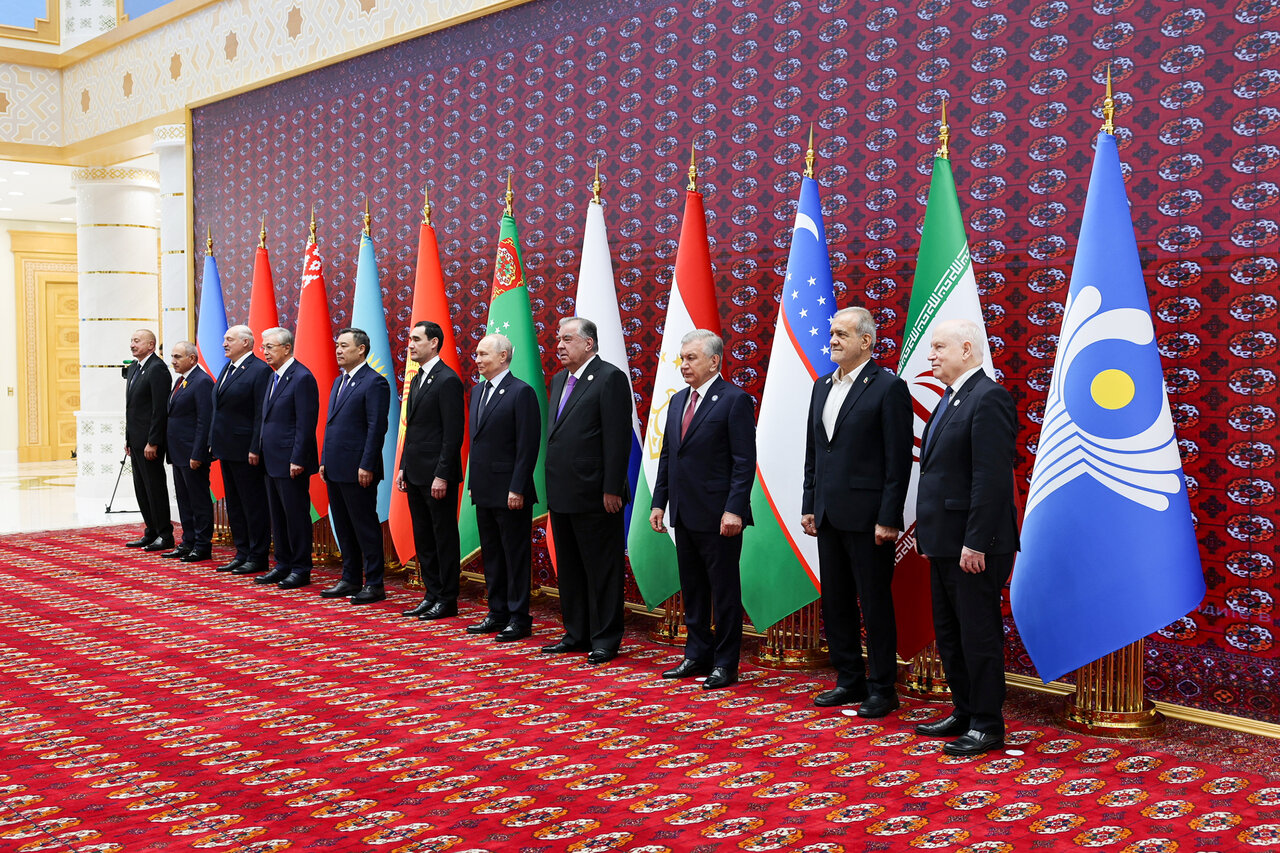
TEHRAN— Iranian President Masoud Pezeshkian has called for deeper regional integration, stronger economic and transport connectivity, and closer cooperation among neighboring countries, proposing a new “CIS+1” framework to expand Iran’s engagement with members of the Commonwealth of Independent States (CIS).
Addressing the CIS leaders’ summit in Turkmenistan on Friday, Pezeshkian emphasized that regional security, economic development and political stability are inseparable, arguing that countries must strengthen their collective capabilities rather than allow external pressures and geopolitical rivalries to undermine cooperation.
His remarks came as he attended two major regional gatherings in Turkmenistan: the CIS leaders’ summit and an extraordinary summit of Caspian Sea littoral states focused on environmental challenges. On the sidelines, the Iranian president held talks with Russian President Vladimir Putin, Azerbaijani President Ilham Aliyev, Armenian Prime Minister Nikol Pashinyan, Shanghai Cooperation Organization (SCO) Secretary General Nurlan Yermekbayev, and Turkmen President Serdar Berdimuhamedov.
Across his speeches and bilateral meetings, Pezeshkian emphasized a common set of priorities: expanding trade and transit links, accelerating joint projects, safeguarding the Caspian Sea, strengthening ties with neighboring countries and advancing a multilateral international order based on dialogue, sovereignty and mutual respect.
‘CIS+1’ framework to strengthen regional connectivity
Pezeshkian described the CIS summit as an opportunity to reinforce existing relationships and open a new chapter in regional cooperation, thanking Turkmenistan for inviting Iran as the gathering’s first special guest.
He proposed establishing a “CIS+1” format to provide a structured framework for cooperation between Iran and CIS member states in trade, energy, transportation, investment, mining, technology, tourism, water management, environmental protection, and scientific and cultural exchanges.
The initiative, he said, could also facilitate joint responses to challenges such as climate change, water scarcity, organized crime, and drug trafficking.
Pezeshkian argued that recent regional and international crises, including the Russia-Ukraine conflict and the US-Israeli military attacks against Iran, had demonstrated the interconnected nature of security and stability.
Countries cannot expect to preserve their own security and pursue economic development while insecurity, economic pressure and instability spread elsewhere in their neighborhood, he said.
The Iranian president also criticized the use of trade, banking, technology, energy and international financial systems as instruments of political pressure, warning that such measures have consequences extending beyond bilateral relations and can undermine regional commerce, investment and economic development.
He maintained that resilience against external shocks and disruptions depends on connecting national capabilities and infrastructure.
“Our shared interests lie not in competition between routes, but in connecting routes,” Pezeshkian said.
Iran positions itself as a regional transit hub
The Iranian president highlighted Iran’s geographical position as a natural link between Central Asia, Eurasia and international markets, particularly through its southern ports on the Persian Gulf and the Sea of Oman.
He singled out Chabahar Port as a strategic gateway capable of connecting Central Asian countries with South Asia, Africa and Europe.
Pezeshkian also welcomed the prospect of implementing a Turkmenistan proposal at the United Nations General Assembly for a transport corridor linking Central Asia, South Asia and Europe through the Caspian region, saying Iran’s infrastructure and geographical position could contribute to the initiative.
He called for the North-South and East-West transport corridors to be developed as complementary components of an integrated regional network rather than competing projects.
The president also urged regional countries to expand cooperation in oil, natural gas, electricity and renewable energy, while exploring practical financial arrangements and barter mechanisms to facilitate trade and sustain economic exchanges despite external restrictions.
He said stronger regional connectivity should be accompanied by genuine multilateralism, with countries in Central Asia, the South Caucasus and neighboring regions playing a more active role in shaping an emerging multipolar world.
“We want connectivity instead of fragmentation, cooperation instead of exhausting competition, interdependence instead of one-sided dependence, and security based on trust and shared interests instead of threats,” Pezeshkian said.
He stressed that regional diplomacy must go beyond summit declarations and become an effective mechanism for managing crises, preventing conflicts from spreading and translating political commitments into practical cooperation.
Pezeshkian calls for coordinated action to protect Caspian Sea
Addressing the extraordinary summit of Caspian littoral states, Pezeshkian warned that declining water levels, climate change, pollution and damage to natural habitats pose serious threats to the region’s environment, economy and coastal communities.
He said the Caspian Sea’s interconnected ecosystem could not be protected through isolated national efforts, calling for joint scientific research, information-sharing and coordinated environmental policies among its five coastal countries.
The Iranian president identified the Tehran Convention as the principal legally binding regional framework for protecting the Caspian marine environment and urged its signatories to strengthen implementation rather than limit their efforts to monitoring environmental deterioration.
He called for a transition toward ‘joint crisis management,’ backed by scientific evidence, sustained political commitment and concrete measures.
Pezeshkian welcomed the decision to establish a high-level commission comprising deputy heads of government from the Caspian littoral states and proposed a long-term regional program under the Tehran Convention to address the sea’s falling water levels.
The proposed program, he said, should include coordinated scientific monitoring, marine pollution control, biodiversity protection, restoration of wetlands and natural habitats, adaptation of ports and coastal infrastructure, support for fisheries and local communities, and the provision of adequate funding and technology.
The president also warned against allowing the Caspian to become an arena for geopolitical rivalry or intervention by extra-regional powers, arguing that lasting security depends on respecting the sovereignty and legitimate interests of all littoral states.
He called for the condemnation of attacks on coastal facilities, ports, vessels and other maritime infrastructure, citing the attack on Iran’s Anzali port during the US-Israeli war against Iran and an armed Ukrainian attack on an Iranian commercial vessel. He warned that such incidents could endanger regional stability and cause environmental damage extending beyond national borders.
Pezeshkian urged the coastal states to choose scientific cooperation and collective action over passively accepting the Caspian’s environmental decline.
“Our choice is cooperation; our choice is science; our choice is protecting the Caspian,” he said, describing preservation of the sea as a shared historical responsibility toward future generations.
Iran and Russia reaffirm strategic partnership
In his meeting with Russian President Vladimir Putin, Pezeshkian called for accelerating bilateral cooperation in trade, energy, agriculture, transportation, and other economic sectors, as well as strengthening humanitarian and people-to-people ties.
The two presidents reviewed progress in bilateral relations and emphasized the need to expedite the completion of joint projects and implement agreements under their comprehensive strategic cooperation framework.
Pezeshkian described the current period as an important opportunity to deepen ties, expressing satisfaction with the progress achieved and calling for faster implementation of bilateral plans.
He also welcomed Moscow’s opposition to unilateralism and called for greater coordination between Tehran and Moscow in support of multilateral cooperation at the regional and international levels.
Turning to the conflict involving Iran, the Iranian president reaffirmed Tehran’s commitment to diplomacy, while criticizing repeated US attacks following negotiations.
“We are in talks, but every time we negotiate with the US, they attack again. However, we will not withdraw from the negotiating table or abandon dialogue,” Pezeshkian said.
He explained that Iran had submitted proposals and that Washington had presented new ones. Tehran was reviewing and revising the proposals, he said, adding that once the revisions were finalized, the parties would meet through existing intermediaries to discuss and consolidate them.
Pezeshkian stressed that Iran’s objective was to end the war while ensuring that the rights of the Iranian nation were respected under international law. He warned, however, that a settlement based on unilateral demands would not be acceptable.
Putin, for his part, welcomed the expansion of relations with Iran and said cooperation between the two countries was growing. He emphasized the need to resolve the regional crisis through diplomatic means, noting that Iran had put forward new proposals aimed at ending the war.
SCO needs to strengthen independence, implement commitments
In a separate meeting with SCO Secretary General Nurlan Yermekbayev, Pezeshkian called on the organization to ensure that its decisions were guided by the collective interests of its members rather than the domestic policies or external pressure of the United States.
He said multilateral organizations such as the SCO and BRICS were established to provide common frameworks for cooperation in finance, trade, economics, security and political affairs.
Allowing Washington’s policies to influence decisions taken by these organizations, he warned, could undermine their unity and effectiveness. He specifically questioned why some SCO decisions concerning Iran continued to be shaped by considerations of the US position.
Pezeshkian urged member states to strengthen independent regional cooperation and pursue dialogue rather than coercion, emphasizing that relations with neighboring countries should not be constrained by the preferences of distant powers.
He also called for greater attention to implementing agreements, arguing that summit declarations would have little value without concrete action.
Yermekbayev agreed on the importance of multilateralism but emphasized that implementing decisions required practical mechanisms and consensus among member states. He proposed compiling a list of outstanding agreements with Iran so they could be pursued through ambassadors and national representatives.
The SCO secretary general also reaffirmed the organization’s commitment to peace, respect for territorial integrity, and the non-use of force. He noted that all countries have the right to peaceful nuclear energy while adhering to nuclear non-proliferation principles.
Tehran seeks stronger ties with Armenia and Azerbaijan
Pezeshkian’s discussions with the leaders of Armenia and Azerbaijan further underscored Iran’s emphasis on strengthening relations with neighboring countries and expanding regional cooperation.
In his meeting with Armenian Prime Minister Nikol Pashinyan, the Iranian president highlighted the considerable potential for expanding bilateral relations and called for sustained coordination, communication and mutual trust.
He stressed that the two neighboring countries should take advantage of their geographical proximity and existing opportunities to deepen cooperation across a range of sectors. Pezeshkian reaffirmed Iran’s readiness to develop relations with Armenia and expressed hope that bilateral engagement would continue to expand.
In talks with Azerbaijani President Ilham Aliyev, the two sides reviewed bilateral relations and explored ways to make fuller use of existing economic and political capacities.
Both presidents emphasized the importance of accelerating the implementation of joint agreements, completing ongoing projects and strengthening cooperation in trade, the economy, transit and regional affairs.
They also called for continued dialogue and constructive consultations between officials to advance shared interests and reinforce good-neighborly relations.
The meetings reflected Tehran’s broader approach of prioritizing engagement with neighboring countries as a means of promoting regional stability, expanding economic opportunities and improving connectivity across the South Caucasus and Central Asia.
Pezeshkian also met with Turkmen President Serdar Berdimuhamedov, during which the two presidents stressed the need to accelerate the implementation of previously agreed projects and make better use of existing opportunities to strengthen bilateral ties.
Regional cooperation and issues concerning the Caspian Sea were also discussed. Both sides underscored the importance of closer coordination among Caspian littoral states, protecting the sea’s environment and expanding joint initiatives in pursuit of the shared interests of countries in the region.
From regional dialogue to practical cooperation
Taken together, Pezeshkian’s speeches and meetings in Turkmenistan outlined an agenda centered on regional integration, economic interdependence, environmental responsibility and diplomatic engagement.
His proposed “CIS+1” format would provide an additional mechanism for connecting Iran with Central Asian and Eurasian economies, while expanded cooperation with Russia, Armenia and Azerbaijan could help advance shared infrastructure and trade objectives.
At the same time, his calls for protecting the Caspian Sea and strengthening the SCO highlighted Tehran’s argument that regional institutions must translate common interests into practical action and resist the destabilizing effects of geopolitical rivalry.
The broader message from the Iranian president’s participation in the two summits was that geography has already connected the countries of Central Asia, the South Caucasus and the Caspian region. The challenge, he argued, is to turn that geographical reality into a durable framework for shared security, sustainable development and regional prosperity.
Disclaimer : This story is auto aggregated by a computer programme and has not been created or edited by DOWNTHENEWS. Publisher: tehrantimes.com