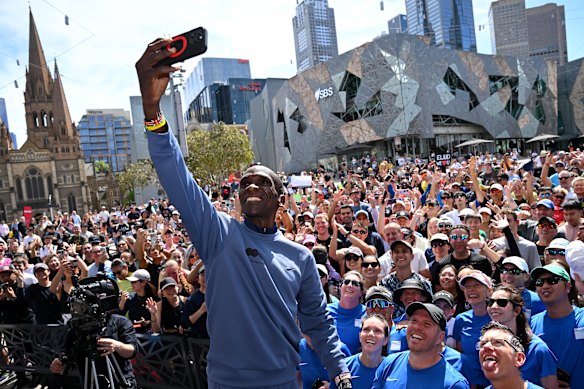

Sunday morning, outside Melbourne Park. You’re standing at the marathon starting line, nerves making you twitchy, you yawn. Is there time for another wee?
Comfort yourself with this: the greatest marathon runner ever, standing just over there, Eliud Kipchoge, is just as nervous. The same thoughts are going through his head.
The only difference between his nerves and yours is he doesn’t have to look across the field and see him standing there ready to race. Otherwise, it’s the same.
Even Kipchoge admits the start is the worst.
“The starting line, that’s the hardest part of my life because now you know, I’m really tense. I’m really nervous. At the starting line physical fitness actually cannot calm you, but mental fitness actually plays a huge role when I’m at the starting line,” Kipchoge said on Thursday at an event for Bupa ahead of Sunday’s Melbourne Marathon.
That Kipchoge is nervous is remarkable, not only because he looks unflappable but because his record suggests someone so imperiously better than the rest should not be troubled by doubt.
Kipchoge broke the world record twice. He was the first man to break two hours for a marathon, albeit in non-race conditions, so it was unofficial. It took seven years for two other men to do it legally, in the same race.
Kipchoge won Olympic gold in Rio and another in Tokyo. Only age ended up beating him. During his peak period, no one else really could.
Australian distance running great Steve Moneghetti describes Kipchoge as the first transcendent distance runner, like the Usain Bolt of marathon running. He was the first marathoner to cross over into broad public consciousness. Less flamboyant than Bolt – all distance runners are – he was the first marathoner to become a world figure.
And he is nervous at the start line.
“The last thing I say to myself before the gun goes off is, ‘I am the best. I trained harder than everybody here. I have done a lot of hours, eaten a lot of hours on the track,’” he said.
The most nervous he got at the start line was not for an Olympics but before breaking two hours in 2019 in controlled conditions, with pacers leading him around.
“You know you think you are the only one actually running and about seven billion people across the world are watching. What will happen if I just quit at 35 [kilometres]? What will the people say? What will the people believe about you? What will happen if I just, you know, quit?” he said.
For most people, the marathon will be a race against themselves. Kipchoge is no different.
The difference, and you might not want to hear this bit if you are toeing the line on Sunday for the full or half-marathon, is that the first half of a marathon is easy for Kipchoge.
“From the first kilometre to 20 or 21 kilometres, that’s the time I kick myself. That’s the time I am training my body to have the right rhythm because halfway anybody can run. It’s for anybody,” he said. Easy for him to say.
“After hitting the halfway, that’s where I’ll start now to calculate what will happen for the next half because that’s where the run is.”
Even Moneghetti – the winner of the Boston Marathon, a world championship bronze medallist and Commonwealth gold medallist – demurred slightly, saying the race cannot be won in the first half, but it can be lost. Go too hard and you can blow up your second half.
Not so much for Kipchoge. When he went unexpectedly fast in the first half of a marathon he was rapt rather than worried. When he broke his own world record in 2022, he was surprised at the halfway mark to discover he had run the first 21 kilometres in 59 minutes.
Did he panic? “No, no, no. I was happy. This is fine. Let it be and try to push on.”
It didn’t affect you?
“No. My mind was telling me that I was in good shape, just move on.”
Maybe when you know you are that good, you can afford not to panic, but it’s also in his nature to be phlegmatic. Like during the Berlin Marathon when the inner sole of his shoe worked its way up and out, and he had to run the remainder of the race without it. He won. He ran 2:04.
It perhaps offers some balance to the idea of the modern marathon being all about the runners, not the runner. “Super shoes” are credited with plummeting recent times, but Kipchoge’s inner sole story gives some balance to that argument. Besides, he achieved his first successes before carbon-plated super shoes were a thing.
Now he is a big advocate for them. As a Nike athlete, it might not be surprising that he promotes their shoes, but he says the biggest influence any of the super shoes have is during training, not the race. The shoes help the body recover more quickly from runs, he said, which enabled him to run further and more often and build greater load in his legs. This was more consequential than the idea of trampolining down the road on carbon-plated sponges.
Moneghetti and fellow Australian marathon legend Rob be Castella say the halfway mark of a 42-kilometre race is not 21 kilometres. It’s about 30 because the last 12 are as hard as the first 30.
Kipchoge smiles – he smiles a lot – but it is the smile of a man who looks slightly mystified that people find running a marathon difficult. He seems to like any pain he experiences.
He admits that in those final stages he asks himself questions. They are the questions he draws on for inspiration and to continue.
“The questions I ask are: ‘Where are you? Why are you running? And why are you in this world? And where are you going?’” Kipchoge says. In a 42-kilometre race you do have time to meditate on existential questions.
You might or might not want to know the answers to those questions you will be asking yourself through searing pain in the last 10 kilometres on Sunday.
For Kipchoge, the answers to those questions helped drive the next stage of his life after competing. Across this year and next he will run a marathon in each of the seven continents, pushing a message of sustainability and education. He is planting trees wherever he goes – 5000 in Australia with Landcare – and raising money to build libraries in Kenya and across Africa to help with children’s education.
He said he chose Melbourne for the Oceania race because he was drawn to racing through a city synonymous with sport. He liked that the route starts where the Australian Open tennis is, then goes down to the beach and around the Albert Park Formula One track, finishing at the MCG where the cricket is played.
Fellow Kenyan Sabastian Sawe and Ethiopia’s Yomif Kejelcha broke two hours legally at the London Marathon in April this year, seven years after Kipchoge did it unofficially.
That inspires Kipchoge.
So how low can times go in the next seven years? The next 70?
“I don’t believe there are limits. But I believe every small second that they will be breaking it, that’s going down slowly by slowly. That’s what we need. Even if we break it by one second, one second for the next 50 years, that’s where we are looking at. I don’t believe in limits.”
News, results and expert analysis from the weekend of sport sent every Friday. Sign up for our Sport newsletter.
 Michael Gleeson is an award-winning senior sports writer specialising in AFL and athletics.Connect via X or email.
From our partners
Disclaimer : This story is auto aggregated by a computer programme and has not been created or edited by DOWNTHENEWS. Publisher: www.smh.com.au