SPOILER ALERT: This article references major plot points in the film Digger, which is currently in cinemas.
After just a week in cinemas, Digger is well on its way to setting the kind of benchmark no film aspires to. In a year when cinema finally appears to be regaining some of its mojo thanks to a string of hits such as The Odyssey and the latest all-conquering Spider-Man offering, the climate-change satire from Oscar-winning director Alejandro González Iñárritu is a reminder that there’s still room for monumental flops.
In Australia, the film opened on 335 screens and took just $791,368 over the weekend, finishing in eighth place. For a Tom Cruise film, that is almost inconceivably bad. By way of comparison, Brad Pitt’s Heart of the Beast played on 336 screens and took almost twice as much ($1.511 million) to finish third in its second outing. The top film of the weekend was Verity, with a haul of $3.54 million on 409 screens on debut.
It’s the same story elsewhere, too. In the US, Digger opened to about $US7.5 million ($10.7 million), a dismal result for a movie with a production budget reported to be somewhere between $US125 million and $US180 million. Already it is predicted that it will be one of the biggest financial disasters in the business in decades.
There are many reasons audiences and critics have failed to warm to this tale of global warming. But one of the key points of contention is the way the film breaks the fourth wall.
For two of our Culture writers, this is actually the point at which they diverge in their response to the film – Nell Geraets finding this the point at which it tips into disaster, and Karl Quinn believing it is the point at which the film finally comes good. Here, they debate the pros and cons of that fault line.
Nell Geraets: The first 20 minutes of Digger surprised me – not because of how bad it was, but because of how much I actually enjoyed it.
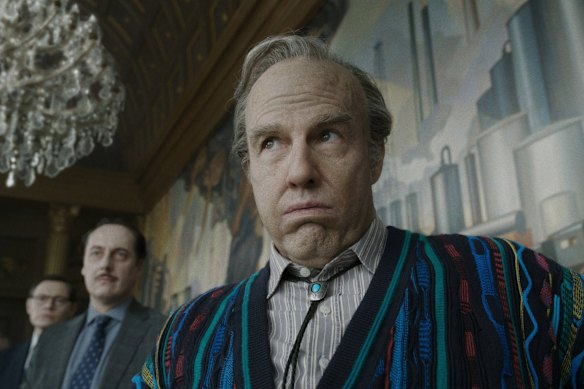
While most people bristled at Cruise’s bombastic depiction of the wealthy oil tycoon Digger Rockwell, I was smiling ear-to-ear. Cruise throws all inhibition out the window, his enjoyment practically oozing off the screen. Finally, this all-American action hero, known best as Ethan Hunt from the Mission: Impossible franchise, is playing a terrible, horrible, no good, very bad guy – one who sports a potbelly, bald spot and creepy cocaine fingernail. Before you start grumbling, I’m aware he rocked a bald patch in Tropic Thunder too. But Les Grossman wasn’t the star of his movie; Digger is the star of his.
By the time he whipped out the ridiculously fake dying cat in a diaper, I was convinced. The blatantly misogynistic jokes from John Goodman’s US president and a vomiting episode from his useless government cronies simply convinced me further. I’ve always enjoyed balls-to-the-wall self-aware stupidity on-screen (think Zoolander and Burn After Reading), and this is certainly that. We’re meant to despise these over-privileged characters – the vastly underqualified leaders we’re expected to trust in the face of climate catastrophe – and boy, do we.
Karl Quinn: Wow, my take on that opening 20 minutes or so was almost the complete opposite. I kept wanting to like the Tropic Thunder-ishness of Cruise’s performance, but I struggled to tally his OTT acting style with Iñárritu’s clear intention to say something about a Very Serious Topic.
Things got a little better as Goodman entered the fray – OK, we’re clearly in the realm of farce – and the wide-angle lenses, washed out palette and general sense of something being a little off all pushed me towards reading it as a Dr Strangelove of the climate crisis. Trouble is, it just wasn’t terribly funny.
I couldn’t fault Cruise for effort – I mean, he really is the hardest working man in showbiz (sorry, James Brown) – but he’s not a natural comedian. In Tropic Thunder, he was surrounded by genuinely funny people; here, he’s doing most of the work, and you can really sense the effort. And that’s not funny at all.
NG: Fair enough, Cruise is certainly no Jack Black. But every gag in Digger has a deeply sinister undertone – it’s about the planet’s impending doom, after all – and I thought Cruise mastered that. There’s already something a little sinister about Cruise anyway (maybe it’s the Scientology of it all), so every time he cracked a joke or pulled a face, my laughter was paired with shivers down the spine.
For me, the film’s true crime lies in its meta narrative. Iñárritu can’t seem to get enough of it, first with Birdman, then Bardo and now Digger – could we just remain grounded in one reality for a change?
While Cruise and Goodman admire the intentionally garish set beyond a window, a tree falls, and a giant man appears from the ground to reposition it. Everything halts. It was at this point that my entire experience flipped on its head, as I realised this wasn’t a movie; it was a movie of a play, fiction within fiction.
Such an abrasive tonal shift rattled me, to the point that I practically mourned the over-the-top character farce I’d been enjoying up until the damn tree. The film lost all momentum, trapping us inside a stuffy backstage area with a stifled actor instead of roaming freely within Digger’s wild, gaudy universe – a universe in which we were free to ridicule and laugh at the characters.
KQ: Despite the obvious symbolism of a tree being knocked over by a human hand, this wasn’t the key transition moment for me. But it started to unlock the movie’s central conceit, which is foreshadowed from almost the first moment, when we see Digger wake up in his bed in front of a massive window with a frame that makes the lush nature scene beyond look like a painting. It says something about the fetishisation of nature as a thing to be framed, curated, tamed and owned.
NG: Sure, it’s symbolism galore. But this film was ultimately marketed as a “comedy of catastrophic proportions”. No laughter was had post-reveal.
The meta-narrative reduced the movie to a heavy-handed lecture, as if Iñárritu were pointing his finger directly at me while shouting, “shame on you for turning real-world catastrophe into entertainment”. Digger is doing just that, making its holier-than-thou finger-pointing more exhausting than compelling.
KQ: I agree that Digger isn’t terribly successful as comedy. But as commentary, it has a lot to say. And it’s all to do with that mise en abyme (picture within a picture) framing device.
At first, we think we’re seeing a movie about a corrupt, avaricious oilman, but then Iñárritu pulls the narrative frame back to show that it’s a construct, a movie-about-a-movie about said character. Exactly why he is revealing its means of production isn’t clear at this point, but it eventually becomes so: the entire movie is about the means of production (specifically, the production of oil and its many spin-off products), and the cost thereof.
When the narrative frame steps back again, we find that in fact this is a movie about a play about trying to make sense of this man and those who abetted his behaviour. That allows Cruise to perform more naturalistically as Curtis Markson, the actor playing Digger, and to show something of the tension between a performer’s personal and professional lives (as he frets over a daughter seemingly lost in a tropical storm, struggles to make sense of the play he is in, and longs to return home).
The reveal of the Jesse Plemons character as Digger’s nephew, who is both a critic of the man and beneficiary of his wealth, frames the play as an attempt to expiate inherited guilt without having to really give up anything. Here, I think, Digger is having a dig at corporate greenwashing.
Finally, the movie steps back once more to show that all this is happening in a near-future world where the failure to respond to the climate crisis has wrought actual catastrophe, and everyone we’ve been watching is having to deal with it.
That final scene, with its vague echoes of Children of Men (made by Iñárritu’s compatriot and sometime collaborator Alfonso Cuarón) is a masterstroke for me. And the theatrical device recalls Iñárritu’s Birdman, celebrates the role of art as a response to crisis, and simultaneously critiques it as a woefully inadequate substitute for more substantial action.
NG: I appreciate the message he’s trying to tell, and satire will always obviously contain an air of cynicism. But Digger takes it a step too far. I’d be more forgiving if its meta commentary were more subtle. But no, Iñárritu gets Plemons’ character to painstakingly lay out the point he’s trying to make – that we’re essentially all doomed, so our political and social bickering is futile. If you’re going to spoon-feed us a message, the least you could do is not make us want to tear our hair out.
KQ: I’m not saying this is a great film. But I think it’s a far more interesting one than the pile-on would have us believe. But, goodness me, it’s a bleak one too. We’re all complicit. We’re all doomed. No wonder people aren’t lining up to buy tickets.
Digger is currently in cinemas.
Must-see movies, interviews and all the latest from the world of film delivered to your inbox. Sign up for our Screening Room newsletter.
 Nell Geraets is a Culture reporter at The Age and The Sydney Morning Herald.Connect via X or email.
From our partners
Disclaimer : This story is auto aggregated by a computer programme and has not been created or edited by DOWNTHENEWS. Publisher: www.smh.com.au